Error Codes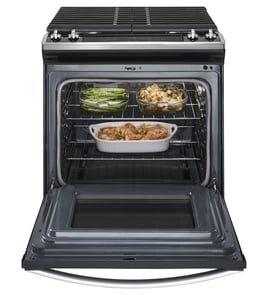

Where can I find my KitchenAid range model number?
On your KitchenAid gas range model KGST307FWH1, the model number is printed on a rating label attached to the range body. On most 30-inch slide-in ranges, you can see it by opening the oven door and checking the frame around the oven opening.
Common places to check on a slide-in gas range
Look in these spots first (in order):
- Oven door frame (around the oven opening)
- Storage drawer area (pull the drawer out and look on the frame)
- Broiler drawer area (if equipped)
- Behind the control panel area (visible from the front on some models)
- Back panel of the range (you may need a flashlight)
What the label looks like and what to copy
The rating label usually includes several fields. Copy the model number exactly as shown.
| Label field | What it’s used for | Example you might see |
|---|---|---|
| Model | Correct parts lookup | KGST307FWH1 |
| Serial | Production run details | Letters and numbers |
| Type / gas info | Service reference | Gas type, BTU info |
Why it matters
We use the exact model number to match the correct KitchenAid range parts and diagrams for your appliance. That prevents ordering a look-alike part that does not fit your burner, oven, or control configuration.
Next step: use the model number to get the right parts
Once you have KGST307FWH1, you can order parts from the parts list for this model, or search by model number on Sears PartsDirect.
Last updated: February 2026
How to replace KitchenAid gas oven igniter?
To replace the oven igniter on your KitchenAid KGST307FWH1 gas range, we shut off power and gas, access the burner/igniter mounting area inside the oven, remove the igniter screws, transfer the wire connection, then reassemble and test for proper ignition. Use the correct replacement igniter for this model, such as the oven igniter WP9782065.
Safety first (do this before any disassembly)
- Turn off electrical power at the breaker; the igniter circuit is live when the oven calls for heat.
- Shut off the gas supply valve to the range.
- Let the oven cool completely.
- Protect the oven bottom with a towel or cardboard to prevent scratches.
- If you smell gas at any point, stop and ventilate the area before continuing.
Replacement steps (typical for this KitchenAid slide-in range)
- Remove oven racks.
- Remove the oven bottom panel (usually held by a few screws) to expose the bake burner.
- Remove the flame spreader or burner cover if present.
- Locate the igniter mounted to the burner tube.
- Remove the igniter mounting screws (a 5/16-in nut driver is commonly used on these fasteners).
- Disconnect the igniter wiring (plug connector or wire nuts, depending on how it is routed).
- Install the new igniter, secure it to the burner, and reconnect wiring.
- Reinstall covers/panels and racks.
- Restore gas and power; test bake operation.
Quick troubleshooting after replacement
- No glow at all: check power, wiring connection, and harness condition.
- Glows but no flame: weak igniter, gas valve issue, or restricted burner.
- Delayed ignition: burner ports dirty or igniter not positioned correctly.
| Symptom | Most common cause | What we check first |
|---|---|---|
| Oven will not heat | Failed igniter | Igniter glow and wiring connection |
| Clicking or repeated tries | Weak igniter or poor gas flow | Burner cleanliness and flame carryover |
| Heat is uneven | Burner or spreader issue | Burner tube alignment and debris |
Why it matters
A properly working igniter draws the current needed to open the gas valve and light the burner quickly. Replacing a weak igniter helps prevent delayed ignition, poor baking performance, and repeated ignition attempts.
You can order the correct parts for KGST307FWH1 from the parts list for this model, or search by model number on Sears PartsDirect.
Last updated: February 2026
What are the most common stove parts to replace?
For your KitchenAid KGST307FWH1 30" slide-in gas range, the most commonly replaced parts are ignition and burner-related components, plus a few high-wear oven and cosmetic items. On this model, common replacements include the oven igniter, spark module, knobs, light parts, and door hardware such as hinges.
Most common replacement parts (gas range)
These are the parts we see replaced most often when a burner will not light, the oven will not heat, or normal wear and tear shows up:
- Oven igniter (oven will not heat or takes too long to preheat): oven igniter WP9782065
- Spark/ignition control (clicking issues, weak or no spark at burners): range spark module WP4454392
- Surface control knobs (cracked, stripped, or loose fit): surface knob W10405147
- Oven light items (light out, broken cover, damaged socket): oven light bulb 8009, range oven light lens WP9781049, light socket W11594027
- Oven door hardware (door not closing evenly, heat leaking, door feels “springy”): door hinge WP9782033
- Temperature safety control (overheating symptoms or nuisance shutoff): thermostat WP9759944
Quick symptom-to-part guide
| Symptom | Most likely part to check first | Why it’s common |
|---|---|---|
| Oven will not heat | Oven igniter | Igniters weaken with age and stop drawing enough current to open the gas valve |
| Burners click but do not light | Spark module | Controls spark timing and output to electrodes |
| Knob turns but does not control flame well | Surface knob | Knob hubs can crack or strip |
| Oven light does not work | Bulb or socket | Bulbs burn out; sockets can overheat or corrode |
Why these parts fail more often
Most “stove part” failures come down to heat, spills, and normal mechanical wear:
- High heat cycles fatigue igniters, thermostats, and wiring connections
- Boilovers and cleaners can foul ignition components and knob shafts
- Door hinges and light lenses take physical stress from frequent use
- Electrical connections can loosen over time (especially after moving the range)
What to do before ordering
We recommend these quick checks to avoid buying the wrong part:
- Confirm the symptom: oven bake vs broil vs surface burners
- Inspect for visible damage (cracks, burn marks, loose terminals)
- If you test electrical parts, shut off power first and use proper tools
- Match parts to model KGST307FWH1 when selecting replacements
For broader part searching by model number, we also offer model lookup and ordering through Sears PartsDirect.
Last updated: February 2026
What are the parts on a gas stove called?
On a KitchenAid KGST307FWH1 30" slide-in gas range, the main parts are the cooktop burner system (burners, caps, grates, igniters, and knobs) plus the oven system (burner, igniter, gas valve, thermostat, door parts, and light). You can match names to your exact unit by browsing the parts list on this model page or searching on Sears PartsDirect.
Common gas stove part names (cooktop)
These are the names customers most often use when ordering or troubleshooting:
- Surface burner (burner head)
- Burner cap
- Grate and grate pads (feet)
- Surface knob
- Spark igniter and wiring
- Spark module (the box that makes the clicking spark)
Common gas stove part names (oven)
The oven section has its own gas and safety components:
- Oven burner igniter (hot surface igniter)
- Gas valve (controls gas flow to the burner)
- Thermostat or high-limit thermostat (temperature safety)
- Oven light bulb, light lens, and light socket
- Door hinge and door glass
- Broiler pan and racks (accessories)
Parts on this KGST307FWH1 page (examples)
If you are trying to put a name to what you see, these are real part names used for this model:
| What you call it | Part name on the parts list | Example part ID |
|---|---|---|
| Oven light bulb | Oven light bulb | 8009 |
| Burner clicking/sparking issue | Range spark module | WP4454392 |
| Oven not heating | Oven igniter | WP9782065 |
| Oven overheating safety | Thermostat | WP9759944 |
| Burner control knob | Surface knob | W10405147 |
Why the exact name matters
Gas ranges often have similar-looking pieces that are not interchangeable. Using the correct part name and part ID helps you:
- Order the right replacement the first time
- Avoid fit issues (especially with knobs, igniters, and door parts)
- Troubleshoot faster by identifying the correct system (cooktop vs. oven)
- Confirm compatibility for finish items like paint and touch-up
Quick tip for identifying what you need
If you are unsure whether the problem is cooktop ignition or oven ignition, start by identifying where the symptom happens:
- Clicking but no flame on top burners: often igniter, wiring, or range spark module WP4454392
- Oven won’t bake or takes too long to heat: often oven igniter WP9782065 or a gas supply issue
- Oven light doesn’t work: bulb, lens, or socket (for example, oven light bulb 8009)
Last updated: February 2026