 Owner’s manual
Where to find model number on Craftsman pressure washer?
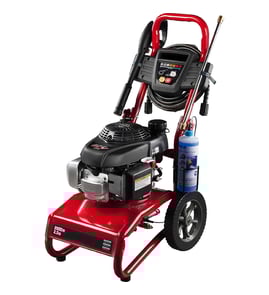
On the Craftsman pressure washer model 580741380, the model number is printed on a decal (label) attached to the unit. This is the number you will use to look up pressure washer parts and diagrams; the engine has a separate model/part number.
Where to look on the unit
Check these common decal locations on a Craftsman gas pressure washer frame:
- Top of the lower frame
- Back of the lower frame
- Top of the upper frame
- Back of the upper frame
If you see multiple labels, use the one that lists the pressure washer model (not the engine information).
Pressure washer model number vs. engine model number
Your unit has two different identifiers, and they are used for different parts:
| What you’re identifying | Where it’s found | Example for this unit |
|---|---|---|
| Pressure washer model number | Decal attached to the pressure washer frame | 580741380 |
| Engine model/part number | On the engine blower housing near the spark plug | 12E802-1115-01 |
Tips to read the label correctly
- Wipe the decal with a damp cloth first; dirt and chemical residue can hide digits.
- Photograph the label and zoom in to confirm each character.
- Write down the full model number exactly as shown (including any dots or dashes if present).
Why it matters
Using the correct model number ensures we match the right pressure washer parts (pump, hose, wand storage hardware, frame components). Using the engine number helps match engine-specific parts (carburetor, air filter, fuel tank cap, spark plug-related components).
For more model identification details and parts information, use the 580741380 owner's manual.
Last updated: February 2026
Is it worth repairing a pressure washer?
Yes, repairing a pressure washer is worth it when the fix is small (hose, nozzle, unloader adjustment, carb cleaning) or when the unit is in good overall condition; for a major pump failure on a homeowner-grade machine, replacement is usually the better value. For Craftsman model 580741380, we also factor in safety and proper maintenance because running without water can damage the pump.
Quick decision checklist (repair vs. replace)
- Repair when the problem is a wear item or simple service: clogged nozzle, leaking fitting, dirty carburetor, old spark plug, or a damaged high-pressure hose.
- Replace when the pump is cracked, seized, or heavily leaking, or when multiple major issues stack up (pump + engine + hose).
- Repair when you can restore performance with maintenance steps from the owner's manual.
- Replace when repair cost is more than about 50% of the cost of a comparable new unit.
- Replace if the machine has been run without a proper water supply, since that commonly leads to pump damage.
Typical cost-to-value guide
| Issue | Most common fix | Usually worth it? |
|---|---|---|
| Low pressure | Clean/replace nozzle, check water supply, inspect hose for leaks | Yes |
| Surging/pulsing | Check for air leaks, clogged inlet screen, unloader issues | Yes |
| Hose leak | Replace high-pressure hose (do not patch) | Yes |
| Pump failure | Pump replacement or rebuild | Often no (homeowner units) |
| Engine won’t start | Fuel, spark plug, carb cleaning | Often yes |
Why it matters (especially on this model)
This Craftsman pressure washer produces a high-pressure fluid stream that can cause serious injury. A leaking or damaged high-pressure hose is a safety issue and should be replaced, not repaired. Also, starting the engine without the proper water supply connected can damage the pump, turning a small problem into an expensive one.
If you choose to repair: smart first steps
- Confirm strong water supply; water temperature should not exceed 140°F.
- Inspect the high-pressure hose for cuts or fraying; replace if damaged.
- Flush the system after use and follow the pump storage steps to reduce freeze and corrosion damage.
- Avoid running the engine with the spray trigger released for long periods (heat buildup stresses the pump).
Last updated: February 2026
Are Craftsman gas pressure washers any good?
Yes; Craftsman gas pressure washers like model 580741380 are a solid choice for typical home cleaning because they deliver strong cleaning power and straightforward operation. Long-term satisfaction mainly depends on routine maintenance (oil, fuel, water supply) and using the washer within its intended PSI and duty cycle as outlined in the 580741380 owner's manual.
What “good” usually means for a gas pressure washer
A gas pressure washer is “good” when it reliably starts, maintains steady pressure, and doesn’t leak or vibrate excessively during normal use.
Common strengths customers look for:
- Strong cleaning performance on concrete, siding, and decks
- No cord needed; good mobility for outdoor jobs
- Simple controls and quick setup
- Easy access to routine service items (oil, spark plug, air filter)
What to watch for (and how to prevent most issues)
Most complaints we see across gas pressure washers come from maintenance gaps or setup problems that stress the pump and engine.
Key prevention steps:
- Add the correct engine oil before first use; many small engines use about 20 oz capacity (check your manual for the exact fill procedure).
- Use fresh gasoline and don’t store fuel in the tank long-term.
- Always turn on the water supply first and purge air before starting the engine.
- Don’t run the pump without spraying water; avoid long idle times with the trigger released.
- Inspect the high-pressure hose and fittings for seepage; tighten connections as needed.
Quick comparison: gas vs electric pressure washers
| Feature | Gas pressure washer (like 580741380) | Electric pressure washer |
|---|---|---|
| Cleaning power | Higher typical PSI and flow | Lower to mid-range |
| Portability | No power cord; louder | Quieter; needs outlet |
| Maintenance | Oil, fuel, spark plug, air filter | Minimal |
| Best for | Driveways, large areas, heavy grime | Cars, patios, light-duty jobs |
Why it matters
Gas pressure washers can clean faster because higher flow and pressure reduce time on tough surfaces. The tradeoff is that engines and pumps last longer when you follow the startup, oil, and water-supply steps in the 580741380 owner's manual.
Last updated: February 2026
Can I use SAE 30 instead of 10W30 in my pressure washer?
Yes. For the Craftsman 580741380 gas pressure washer, SAE 30 detergent engine oil is the standard choice for normal operating temperatures; 10W-30 is also usable, especially when you expect cooler starts. Choose the viscosity based on temperature and keep the oil level full.
What the manual recommends for model 580741380
The owner's manual specifies using high-quality detergent oil with API service classification SF, SG, or SH. It also shows a temperature-based viscosity chart.
- Use SAE 30 for typical warm-weather operation
- Use 5W-30 when operating below 32°F
- Use 10W-30 when you need easier starting across changing temperatures
- Avoid non-detergent oil
- Check oil level frequently; the sump capacity is about 20 oz
Quick comparison
| Oil viscosity | Best use case | Notes |
|---|---|---|
| SAE 30 | Above 32°F | Common small-engine choice for warm conditions |
| 10W-30 | Variable temps | Helps cold starts; monitor level as part of normal maintenance |
| 5W-30 | Below 32°F | Cold-weather option shown in the manual chart |
How to prevent low-oil damage
Running low on oil is what causes engine damage, not simply choosing SAE 30 vs 10W-30. We recommend:
- Check oil before each use (or at least every 5 hours)
- Keep the pressure washer level when checking the dipstick
- Fill to the FULL mark; do not overfill
- Change oil after the first 5 hours, then every 50 hours (more often in heat, dust, or heavy use)
Why it matters
Oil viscosity affects how quickly oil flows at startup and how well it maintains a lubricating film at operating temperature. Matching viscosity to temperature and keeping the level at the FULL mark protects the engine on your Craftsman 580741380.
Last updated: February 2026