
How to tell if an air compressor regulator is bad?
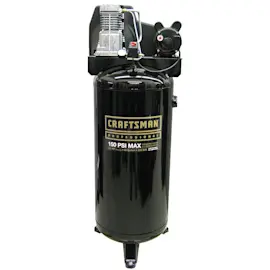
A bad regulator on your Craftsman 106174541 twin-cylinder tank-type air compressor shows up as unstable outlet pressure: it creeps up after you set it, droops when a tool runs, or leaks air from the knob or vent. If the tank gauge is steady but the outlet gauge is not, the regulator is the problem.
- Pressure creep: outlet PSI rises even when you are not using air
- Pressure droop: outlet PSI falls sharply when a tool starts, even with a full tank
- Won’t adjust: turning the knob does little or nothing
- Inconsistent readings: outlet gauge jumps around or lags badly
- Constant hissing: air leaks from the regulator body, knob area, or relief/vent
- Tool performance issues: nailer, impact, or spray gun surges or starves for air
- Fill the tank to normal cut-out pressure.
- Set the regulator to a common working pressure (example: 90 PSI).
- Close the outlet (disconnect the hose or shut a downstream valve).
- Watch the outlet gauge for 2 to 5 minutes.
- If outlet PSI climbs on its own, that is regulator creep.
- Reconnect a tool and run it.
- If tank PSI stays healthy but outlet PSI drops hard and stays low, the regulator is restricting flow.
| Cause | What you notice | What to do next |
|---|---|---|
| Dirt or moisture inside | Sticky adjustment, erratic PSI | Drain tank, clean/replace regulator |
| Worn seat/diaphragm | Pressure creep, won’t hold setpoint | Replace regulator |
| External leak at fittings | Hissing, bubbles with soapy water | Reseal fittings, then retest |
| Damaged gauge (not regulator) | Gauge reads wrong but air feels normal | Test with a known-good gauge |
A regulator that creeps or droops can overpressure air tools, cause poor spray patterns, and make the compressor cycle more often. Fixing the regulator issue helps protect your tools and keeps pressure consistent.
For electrical checks related to compressor controls (if you are also troubleshooting power or cut-in/cut-out issues), use our guide: how to use a multimeter to test electrical parts video.
Last updated: February 2026
Is it worth it to repair a compressor?
For a Craftsman 106174541 twin-cylinder tank-type air compressor, repairing the compressor is worth it when the unit is otherwise in good shape and the problem is limited to a serviceable item (leaks, pressure switch, check valve, capacitor). It is not worth it when the pump or motor is failing and repair cost approaches the price of a comparable replacement.
Use these points to decide before you spend time or money:
- Age and usage: If it has seen heavy daily use for years, major repairs usually do not pay back.
- What failed: Air leaks and controls are typically practical repairs; a worn pump or burned motor usually is not.
- Parts availability: If you cannot source the exact replacement parts for model 106174541, repair becomes less practical.
- Total cost: Add parts, tools, and your time; if you are near 50% or more of replacement cost, replacement is the better value.
- Safety and reliability: Repeated breaker trips, overheating, or slow recovery time often signals deeper issues.
| What you notice | Most likely cause | Usually worth repairing? |
|---|---|---|
| Hissing at fittings or tank drain | Loose fitting, bad seal, drain valve leak | Yes |
| Won’t start, hums, trips breaker | Bad capacitor, pressure switch, wiring issue | Often |
| Runs but won’t build pressure | Intake filter clogged, valve issue, major pump wear | Sometimes |
| Oil blow-by, loud knocking, low compression | Worn rings/cylinder, damaged reed valves | Usually no |
| Motor smells burnt or won’t spin freely | Motor failure | Usually no |
A compressor repair that only fixes the symptom can lead to repeat failures and higher long-term cost. A quick diagnosis helps you avoid sinking money into a pump or motor that is already near end-of-life.
- Confirm the model number on the data plate matches 106174541 so you are shopping the right diagrams and parts lists.
- Do a leak check (soapy water on fittings, regulator, check valve area).
- Check electrical basics (outlet, extension cord gauge, breaker size, visible wire damage).
- Estimate repair cost vs. replacement before ordering anything.
- Use our guide: how to find your appliance model number (and what it means for parts).
Last updated: February 2026
What are the 4 types of compressors?
The four common compressor types are reciprocating (piston), rotary screw, centrifugal, and axial. Your Craftsman 106174541 is a twin-cylinder tank-type air compressor, which is a reciprocating (piston) design that compresses air using pistons moving in cylinders.
- Reciprocating (piston): Pistons compress air in one or more cylinders; common for home garages and small shops.
- Rotary screw: Two intermeshing screws compress air continuously; common for steady, high-duty shop use.
- Centrifugal: A high-speed impeller accelerates air and converts velocity to pressure; common in large industrial systems.
- Axial: Rotating blades move air along the shaft axis; used in very high-flow applications (often turbines and large process equipment).
| Type | How it makes pressure | Best for | Typical tradeoff |
|---|---|---|---|
| Reciprocating (piston) | Piston strokes reduce air volume | Intermittent use, higher pressure needs | Louder, more vibration |
| Rotary screw | Screws trap and compress air | Continuous duty, steady airflow | Higher upfront cost |
| Centrifugal | Impeller adds velocity, diffuser builds pressure | Large facilities, high flow | Needs stable operating range |
| Axial | Blade stages progressively compress air | Very high flow systems | Complex, specialized |
Knowing the compressor type helps you focus on the right wear points and symptoms.
- Piston units (like the 106174541) commonly involve valves, piston rings, gaskets, pressure switch controls, and tank check valve behavior.
- Screw and centrifugal units are more likely to involve oil separation, inlet modulation, and control systems.
- Axial systems are typically outside the home and light-shop repair category.
For electrical checks that apply to many compressor no-start or trip issues, use how to use a multimeter to test electrical parts video.
Last updated: February 2026
What is the most common cause of air compressor failure?
The most common cause of failure in a Craftsman 106174541 twin-cylinder tank-type air compressor is preventable maintenance and cooling issues: dirty intake filtration, poor lubrication (on oil-lube pumps), and restricted airflow that leads to overheating. These problems accelerate wear on valves, rings, bearings, and the motor.
- Restricted intake air (dirty/clogged air filter) causing the pump to run hotter and longer
- Overheating from blocked cooling fins, poor ventilation, or long duty cycles
- Lubrication breakdown (oil-lube units): low oil, dirty oil, or wrong oil leading to bearing and cylinder wear
- Moisture and corrosion from not draining the tank, which can damage fittings and check valves
- Air leaks at fittings, regulator, hose, or tank check valve that force excessive run time
- Electrical stress (weak outlet, undersized extension cord, failing capacitor) that overheats the motor
- Unplug power and let the unit cool.
- Drain the tank after use to remove water.
- Inspect airflow: keep shrouds/vents clear; clean dust from the pump and motor.
- Check for leaks: listen for hissing; use soapy water on fittings.
- Verify electrical supply: plug directly into a properly rated outlet; avoid long/light extension cords.
| Symptom | Most likely cause | What to do first |
|---|---|---|
| Runs constantly, won’t reach cut-out | Air leak or failing check valve | Leak test fittings; inspect unloader/check valve area |
| Trips breaker on start | Weak power, bad capacitor, tight pump | Try direct outlet; check cord; inspect pump for binding |
| Low pressure at tools | Regulator issue or restriction/leak | Check regulator setting; inspect hose/couplers |
| Hot smell, shuts off | Overheating | Improve ventilation; clean cooling surfaces |
When an air compressor runs hot or runs too long, internal parts wear faster and the motor draws higher current. Fixing airflow, leaks, and moisture control early prevents the expensive failures.
For safe electrical troubleshooting steps, use our guide: how to use a multimeter to test electrical parts video.
Last updated: February 2026