Installation guide
 Owner’s manual
 Error Codes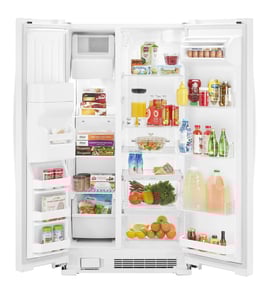


How big is the Frigidaire FFSS2614QS1A?
The Frigidaire FFSS2614QS1A is a full-size side-by-side refrigerator in the 26 cu. ft. class; most models in this size range measure about 36 inches wide, about 69 to 70 inches tall, and about 32 to 34 inches deep (not counting the door handles). For the exact dimensions for your unit, use the FFSS2614QS1A owner’s manual.
Typical size you can plan around
Use these common planning numbers for a 26 cu. ft. side-by-side like the FFSS2614QS1A:
- Width: ~35 7/8 to 36 inches
- Height: ~69 to 70 inches (to top of case or hinge cover varies)
- Depth: ~32 to 34 inches (case); deeper with doors and handles installed
- Clearance: plan extra space for airflow and door swing
How to measure your refrigerator correctly
We recommend measuring in three ways so you do not get surprised by hinges, doors, or handles.
- Measure width at the widest point (often the cabinet, sometimes the doors)
- Measure height from floor to the highest point (hinge cover can be the tallest)
- Measure depth three ways: cabinet only, doors on, and doors plus handles
- Check door swing space so drawers and bins clear nearby walls
- Confirm opening clearance for delivery (doorways, hallways, and turns)
Quick planning table
| Measurement | What it includes | Why it matters |
|---|---|---|
| Width | Cabinet and/or doors | Fit in the cutout and through doorways |
| Height | Floor to top (hinge area) | Clears overhead cabinets |
| Depth | Cabinet vs. doors vs. handles | Prevents sticking out too far |
| Clearance | Space around unit | Helps cooling and reduces noise |
Why it matters
Correct dimensions help you avoid installation problems like poor ventilation, doors that cannot open fully, and water line kinks behind the cabinet. It also makes replacing door gaskets and aligning doors easier over the life of the refrigerator.
Last updated: January 2026
How to defrost a Frigidaire side by side freezer?
To defrost the freezer on your Frigidaire FFSS2614QS1A side-by-side refrigerator, we recommend moving food to a cooler, turning the unit off, and letting the frost melt naturally; this protects the evaporator and helps restore normal airflow and cooling.
Safe manual defrost steps
- Unplug the refrigerator (or switch off power at the breaker).
- Remove freezer items and shelves/bins as needed.
- Leave the freezer door open to speed melting.
- Place towels at the base of the freezer and empty the drip pan if accessible.
- Let ice melt on its own; do not chip ice with sharp tools.
- Wipe the compartment dry, then restore power and reload food.
Speed it up (without damaging parts)
| Method | How to do it | What to avoid |
|---|---|---|
| Warm room air | Keep the door open; run a fan in the kitchen | Do not use open flames |
| Warm water | Set a bowl of hot water on a towel inside the freezer | Do not pour water into vents |
| Hair dryer (carefully) | Use low heat, keep moving, stay several inches away | Do not overheat plastic liners or wiring |
If frost keeps coming back quickly
Heavy frost usually means airflow is blocked or warm, moist air is leaking in.
- Check the door seal for gaps, rips, or areas not gripping the cabinet.
- Make sure packages are not holding the door open.
- Confirm vents are not blocked by food.
- If you hear the evaporator fan struggling or the freezer warms up, inspect for ice buildup around the fan area.
If the gasket is torn or won’t seal after cleaning and warming it, replacement is the lasting fix; for this model, see the refrigerator freezer door gasket 241786014.
Why it matters
A frosted-over evaporator restricts airflow, so the freezer may warm up and the fresh food side can also lose cooling. Defrosting restores airflow and helps the compressor run more efficiently.
For model-specific operating details and any control settings related to defrost, follow the FFSS2614QS1A owner’s manual.
Last updated: January 2026
What is the most common problem with a Frigidaire refrigerator?
Cooling problems are the most common issue we see on Frigidaire refrigerators, including the FFSS2614QS1A; symptoms include warm fresh food, soft ice cream, or long run times. The usual causes are restricted airflow (dirty coils or blocked vents), a weak evaporator fan, or air leaks from worn door gaskets.
Most common symptoms (what you notice)
- Refrigerator section too warm but freezer seems OK
- Freezer too warm or items thawing
- Frost buildup on the back wall of the freezer
- Loud humming, rubbing, or rattling from the freezer area
- Ice maker or dispenser acting up after cooling starts drifting
Quick checks we recommend first
- Confirm settings: Set fresh food to about 37°F and freezer to about 0°F.
- Check airflow: Make sure packages are not blocking vents in either compartment.
- Clean condenser coils: Dusty coils commonly cause poor cooling and long run times.
- Listen for the evaporator fan: When the compressor is running, you should typically hear airflow in the freezer.
- Inspect door seals: Look for gaps, tears, or areas that do not grip paper when the door is closed.
Parts that commonly solve “not cooling” complaints
If the quick checks point to a component issue, these model-matched parts are common fixes:
| Problem clue | Likely area | Model-matched part example |
|---|---|---|
| Warm temps, weak/no airflow in freezer | Evaporator fan system | Refrigerator evaporator motor 808602602 |
| Temps swing, unit runs oddly | Temperature sensing | Refrigerator temperature sensor 240597220 |
| Frost buildup, poor cooling after days | Defrost system | Refrigerator defrost bi-metal thermostat 5303918214 |
| Fresh food too warm, freezer OK | Airflow control between sections | Refrigerator air damper control assembly 242303001 |
Why it matters
Cooling problems usually get worse over time; food safety and ice production depend on stable temperatures and good airflow. Catching a failing fan, defrost issue, or leaking gasket early helps prevent heavy frost buildup and extended compressor run time.
Helpful model-specific reference
- Use the FFSS2614QS1A owner’s manual for temperature recommendations, airflow guidance, and feature operation details.
Last updated: January 2026
Why is my Frigidaire side by side flashing H?
When your Frigidaire FFSS2614QS1A side-by-side refrigerator flashes H or HI, it is a high-temperature alarm. It means the refrigerator or freezer temperature stayed too warm for about an hour, most often because a door was left open or the door seal is leaking.
What to check first (fast fixes)
- Make sure both doors close fully and nothing is blocking them (bins, shelves, food packages).
- Check for a gap in the door seal; look for torn, warped, or dirty gasket areas.
- Close the doors and wait; the alarm typically clears after temperatures recover.
- Confirm the temperature settings are at normal targets (commonly 0°F freezer and 37°F fresh food).
- Avoid loading a large amount of warm food at once; it can trigger a temporary high-temp condition.
Door seal and airflow checks
A high-temp alarm is frequently caused by warm air leaking in or cold air not circulating correctly.
- Wipe the gasket sealing surfaces with warm, mild soapy water; dry thoroughly.
- Do the “paper test”: close the door on a sheet of paper and pull; strong resistance indicates a good seal.
- If the gasket is damaged or won’t seal, replacement is the long-term fix (for example, the fresh food door gasket may be Frigidaire refrigerator door gasket (black) 241786013).
Quick troubleshooting guide
| What you notice | Most likely cause | What to do |
|---|---|---|
| H/HI after door was ajar | Door left open | Close door, allow 1 to 4 hours to recover |
| Frost buildup, weak cooling | Airflow or defrost issue | Check vents, reduce overpacking, inspect for heavy frost |
| Alarm returns repeatedly | Seal leak or cooling problem | Check gaskets, condenser cleanliness, and fan operation |
Why it matters
Running warm for extended periods can spoil food and force the compressor to run longer. Fixing door sealing and airflow issues quickly helps restore safe temperatures and improves energy efficiency.
Helpful references
- Use the FFSS2614QS1A owner’s manual for alarm behavior, temperature recommendations, and control panel steps.
- If your display shows other codes, use Frigidaire refrigerator error codes to narrow down the cause.
Last updated: January 2026