Error Codes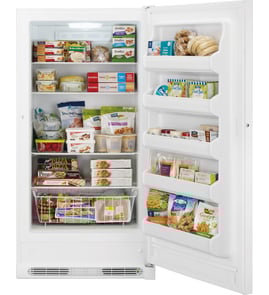





What size is a Kenmore freezer by model number 25320402000?
The Kenmore upright freezer model 25320402000 is a full-size upright freezer; in most homes, units in this class are about 15 to 17 cubic feet. For exact capacity and exterior dimensions, match your model number on the rating label and compare it to the specifications listed with your parts diagrams.
What “size” usually means (and what to measure)
When customers ask for freezer size, they typically mean one of these:
- Capacity (cubic feet): how much food it holds
- Exterior dimensions: height, width, depth (for fit in a space)
- Door swing clearance: room needed to open the door fully
- Shelf/bin layout: usable storage, not just total volume
Quick measuring checklist (for fit and clearance)
Use a tape measure and record these before ordering or moving the freezer:
- Width: side-to-side at the widest point (often the hinge area)
- Height: floor to top (include hinge cover if it sticks up)
- Depth: front to back (measure with and without the handle)
- Clearance: at least a few inches behind and above for airflow
Typical upright freezer size ranges
These are common ranges for Kenmore upright freezers similar to model 25320402000.
| Spec | Typical range | Why it matters |
|---|---|---|
| Capacity | 15 to 17 cu. ft. | Storage planning and comparisons |
| Width | 28 to 32 in. | Cabinet opening and doorway fit |
| Height | 60 to 67 in. | Under-shelf fit and moving |
| Depth | 28 to 32 in. | Walkway clearance and door swing |
Why it matters
Getting the right size prevents installation surprises (tight door swing, blocked airflow, or a freezer that will not fit through a doorway). It also helps when choosing replacement parts that affect sealing and efficiency, such as the freezer door gasket 5304507201.
Last updated: February 2026
What's the average lifespan of an upright freezer?
Most upright freezers last 10 to 15 years. With steady indoor temperatures, good airflow, and basic upkeep, many units (including Kenmore upright freezers like model 25320402000) reach the high end of that range.
Typical lifespan and what changes it
An upright freezer’s life is mostly driven by compressor workload, heat exposure, and door-seal condition.
- Indoor, climate-controlled location: longest life
- Hot garage or unventilated space: shorter life (compressor runs harder)
- Dirty condenser area: higher run time and wear
- Worn door gasket: moisture intrusion, frost, and longer run cycles
- Overpacking: blocks airflow and raises temperatures
- Frequent door openings: adds heat and humidity
Quick maintenance checklist (keeps it closer to 15 years)
- Keep 2 to 3 inches of clearance around the cabinet for airflow.
- Vacuum dust from the condenser area regularly.
- Keep the door closing squarely; confirm the door is not sagging.
- Do the “paper test” on the gasket (it should grip paper firmly).
- Defrost and remove heavy frost buildup if your model is not frost-free.
Parts that commonly affect longevity
If you’re seeing frost, warm temps, or long run times, these parts are often involved:
| Symptom | Common cause | Example part for model 25320402000 |
|---|---|---|
| Frost around door, sweating cabinet | Door not sealing | Freezer door gasket 5304507201 |
| Runs a lot, poor cooling | Dirty or restricted heat rejection | Freezer condenser coil 5300123788 |
| Clicking, won’t start, intermittent cooling | Start device issue | Starter 5304413178 |
Why it matters
A freezer that runs longer than normal uses more electricity and can struggle to hold safe food temperatures. Keeping airflow clear and the door sealed reduces compressor stress, which is the biggest factor in overall lifespan.
Last updated: February 2026
What is the disadvantage of an upright freezer?
The main disadvantages of an upright freezer (including Kenmore model 25320402000) are higher cold-air loss when the door opens, less usable space for bulky items, and more frost or maintenance on some designs. You gain easier organization, but you typically give up maximum capacity and efficiency.
Common disadvantages (upright vs. chest)
- More temperature swing when opened: cold air spills out, so the compressor may run more.
- Less usable space for large items: shelves and door bins can limit tall or awkward packages.
- More frost management on some models: upright designs are more prone to frost buildup if the door seal leaks or the door is opened often.
- More parts that affect door sealing and airflow: gaskets, hinges, and vents matter more.
- Usually higher purchase price per cubic foot: you often pay for convenience and shelving.
What to check if your upright freezer seems inefficient
A lot of the “upright freezer disadvantages” show up faster when the door does not seal tightly.
- Inspect the door perimeter for gaps, tears, or hardened sections.
- Clean the gasket and the cabinet sealing surface with mild soap and water; dry fully.
- Confirm the freezer is level and the door self-closes.
- Avoid overpacking; blocked air paths can cause warm spots and longer run times.
- Keep the condenser area clean (dust buildup increases run time).
If the gasket is damaged or not sealing, the correct replacement for this model is the freezer door gasket 5304507201.
Upright vs. chest freezer: quick comparison
| Feature | Upright freezer | Chest freezer |
|---|---|---|
| Organization | Excellent (shelves/bins) | Moderate (baskets, stacking) |
| Energy use | Typically higher | Typically lower |
| Bulky items | Harder to fit | Easier to fit |
| Door-open loss | Higher | Lower |
Why it matters
When warm, moist air enters an upright freezer, it can increase run time, raise energy cost, and create frost that reduces airflow. Keeping the door seal in good shape and maintaining airflow helps your Kenmore 25320402000 stay colder, longer, with fewer temperature swings.
Last updated: February 2026
Where is the model number on a Kenmore upright freezer?
On a Kenmore upright freezer like model 25320402000, the model number is printed on a rating label inside the cabinet or on the exterior cabinet. The most common spots are the inside side wall, the ceiling area, behind the kick plate, or on the back panel.
Most common places to check
Look for a paper or foil sticker that lists the model and serial number. Check these locations:
- Inside the freezer on a side wall (often near the front)
- Inside at the top (ceiling area)
- Behind the lower kick plate or toe grille
- On the back of the cabinet near the bottom
- Along the door opening frame (hinge side)
Quick tips to find it faster
- Use a flashlight; the label is often in a shadowed corner.
- Wipe frost or dust off the surface; light buildup can hide the print.
- If the label is inside, check near where shelves or baskets mount.
- If you removed the kick plate, reinstall it after you are done to keep airflow correct.
What the label usually looks like
| What you will see | What it’s used for | Why it matters |
|---|---|---|
| Model number (example: 25320402000) | Matching parts to your exact freezer | Prevents ordering the wrong gasket, harness, or control part |
| Serial number | Identifying production run | Helps confirm compatible revisions |
| Electrical ratings | Power requirements | Useful when troubleshooting power or breaker trips |
Why it matters
Kenmore freezer parts can vary by revision even within the same product family. Using the exact model number helps us match the correct replacement parts for your 25320402000, such as a door seal or electrical components.
Related parts customers often match by model number
Last updated: February 2026
What causes an upright freezer to stop freezing?
If your Kenmore upright freezer model 25320402000 stops freezing, the most common causes are poor airflow from heavy frost, a warm-air leak at the door, or a failed start or cooling component (such as the compressor start device). Start with simple checks before replacing parts.
Quick checks we recommend first
- Confirm the temperature control is set colder and the unit has power.
- Make sure the door closes fully and is not held open by a bin or package.
- Look for heavy frost on the back wall inside the freezer (a defrost/airflow problem).
- Verify the freezer is not overpacked; blocked vents stop cold air circulation.
- Clean dust from the condenser area if accessible; dirty coils reduce cooling.
What the symptoms usually mean
| What you notice | Most likely cause | What to do next |
|---|---|---|
| Freezer runs but is warm | Frost blockage or airflow issue | Defrost fully, then recheck cooling |
| Door area has frost or you feel air leaking | Door seal not sealing | Inspect and replace gasket if torn or warped |
| Clicking near compressor, won’t start | Start device issue | Check/replace the start component |
| Runs constantly, still not cold | Sealed system or compressor issue | Professional service is typically required |
Parts that commonly fix “not freezing” problems
These parts are listed for model 25320402000 and are often involved when cooling stops:
- Freezer door gasket 5304507201: fixes warm-air leaks that cause frost buildup and poor freezing.
- Starter 5304413178: helps the compressor start; failure can cause clicking and no cooling.
- Compressor 5304507765: the main cooling pump; replacement is a major repair.
- Filter drier 5303305677: part of the sealed system; typically replaced during sealed-system service.
Why it matters
When an upright freezer can’t move air or keep the door sealed, temperatures rise quickly and frost builds up. Catching a gasket leak or start-device failure early can prevent food loss and reduce strain on the compressor.
Last updated: February 2026