Owner’s manual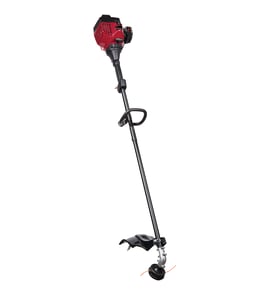




How to replace a line trimmer head?
On the Craftsman 358795020 gas line trimmer, most “head” service is replacing the spool line and reassembling the tap button and lock ring. We remove the lock ring, pull the spool, install new .095 in (2.4 mm) line, then lock everything back in place per the 358795020 owner's manual.
- Shut the engine off and let it cool.
- Disconnect the spark plug boot so the trimmer cannot start.
- Keep the debris shield installed; it protects you and also trims line length.
- Wear gloves and eye protection.
- Work over a bench so the springy parts do not get lost.
- Press the tab on the side of the trimmer head and twist the lock ring.
- Remove the lock ring and tap button.
- Pull the spool out; remove any remaining line and clean debris.
- Install new line: use two 20-foot lengths of .095 in (2.4 mm) line.
- Insert about 1/16 in of each line end into the spool’s anchoring holes.
- Wind both lines evenly in the direction of the arrow; set lines into guide slots.
- Feed line ends through the exit holes, seat the spool, then reinstall the tap button and lock ring.
- Twist until all catches lock; pull and twist the lock ring to confirm it is secure.
- Start and run at full throttle; tap the head lightly on grass to advance line.
- If line is worn down to about 2 in (5 cm) or less, it can take more than one tap.
- Avoid tapping on concrete or asphalt; it causes excessive trimmer head wear.
| Symptom | Most common cause | What to do |
|---|---|---|
| Line will not advance | Wrong line diameter | Use .095 in (2.4 mm) line |
| Line feeds unevenly | Line wound crossed or loose | Rewind evenly and firmly |
| Lock ring pops loose | Catches not fully engaged | Reinstall and lock until secure |
| Engine runs but head acts erratic | Debris or worn internal parts | Clean head; replace worn pieces |
Correct line size and a fully latched lock ring prevent poor cutting performance and reduce the chance of parts coming loose during operation.
Last updated: January 2026
Which is better, .080 or .095 trimmer line?
For the Craftsman 358795020 gas line trimmer, .095-inch line is the better choice because it is the specified diameter for this model and it feeds correctly through the trimmer head. Using .080-inch line can cause poor line advance and uneven cutting.
The operator instructions for this trimmer call for .095 in (2.4 mm) diameter line for safe, consistent performance. See the 358795020 operator's manual for the exact line specification and operating guidance.
| Feature | .080 in line | .095 in line |
|---|---|---|
| Best use | Light trimming and edging | Thicker grass and heavier weeds |
| Durability | Lower | Higher |
| Line advance in this model | Can slip or not advance well | Advances as designed |
| Cutting feel | Lighter, less load | More stable, more control |
Use these guidelines when you are deciding what to buy and how you want the trimmer to behave:
- Choose .095 for thicker grass, fence lines, and tougher weeds.
- Choose .095 if you want fewer breaks and longer run time between reloads.
- Avoid .080 if your trimmer head is designed around .095 line (common cause of feed problems).
- If you are getting frequent line breaks with .095, reduce bumping on hard surfaces and avoid crowding the head into rocks and edging.
- Run at full throttle when bump-feeding so the head advances line cleanly.
Line diameter affects both cutting power and how the bump-feed system works. On the 358795020, the line limiter and feed mechanism are designed around .095-inch line; the wrong diameter can lead to wasted line, poor trimming results, and extra wear on the trimmer head.
Last updated: January 2026
What is the strongest .095 trimmer line?
For the Craftsman 358795020 gas line trimmer, the strongest .095-inch line is a premium, abrasion-resistant nylon line that matches the manual’s required .095 in (2.4 mm) diameter; twisted or “diamond” profiles typically hold up best in thick weeds and along fences. Confirm the exact line type and loading method in the 358795020 operator’s manual.
We see the best durability with these .095 line styles:
- Twisted (quiet, strong, clean cut): great all-around choice for heavy grass and weeds
- Serrated or “diamond” profile: aggressive cutting, good wear resistance
- Round (most reliable feed): best if your head is picky about advancing line
- Square (fast cutting): strong edges, but can wear faster on rocks and concrete
Your 358795020 is designed to run only .095 in (2.4 mm) line. Using thicker line can prevent proper line advance and overload the trimmer head.
| What you’re doing | Best .095 line shape | Why |
|---|---|---|
| General trimming | Twisted | Durable and typically quieter |
| Fence lines and edging | Diamond/serrated | Resists abrasion and cuts aggressively |
| Lots of bump-feed issues | Round | Feeds and advances most consistently |
- Keep the shield installed so the line limiter can trim to the correct length
- Advance line by tapping the head lightly on grass at full throttle
- Avoid tapping on concrete or asphalt; it accelerates head and line wear
- Do not “crowd” the line into rocks, gravel, or posts; let the RPM do the work
- If performance drops, service the air and fuel system (a lean-running engine reduces cutting power)
The right .095 line profile improves cutting speed and reduces breakage, but staying within the trimmer’s specified diameter protects the bump-feed system and helps prevent excessive vibration and wear.
Last updated: January 2026