Owner’s manual
How do I fix the 4E error on my Samsung washer?
On Samsung washer model WF410ANR, a 4E-type fill error means the washer is not getting enough water fast enough. We fix it by confirming both hot and cold faucets are fully open, hoses are not kinked, and the inlet hose screens are clean; then restart the cycle per the WF410ANR owner's manual.
- Turn OFF the washer, wait 10 seconds, then power it back on and retry the cycle.
- Verify both HOT and COLD faucets are opened all the way (even if you wash cold).
- Straighten any kinked inlet hoses; make sure the washer is not pinching them.
- Confirm each fill hose has a rubber washer installed at the hose connection.
- Remove the hoses at the faucets and clean the mesh inlet screens (sediment blocks flow).
- Check household water pressure; low pressure can trigger a fill error.
- Unplug the washer.
- Turn off HOT and COLD water supply valves.
- Place a towel or shallow pan under the hose connections.
- Disconnect the hoses at the faucets.
- Rinse or gently brush the small screens in the hose ends.
- Reconnect hoses (HOT to HOT, COLD to COLD), hand-tighten, then snug slightly with pliers.
If the faucets are open and screens are clean but the washer still will not fill, the water inlet valve can be sticking or restricted. For this model, the matching replacement is the washer water inlet valve DC62-30314K.
| Symptom | Most common cause | Best next step |
|---|---|---|
| No water enters at all | Closed faucet, kinked hose, clogged screen | Open valves, straighten hoses, clean screens |
| Slow fill, then error | Screen sediment, low water pressure | Clean screens, verify pressure |
| Hot and cold reversed | Incorrect hose hookup | Reconnect HOT to HOT, COLD to COLD |
A fill error stops the cycle to prevent poor washing performance and protect components that rely on the correct water level (like the water-level pressure system).
Last updated: February 2026
How long does a Samsung VRT washer last?
A Samsung VRT front-load washer like model WF410ANR typically lasts 10 years with normal household use. With consistent cleaning, correct loading, and prompt repair of leaks or vibration issues, it commonly reaches 12 to 15 years of service.
A washer’s life is mostly determined by how hard it works and how well it is maintained.
- Load size and frequency (daily heavy loads shorten life)
- Installation and leveling (reduces vibration and bearing wear)
- Water quality and detergent use (helps prevent buildup)
- Drain and door-boot care (prevents leaks and odor)
- Fixing small problems early (stops secondary damage)
VRT (Vibration Reduction Technology) helps the washer run smoother at high spin speeds, which reduces noise and shaking. It does not eliminate wear from overloading, poor leveling, or running with damaged suspension parts.
| Symptom | Most common cause | What to do next |
|---|---|---|
| Excessive shaking or banging | Worn suspension | Inspect/replace shocks; see Samsung washer shock absorber DC66-00470A |
| Water under the front | Door boot leak or clamp issue | Inspect boot and clamps; see WF410ANR owner’s manual |
| Won’t drain or drains slowly | Drain restriction or hose issue | Check drain path; consider washer drain hose DC97-15273A |
| Won’t fill or fills slowly | Inlet valve or supply issue | Check screens/hoses; consider washer water inlet valve DC62-30314K |
Knowing the expected lifespan helps you decide whether to repair or replace. If your WF410ANR is near the 10-year mark and you’re seeing repeated vibration, leaking, or fill and drain problems, addressing the root cause early often prevents more expensive tub, motor, or control issues.
Last updated: February 2026
What is the capacity of Samsung WF410ANR?
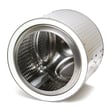
The Samsung WF410ANR washer has a 4.3 cu. ft. tub capacity (super-capacity). This extra-large drum is built to handle bulky loads like bedding and big towel loads in fewer cycles; confirm the spec in the WF410ANR owner's manual.
A 4.3 cu. ft. Samsung front-load washer is sized for larger households and bulky items.
- Wash a full set of bedding more easily than standard-capacity models
- Handle large towel loads (up to about 26 bath towels, depending on thickness)
- Fit comforters better because the drum has more room to tumble
- Reduce the number of weekly loads compared to smaller tubs
- Help cleaning performance by allowing proper agitation and rinsing space
| Capacity class | Typical cu. ft. | Best for |
|---|---|---|
| Standard | 3.0 to 3.5 | Smaller loads, smaller households |
| Large | 3.6 to 4.2 | Family laundry, some bulky items |
| Super-capacity | 4.3 and up | Bedding, towels, fewer loads |
Even with a 4.3 cu. ft. drum, loading technique matters.
- Load loosely; keep items below the top of the drum so they tumble
- Mix large and small items to reduce out-of-balance spinning
- Use HE detergent and measure carefully to prevent oversudsing
- If vibration increases, inspect suspension parts like the washer shock absorber DC66-00470B
Correct capacity helps you choose the right washer size for your household, avoid overloading (which increases vibration and wear), and set realistic expectations for bulky items like comforters.
Last updated: February 2026
Why is my Samsung washer leaking water from underneath?
On your Samsung WF410ANR washer, water leaking from underneath usually comes from a drain backup, a loose or cracked hose, or a door boot leak that runs down into the base. Follow the safety and shutoff steps in the WF410ANR owner's manual before inspecting.
- Drain hose kinked, shoved too far into the standpipe, or standpipe partially clogged
- Drain pump area or internal drain hose connection leaking during drain/spin
- Fill hoses loose at the faucet or washer inlet; water runs down the cabinet
- Door boot has debris in the folds or a tear; drip tracks down to the bottom
- Oversudsing from too much detergent or non-HE detergent
| When you see water | Most likely area | Best next step |
|---|---|---|
| During fill | Supply hoses, inlet valve area | Tighten fittings; check hose washers |
| During tumble | Door boot, oversudsing | Clean boot folds; reduce detergent |
| During drain/spin | Drain hose, pump/filter path | Check for clogs; verify drain hose routing |
| Drips even when off | Inlet valve not sealing | Turn off faucets; plan valve replacement |
- Unplug the washer; turn off both water faucets.
- Pull the washer forward; look for the highest wet point (that is usually the source).
- Confirm the drain hose is not kinked and the standpipe drains freely.
- Wipe and inspect the door boot folds for small items and tears.
- Run a short rinse/spin while watching for leaks (only after panels are reinstalled).
- Washer drain hose DC97-15273A if you find cracks, pinholes, or a loose connection
- Washer door boot DC64-00802C if the seal is torn or won’t seat evenly
- Washer water inlet valve DC62-30314K if it drips at the valve body or won’t shut off
Leaks can create a slip hazard and can wet internal electrical components. The WF410ANR manual also notes that drain errors point to a draining problem; fixing restrictions prevents repeat leaks.
Last updated: February 2026