Owner’s manual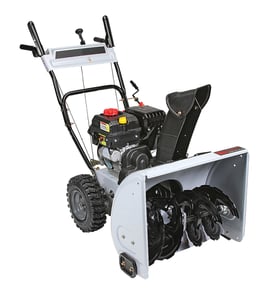



What is the typical lifespan of a gas snowblower?
A gas snowblower typically lasts 10 to 20 years with normal residential use and consistent maintenance. For your Briggs 1696610-03 snowthrower, following the oil-change and inspection intervals in the 1696610-03 owner's manual is the most reliable way to reach the upper end of that range.
Typical lifespan ranges (what we see most often)
- 10 to 20 years: common lifespan for a well-maintained gas snowblower
- 8 to 12 years: more likely with heavy use, poor storage, or skipped maintenance
- 15 to 20 years: more likely with proper off-season storage, routine lubrication, and timely wear-part replacement
| Usage and care level | Typical outcome | What usually fails first |
|---|---|---|
| Light use + stored dry | Longer lifespan | Skid shoes, scraper bar, belts/friction parts |
| Average use + basic upkeep | Average lifespan | Friction wheel, cables, pulleys |
| Heavy use + minimal upkeep | Shorter lifespan | Drive system wear, auger/gearbox issues |
Maintenance that most affects lifespan on the 1696610-03
The manual’s maintenance schedule is the playbook for long life. Focus on these items:
- Change engine oil after the first 5 hours, then about every 25 hours or annually
- Check engine oil level before each use
- Check auger stop time before each use (important for safety and clutch/brake performance)
- Inspect wear items like the scraper bar and hardware regularly
- Remove snow and slush after each use so controls, wheels, chute, and auger do not freeze up
When repair makes sense vs replacement
A good rule is to repair when the machine is structurally sound and the fix restores safe, reliable operation.
Consider repair first when:
- The engine runs well and starts consistently
- The auger and chute are solid (no major housing damage)
- The issue is a normal wear item (drive/friction, cables, skid shoes)
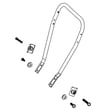
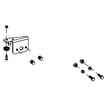
Common repair parts for this model include the snowblower friction wheel kit 707840 and the snowblower skid shoe kit 84004733.
Why it matters
A snowblower’s lifespan is mostly about preventing corrosion, fuel-system problems, and drive/auger wear. Consistent oil changes and proper off-season storage reduce the most common causes of early failure and keep performance steady in heavy snow.
Last updated: February 2026
How to find snowblower model number?
For your Briggs 1696610-03 gas snowthrower, the model number is typically on a product identification label or stamped into the metal on the frame near the engine, on the rear of the base between the wheels, or on the auger housing. Use that exact number to match the correct parts and manual.
Where to look on a snowblower
Check these common spots first (wipe off snow, salt, and grime so the tag is readable):
- Frame near the engine (often on the side rail)
- Rear of the base between the wheels
- Auger housing (side or top area near the front)
- Handlebar or dash panel area (less common, but possible)
- Stamped metal near the frame if the label is missing
For model-specific diagrams and labeling references, use the 1696610-03 owner's manual.
Model number vs. engine number (why you may need both)
Your snowblower has two “identities” that can matter for parts:
| What you are identifying | What it’s used for | Where it’s usually found |
|---|---|---|
| Snowblower model number (example: 1696610-03) | Chute, auger, drive, controls, hardware | Frame, base, auger housing |
| Engine model/type/code | Spark plug, carburetor, ignition, engine tune-up items | On the engine shroud, valve cover area, or recoil housing |
If you are ordering drive or auger parts, the snowblower model number is the key. If you are ordering engine-specific parts, the engine model/type/code is the key.
Tips to read the tag correctly
- Copy the model number exactly, including dashes (for example, 1696610-03).
- Take a clear photo before the label wears further.
- If the label is scratched, use a flashlight at an angle to make stamped characters stand out.
- Match the model number to the parts list before ordering high-cost assemblies.
Why it matters
Snowblower parts like an auger assembly, friction wheel kit, or gearbox kit can look similar across models, but mounting points and cable lengths vary. Using the exact model number helps ensure the right fit and avoids return delays.
Last updated: February 2026
Is sae 30 the same as 5W30 for snowblower?
No. On the Briggs 1696610-03 gas snowblower, SAE 30 and 5W-30 are different oils; SAE 30 is a single-weight oil that can cause hard starting in cold weather, while 5W-30 (especially synthetic 5W-30) flows better for cold starts and still protects when the engine warms up. See the oil viscosity chart in the owner's manual.
What the numbers mean (SAE 30 vs 5W-30)
- SAE 30: single viscosity grade; thicker when temperatures drop.
- 5W-30: multi-grade; the “5W” rating helps it flow in winter conditions, and the “30” rating provides protection at operating temperature.
- For most outdoor power equipment use, 5W-30 synthetic is a strong all-around choice.
- If you run the machine in hot temperatures, a heavier synthetic (such as 15W-50) is commonly used for added protection.
What we recommend for this snowblower
Your manual’s guidance is clear: outdoor temperature determines the correct oil viscosity.
- Use 5W-30 (synthetic preferred) for typical snowblower conditions.
- Avoid SAE 30 for cold weather use; below about 40°F (4°C) it commonly leads to hard starting.
- Avoid 10W-30 in high heat; above about 80°F (27°C) it can increase oil consumption, so oil level checks become more important.
Quick comparison
| Oil type | Cold starting | Warm protection | Best use case |
|---|---|---|---|
| SAE 30 | Poor in cold | Good | Warmer weather operation |
| 5W-30 | Good | Good | Most snowblower conditions |
| Synthetic 5W-30 | Best | Excellent | Wide temperature range, frequent starts |
Why it matters
Oil that is too thick during a cold start does not circulate quickly. That increases wear and can make the engine difficult to start. Using the viscosity listed in the manual helps the engine lubricate immediately and run consistently.
Helpful oil-check tips (before every use)
- Park the snowblower on a level surface.
- Clean around the oil fill/dipstick area.
- Check oil level and keep it at the FULL mark.
- Do not overfill; recheck after waiting about a minute.
- Never run the engine with low or no oil.
Last updated: February 2026
Is it worth fixing a snowblower?
Yes, it’s usually worth fixing a Briggs 1696610-03 gas snowthrower when the problem is a wear item or adjustment (skid shoes, scraper bar, cables, friction drive parts) and the machine is otherwise solid. If the repair involves major drivetrain damage and repeated breakdowns, replacement often makes more sense. For model-specific maintenance intervals and safety steps, use the 1696610-03 owner's manual.
Quick way to decide (repair vs. replace)
We use three checks to make the call:
- Repair cost vs. replacement cost: If the repair is under about 50% of the cost of a comparable new snowblower, repairing is typically the better value.
- How often it fails: One-time wear is normal; frequent failures point to deeper issues.
- What failed: Wear parts are expected; major gearbox or drive damage is a bigger investment.
Common “worth fixing” repairs on this model
These are typical snowblower repairs that restore performance without rebuilding the whole unit:
- Adjusting skid shoes to match your surface (pavers, concrete, gravel)
- Replacing worn traction components (friction wheel or related drive parts)
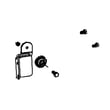
- Replacing chute knobs, cables, or handle hardware
- Replacing wear items that affect scraping and throwing performance
If you’re dealing with traction problems (poor drive, slipping, no forward movement), a friction-drive repair is often a good investment; see the snowblower friction wheel kit 707840 as an example of a common wear-part replacement.
Signs it’s time to stop investing in repairs
If you see several of these at once, replacement is usually the smarter long-term choice:
- The snowblower needs major repairs every season
- The drive system has persistent slipping even after correct adjustment
- You find metal damage after striking an object (auger housing, impeller area)
- The machine has multiple missing or unsafe guards
Why maintenance history matters
Your manual calls out routine items that strongly affect reliability, including oil changes, checking auger stop time, inspecting for loose hardware, and checking cable adjustment. Staying on that schedule reduces repeat failures and makes repairs more cost-effective.
Repair impact guide
| What you notice | Likely area | Typical outcome |
|---|---|---|
| Poor traction or slipping drive | Friction drive system | Often worth fixing |
| Scraping poorly, leaves snow behind | Scraper bar or skid shoe setup | Usually worth fixing |
| Auger does not pull snow in well | Auger system or cable adjustment | Often worth fixing |
| Damage after hitting debris | Auger/impeller area | Inspect first; repair if limited |
Last updated: February 2026