Installation guide
 Owner’s manual
 Error Codes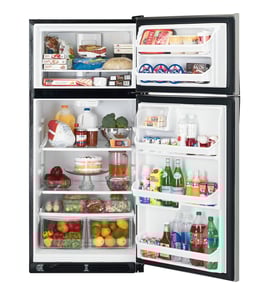




What is the upper part of a fridge called?
In a top-mount refrigerator like the Frigidaire FFTR1621QB1, the upper compartment is the freezer. It is the section designed to keep foods frozen, and it also helps the refrigerator maintain proper overall temperatures through shared airflow and controls (depending on how your settings are adjusted in the FFTR1621QB1 owner's manual).
- Keeps food at freezing temperatures for long-term storage.
- Shares cooling air with the fresh-food (refrigerator) section through vents.
- Uses a temperature control system that affects both compartments when you adjust the main control.
- Relies on good airflow; blocking vents with food can reduce cooling performance.
- May include an ice maker on some configurations; avoid contact with moving parts if equipped.
On FFTR1621QB1, the main refrigerator/freezer control changes temperatures in both the freezer (upper) and refrigerator (lower) compartments. Adjust in small steps and allow time for temperatures to stabilize.
| What you change | What it affects | Best practice |
|---|---|---|
| Main refrigerator/freezer control | Freezer and refrigerator temps | Small adjustments; allow about 24 hours to stabilize |
| Auxiliary freezer control (if present) | Fine-tunes freezer airflow/temperature balance | Leave at “Normal” unless you need a minor tweak |
If the freezer (upper compartment) is too warm, the refrigerator section often warms up too because the cooling system and airflow are connected. Keeping vents clear and making gradual control changes helps prevent temperature swings and food spoilage.
Last updated: February 2026
Do you need space on top of the fridge?
Yes. For the Frigidaire FFTR1621QB1 top-mount refrigerator, we recommend leaving clearance above the cabinet for airflow; the installation guidance calls for 3/4 inch at the top (and sides) and 1 inch at the back for proper air circulation and easier installation. See the installation guide for the exact clearance notes.
Use these minimum clearances to help the compressor cool efficiently and to avoid overheating.
- Top: 3/4 inch
- Sides: 3/4 inch
- Back: 1 inch
- Front (toe grille): keep it open and unobstructed
- Hinge side: allow extra space if the door needs to swing past a nearby wall
| Location | Minimum clearance | Why it matters |
|---|---|---|
| Top | 3/4 inch | Lets warm air escape and improves overall ventilation |
| Sides | 3/4 inch | Helps airflow and makes positioning easier |
| Back | 1 inch | Prevents heat buildup behind the unit |
Refrigerators reject heat through the condenser area and need steady air circulation. When the top is tight to cabinetry, heat can linger, which makes the refrigerator run longer, cool less consistently, and waste energy.
Before you slide the refrigerator into place:
- Measure the opening width, height, and depth, then add the clearances above.
- Keep the toe grille at the lower front unblocked (it is part of the airflow path).
- Avoid placing the refrigerator next to heat sources or in direct sunlight.
- Make sure the floor is level and supports a fully loaded refrigerator.
- If the hinge side is against a wall, plan extra room so the door can open fully.
Last updated: February 2026
Is top mounted refrigerator better than bottom mounted?
A top-mount refrigerator like the Frigidaire FFTR1621QB1 is better when you want lower cost, strong energy efficiency, and easy access to the freezer; a bottom-mount is better when you want the fresh-food section at eye level and less bending. The “better” choice depends on how you use your refrigerator day to day.
| Feature | Top-mount (freezer on top) | Bottom-mount (freezer on bottom) |
|---|---|---|
| Fresh-food access | Lower shelves require more bending | Most-used items are at eye level |
| Freezer access | Easier to reach | Often requires bending or a pull-out drawer |
| Energy use (typical) | Often lower due to simpler design | Often slightly higher due to added features |
| Price and repairs | Usually lower cost, fewer complex parts | Often higher cost, more features to maintain |
- You use frozen foods often and want the freezer at a comfortable height.
- You want a simpler layout with fewer features to troubleshoot.
- You prefer a refrigerator that is easier to place and ventilate correctly (good airflow matters for cooling performance).
- You want straightforward door swing options; many top-mount designs allow reversing the door swing.
- You want a design that is typically easier on long-term maintenance costs.
Proper installation and airflow have more impact on real-world cooling than freezer location. For top-mount installation guidance, we follow the clearances and leveling basics in the installation guide.
- Keep airflow clear at the toe grille area and around the cabinet.
- Allow typical clearances: about 3/4 inch at the sides and top, and about 1 inch at the back.
- Level the cabinet so doors seal well; a slight tilt back (about 1/4 inch) helps doors close.
- Avoid placing the refrigerator in extreme room temperatures (below 55°F or above 110°F) because cooling performance drops.
Choosing the right configuration affects comfort (bending vs reaching), food organization, and how often doors stay open. Longer door-open time can raise temperatures, increase frost, and make the compressor run more.
Last updated: February 2026
What does my Frigidaire model number tell me?
Your Frigidaire model number (for this refrigerator, FFTR1621QB1) identifies the product series and configuration, and it helps us match the correct parts, manuals, and features for your exact unit. It is the fastest way to ensure you get the right door gasket, control, shelf, or motor for your refrigerator.
Model numbers are designed to encode key details that affect fit and compatibility. Depending on the series, the model number can indicate:
- Product type and platform (for example, top-mount refrigerator vs. other styles)
- Capacity and feature package (varies by series)
- Finish or color code (often represented by a letter in the model number)
- Engineering revision or production change level (the last characters often matter for parts)
- Which parts diagrams and wiring/control versions apply
Check these common locations on Frigidaire top-mount refrigerators:
- Inside the fresh food compartment on a side wall
- Near the crisper area or lower liner
- On a rating label that also lists electrical information
Small model-number differences can change which parts fit, even when refrigerators look identical.
| What you are doing | What to use | Why it helps |
|---|---|---|
| Replacing a broken bin/rail | Exact model number | Ensures the mounting points and length match |
| Fixing a cooling issue | Model number plus symptom | Helps narrow to fan motor, sensor, or control |
| Replacing a gasket | Exact model number | Prevents air leaks and frost from a poor fit |
Here are a few parts that are matched by model number for FFTR1621QB1:
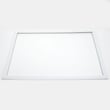
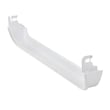
- Door shelf trim and supports such as the Frigidaire refrigerator door shelf rail 240535101
- Cooling system components such as the refrigerator temperature sensor 240597220
- Interior lighting (use the same wattage listed in the manual) such as the refrigerator light bulb 316538904
Using the correct model number prevents wrong-part returns and helps restore proper temperatures, door sealing, and normal operation faster.
For model-specific identification details and feature references, use the FFTR1621QB1 owner's manual.
Last updated: February 2026
What is the most common problem with a Frigidaire refrigerator?
The most common problem we see with Frigidaire refrigerators like model FFTR1621QB1 is a cooling complaint, such as the fresh food section getting warm while the freezer still seems cold. This is usually tied to airflow, temperature sensing, or heat removal issues rather than a simple control setting.
- Dirty condenser area: Dust buildup reduces heat transfer and can cause warm refrigerator temps.
- Evaporator fan not moving air: If the fan is weak, noisy, or not running, cold air will not circulate well.
- Frost or ice buildup: A defrost problem can block airflow and mimic a “not cooling” failure.
- Temperature control set incorrectly: On many models, turning controls to “0” or “OFF” stops cooling (power to lights may still remain on).
- Power or voltage issues: Loose plug, tripped breaker, or low voltage can affect compressor performance.
| What you notice | Most likely area to inspect | Common related part on this model |
|---|---|---|
| Freezer cold, fridge warm | Airflow from freezer to fridge | Refrigerator motor 242077705 |
| Clicking/humming, poor cooling | Start components or compressor system | Gibson refrigerator run capacitor 297286803 |
| Temps swing up and down | Temperature sensing/control | Refrigerator temperature sensor 240597220 |
| Interior light out | Bulb or socket/door switch | Refrigerator light bulb 316538904 |
Cooling problems usually get worse fast: food safety, excess frost, and longer compressor run time can follow. Catching airflow and coil-cleaning issues early often prevents more expensive sealed-system repairs.
- Confirm the controls are not set to “0” or “OFF”.
- Unplug the refrigerator before cleaning or replacing a bulb (per safety guidance in the FFTR1621QB1 owner's manual).
- Clean the condenser area and verify the fans run when the unit is cooling.
- If you have a display or blinking pattern, use Frigidaire refrigerator error codes to narrow the failure.
Last updated: February 2026