
Who made Craftsman drill presses?
Craftsman drill presses were built by several different manufacturers over the years. For classic U.S.-made machines, the model number prefix is the best clue; Craftsman model 11321370 (a “113” model) is typically associated with Emerson Electric as the original manufacturer.
How to identify the maker from the model number
On many older Craftsman tools, the first three digits of the model number indicate the original manufacturer (often called the “source code”). Common drill press source codes include:
- 113: commonly Emerson Electric (many classic Craftsman stationary tools)
- 103: commonly King-Seeley (many mid-century Craftsman tools)
- Other prefixes: used on later-era tools and can vary by production period
Where to find the model number on a drill press
For a Craftsman 15-1/2 inch drill press like model 11321370, the model number is usually on an ID plate or label located on one of these areas:
- The head casting (near the motor or belt cover)
- The column (rear or side)
- The base (side or rear edge)
- Near the switch box or power cord entry
If the label is missing or unreadable, our guide on how to find your appliance model number (and what it means for parts) helps you confirm the exact model so you can match parts correctly.
Why the manufacturer matters for parts and repairs
Knowing who made the drill press helps you avoid mismatched parts and specs, especially for items like pulleys, quill assemblies, bearings, switches, and belts.
Quick guide: what you can reliably use
| What you have | What it tells you | Best next step |
|---|---|---|
| Full model number (example: 11321370) | Strong clue to original maker and correct parts list | Use the model-specific parts diagrams and list |
| Only “Craftsman” branding | Not enough to identify the exact build | Locate the ID plate and confirm the model |
| Partial model number | May point to the wrong parts | Re-check label locations and compare digits |
Practical tip before ordering parts
- Match the full model number exactly (all digits)
- Compare the part description to your drill press configuration (belt drive, pulley sizes, switch style)
- Inspect for prior modifications (aftermarket motor, non-original pulleys)
Last updated: February 2026
What are the parts of the drill press?
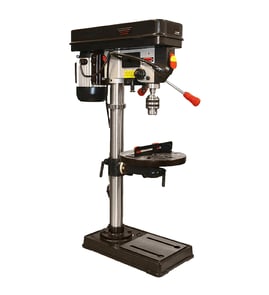
On the Craftsman 11321370 15-1/2" drill press, the main parts are the base and column (support), the head (motor and drive), the table assembly (work support), and the quill and spindle (drilling mechanism). These components work together to keep the bit aligned and control drilling depth.
Main drill press parts and what they do
- Base: Stabilizes the drill press and provides mounting holes for bolting it down.
- Column: Vertical support that keeps the head and table aligned.
- Head: Houses the motor and the drive system (commonly pulleys and a belt) that turns the spindle.
- Table and table clamp: Supports the workpiece; the clamp locks table height and rotation.
- Fence (optional accessory): Helps position and repeat holes consistently.
- Power switch (on/off): Controls power to the motor.
- Quill and spindle: The quill moves up and down; the spindle holds the chuck/arbor and rotates the bit.
- Quill feed handle and depth stop: Lowers the quill and sets repeatable drilling depth.
Quick map: where each part is located
| Part | Where you see it | What you adjust most often |
|---|---|---|
| Base | Bottom | Mounting/leveling |
| Column | Vertical tube | Usually none |
| Table | Mid-height | Height, tilt, rotation |
| Head | Top | Belt speed (if equipped) |
| Quill/spindle | Under the head | Feed and depth |
Why it matters
Knowing the names of the drill press parts helps you troubleshoot common issues (wobble, poor hole accuracy, slipping belt, or table drift) and makes it easier to identify the correct replacement components when you search by model number on Sears PartsDirect.
Common symptoms tied to specific parts
- Bit wobble or runout: chuck/arbor fit, spindle bearings, quill play
- Squealing or slipping: belt tension, pulley alignment
- Table won’t stay put: table clamp wear or loose hardware
- Drill won’t start: power switch, cord, internal wiring
Last updated: February 2026
How to repair a drill press spindle?
On the Craftsman 11321370 15-1/2" drill press, spindle repair means removing the quill assembly, replacing worn spindle bearings (and the spindle if it is bent or scored), then reassembling and checking for smooth quill travel and minimal runout.
Before you start (safety and setup)
- Unplug the drill press; remove the bit and chuck.
- Lower or remove the table for clearance.
- Mark the depth stop and return spring housing positions.
- Take photos; keep spacers and washers in order.
- Avoid hammering on the spindle nose; use a press and proper supports.
Typical spindle repair steps
- Remove the belt cover, release belt tension, and slip the belt off.
- Carefully unload the return spring tension (control the spring housing).
- Remove quill retaining hardware (retaining ring or collar, depending on revision).
- Slide the quill out of the head.
- Press the spindle out of the quill if needed.
- Replace spindle bearings; press only on the correct race.
- Reinstall spindle into the quill, then reinstall the quill into the head.
- Re-tension the return spring, reinstall the belt, and verify full return.
What to replace vs. reuse
| Symptom | Likely cause | Typical fix |
|---|---|---|
| Growling, heat at quill | Bearing wear | Replace spindle bearings |
| Chuck wobble that follows spindle | Bent/scored spindle | Replace spindle and bearings |
| Quill sticks or has side play | Debris or wear | Clean/lube; inspect quill and head bore |
Checks after reassembly
- Rotate by hand; feel for roughness or tight spots.
- Check runout with a straight rod in the chuck.
- Confirm belt tracks centered and pulleys align.
Why it matters
A worn bearing or bent spindle causes chatter, oversized holes, and poor accuracy. Restoring a true-running spindle protects bits and improves drilling results.
For safe electrical testing while the head is open, use our how to use a multimeter to test electrical parts video.
Last updated: February 2026
Can you replace the chuck on a drill press?
Yes. On the Craftsman 11321370 15-1/2" drill press, you can replace the chuck by removing the chuck and arbor from the spindle taper, cleaning the mating tapers, then seating a correctly matched replacement chuck (keyed or keyless) so it runs true.
Safe prep
- Unplug the drill press and remove the bit.
- Lower the quill and lock it if your drill press has a quill lock.
- Wear eye protection; the chuck can drop when it releases.
- Protect the table with a wood block or folded towel.
- Keep hands clear of pinch points around the quill and chuck.
Typical chuck removal and installation steps
- Remove chuck and arbor from the spindle: Many drill presses have a slot in the quill/spindle for a drift key (wedge). Insert the drift and tap to eject the arbor and chuck.
- Separate chuck from arbor (if reusing the arbor): Use chuck/arbor wedges or a press; avoid prying on the chuck body.
- Clean the tapers: Wipe both tapers clean and dry (no oil or grease). Remove burrs carefully.
- Seat the new chuck: Press the chuck onto the arbor taper, then press the arbor into the spindle taper using firm, straight pressure (a light tap through a wood block is fine).
What to match when buying a replacement chuck
| Item to match | Examples | Why it matters |
|---|---|---|
| Mount type | Taper vs threaded | Determines whether it fits at all |
| Taper sizes | Jacobs taper (JT), Morse taper (MT) | Prevents wobble and slipping |
| Capacity | Commonly up to 1/2" on many presses | Limits bit shank size |
Why it matters
A worn chuck or dirty taper causes runout (wobble), bit slippage, oversized holes, and extra vibration that can shorten spindle bearing life.
For general repair safety practices before working around switches or wiring, review are diy appliance repairs safe.
Last updated: February 2026