Owner’s manual

Are all table saw arbor nuts the same size?
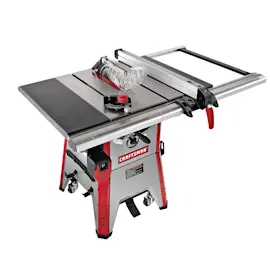
No. Table saw arbor nuts are not all the same size because the arbor shaft diameter and thread direction can vary by saw design. On the Craftsman 315284620 10-inch table saw, use the correct nut and washer setup shown in the 315284620 owner's manual to ensure the nut fully engages the arbor.
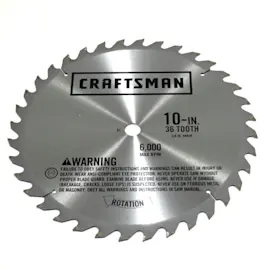
Most 10-inch table saw blades share a common arbor hole size, but that does not make arbor nuts universal.
- Blade arbor hole: Most 10-inch blades use a 5/8-inch arbor hole.
- Arbor shaft threads: Can differ by brand and model (diameter, pitch, and thread direction).
- Nut wrench size: Can differ even when arbor diameter is similar.
- Washer stack-up: Inner/outer blade washers can be model-specific.
- Dado setups: Often require a special washer and throat plate; the nut must still fully engage.
Your manual calls out an important fit check: the arbor shaft should extend slightly beyond the arbor nut when tightened, and the nut must be fully engaged. This is especially important when installing a dado stack.
- Unplug the saw before checking the arbor nut.
- Confirm the blade (or dado stack) seats flat against the inner blade washer.
- Tighten the arbor nut so it is fully engaged on the threads.
- Verify the arbor extends slightly past the tightened nut.
- Hand-spin the blade to confirm it turns freely before powering on.
| Saw type | Typical blade arbor hole | Nut/threads | What you should do |
|---|---|---|---|
| 10-inch table saw | 5/8 inch | Varies by model | Match the nut to the saw’s arbor |
| 12-inch table saw | 1 inch | Varies by model | Use the correct OEM-style nut/washer set |
Using the wrong arbor nut (wrong thread, wrong direction, or not enough engagement) can let the blade loosen, wobble, or bind. Correct engagement and washer placement helps the blade run true and reduces kickback risk.
We recommend matching parts by the exact model number 315284620 when you shop; you can search by model on Sears PartsDirect.
Last updated: February 2026
Are Craftsman table saws any good?
Yes. Craftsman table saws are a solid choice for many DIYers and hobbyists because they typically deliver good cutting power and durability for the price; the key is setup and alignment. For the Craftsman 315284620 10-inch table saw, following the safety and adjustment procedures in the 315284620 operator's manual is what makes it perform well and cut accurately.
A table saw is “good” when it is safe, repeatable, and accurate. For most owners, that comes down to fence alignment, blade selection, and stable work support.
- The rip fence stays parallel to the blade to reduce binding and kickback
- The blade is appropriate for the cut (rip vs. crosscut vs. combination)
- The saw is set up square (blade to miter slot, fence to blade)
- The workpiece is supported and fed smoothly
- Safety components are installed and used correctly
Your 315284620 manual calls out two big quality factors that affect real-world results: alignment and using the right blade.
- After any blade adjustment, align the rip fence to the blade and confirm it is parallel before cutting
- Rotate the blade by hand one full revolution to confirm clearance before powering on
- Use only blades rated at or above the saw’s speed rating
| Check | Target result | Why it matters |
|---|---|---|
| Rip fence to blade | Parallel | Reduces kickback and burning |
| Blade to miter slot | Square/parallel | Improves straight cuts and sled accuracy |
| Blade type | Correct for task | Cleaner cuts, less strain |
| Work support | Stable infeed/outfeed | Prevents tipping and binding |
Many “mixed review” experiences come from one of these situations:
- Fence not aligned after adjustments
- Dull or wrong blade installed
- Expecting cabinet-saw precision from a portable saw
- Using jigs/sleds that do not match the saw’s miter gauge groove fit
When ordering repair parts, always use the full model number from the cabinet label (315284620) so you get the correct fit. You can shop by model on the parts list for this saw, or search by model on Sears PartsDirect.
Last updated: February 2026
What not to do with a table saw?
For the Craftsman 315284620 10-inch table saw, do not cut freehand, reach over or around the blade, stand in line with the blade, or run the saw on the floor; these actions greatly increase kickback and contact-injury risk. Follow the safety rules in the 315284620 owner's manual.
- Do not perform any operation freehand; always use the rip fence or miter gauge.
- Do not reach around, over, or across the blade.
- Do not stand directly in line with the blade; stand slightly to the side of the blade path.
- Do not operate the saw on the floor or below waist height; mount it securely to a bench or approved stand.
- Do not run without the blade guard and riving knife/spreader unless a specific procedure requires removal.
- Do not start the saw with the wood touching the blade; let the blade reach full speed first.
- Mount the saw securely; use all mounting holes and tighten hardware.
- Confirm the rip fence is parallel to the blade after any blade adjustment.
- Rotate the blade by hand (power disconnected) to confirm clearance before powering on.
- Hold the workpiece firmly against the table; keep hands out of the blade line.
- Use a push stick or push block for narrow rips and small pieces.
| If you do this | It can cause | Do this instead |
|---|---|---|
| Cut freehand | Binding, loss of control, kickback | Use rip fence or miter gauge |
| Stand behind the cut line | Kickback hits you | Stand slightly to the side |
| Reach over the blade | Hand contact with blade | Stop the saw, wait for full stop |
| Operate on the floor | Instability, poor control | Bolt to bench or approved stand |
Kickback happens when the blade stalls or binds and throws the workpiece back with force. The 315284620 is designed to reduce that risk when the fence is aligned, the work is supported, and the guard and riving knife/spreader are used correctly.
If you need replacement parts for the Craftsman 315284620 (guards, fence components, switches, or hardware), we list model-specific diagrams and parts on this model page; you can also search by model number on Sears PartsDirect.
Last updated: February 2026
Can you use an 8 inch blade on a 10 inch table saw?
Yes; you can use an 8-inch blade on the Craftsman 315284620 10-inch table saw as long as the blade fits the arbor, is rated at or above the saw’s RPM, and you set up the guard and riving knife/spreader correctly for the cut. For exact blade and accessory guidance, use the 315284620 owner's manual.
An 8-inch blade reduces maximum cutting depth and can change how your safety accessories line up.
- Less cut depth: smaller diameter means a shallower maximum cut.
- Guard and riving knife/spreader alignment: you still need the blade guard and riving knife/spreader/splitter for through cuts whenever it can be used.
- Kickback risk can increase if the fence is not parallel to the blade or the workpiece is not controlled.
- Clearance checks matter: rotate the blade by hand one full revolution before powering on to confirm nothing rubs.
Before installing any blade size, we follow these basics from safe table saw setup practices:
- Unplug the saw and confirm the switch is OFF before changing blades.
- Use only blades rated at least as fast as the saw (never lower).
- Confirm the blade’s arbor hole matches the saw arbor (do not force-fit).
- Keep the rip fence parallel to the blade after any blade change.
- Use a push stick or push block when needed; keep hands at least 3 inches from the blade.
| Feature | 10-inch blade (typical) | 8-inch blade (typical) |
|---|---|---|
| Max cutting depth | Deeper | Shallower |
| Common use | General ripping and crosscuts | Specialty cuts, thinner stock, some accessory setups |
| Guard/riving knife fit | Usually straightforward | May require extra attention to alignment and clearance |
Many 8-inch dado sets are designed to be used on 10-inch table saws because dado work is typically a non-through cut. When making dado cuts, use the correct throat plate and then reinstall the spreader/riving knife in the up position and put the blade guard back on when you are done.
Blade size affects cutting depth, accessory alignment, and kickback control. Staying within the saw’s blade speed rating and using the guard, riving knife/spreader, fence alignment, and push tools helps you cut safely and get clean results.
If you need replacement parts or accessories for your Craftsman 315284620, start with the model’s parts list, or search by model number on Sears PartsDirect.
Last updated: February 2026