

How do I know if my Whirlpool dryer thermal fuse is blown?
A blown thermal fuse on your Whirlpool WED5100HW3 often shows up as a dryer that will not start, or a dryer that runs but has no heat. We confirm it by testing the fuse for continuity with a multimeter; a blown fuse reads open (no continuity) and must be replaced.
Quick symptoms to look for
- Dryer will not start (motor will not run)
- Dryer runs but does not heat (clothes stay damp)
- Cycle ends with poor drying because airflow is restricted
- You recently had a clogged vent, crushed duct, or heavy lint buildup
How we test the thermal fuse (the definitive check)
- Unplug the dryer (electric shock hazard).
- Access the thermal fuse (commonly on the blower housing or exhaust path on many Whirlpool electric dryers).
- Pull the wire connectors off the fuse terminals.
- Set a multimeter to continuity or ohms.
- Touch one probe to each terminal.
What the meter reading means
| Meter result | What it means | What to do next |
|---|---|---|
| Beep or near 0 Ω | Fuse is good | Check airflow, heater circuit, and thermostats |
| No beep or OL/infinite Ω | Fuse is blown | Replace the fuse and correct the airflow problem |
A thermal fuse is a one-time safety device; once it opens, it does not reset.
Parts that commonly apply on this model
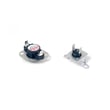
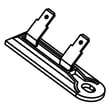
If your WED5100HW3 needs a fuse, match by model and symptom. For this model page, common safety parts include the thermal fuse W10909685 and the Whirlpool dryer thermal cut-off fuse kit 279973.
Why it matters
A thermal fuse usually blows because the dryer overheated from restricted airflow. Replacing the fuse without fixing the venting often leads to another failure and longer dry times.
Airflow fixes we recommend before running the dryer again
- Clean the lint screen and confirm it is not coated with fabric softener residue
- Inspect the vent hose for kinks, crushing, or long runs
- Clean lint from the exhaust duct and outside vent hood
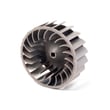
- Make sure the blower wheel is moving air (a loose wheel can reduce airflow)
Last updated: February 2026
What are the common problems with Whirlpool dryers?
Common Whirlpool dryer problems on model WED5100HW3 fall into a few buckets: it will not start, it runs but will not heat, it tumbles but dries slowly, or it makes squealing or thumping noises. Most fixes come down to power supply, airflow, or a worn moving part like a roller or idler.
Most common symptoms and what they usually mean
- Dryer will not start: tripped breaker, bad door switch, failed thermal fuse, or control issue
- No heat or weak heat: heating circuit problem, failed heater, or a safety device opened from overheating
- Long dry times: restricted venting, clogged lint path, weak airflow, or moisture sensing issues
- Loud squeal or rumble: worn drum support rollers or idler pulley
- Thumping: flat-spotted rollers, drum issue, or something caught in the blower housing
Quick checks we recommend first (fast, no parts)
- Confirm 240V power at the outlet (electric dryers can run on 120V but not heat on 240V issues).
- Clean the lint screen and inspect the lint duct path.
- Check the vent run for kinks, crushed flex duct, or heavy lint buildup.
- Try a timed dry cycle to separate “sensor” issues from “heat/airflow” issues.
- If the dryer overheated recently, inspect safety fuses before replacing other parts.
Common parts tied to common Whirlpool dryer problems
| Symptom | Likely area | Example part for WED5100HW3 |
|---|---|---|
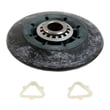
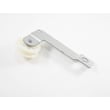
| Squealing, grinding, rumbling | Drum support and belt path | Dryer drum support roller WPW10314173 |
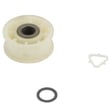
| Squealing, belt not tracking well | Idler system | Dryer idler pulley W10837240 |
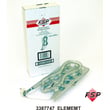
| No heat | Heating circuit | Element, heater 5400w WP3387747 |
| Runs then stops, no heat, overheats | Safety cutoffs | Whirlpool dryer thermal cut-off fuse kit 279973 |
| Poor temperature control, odd cycling | Temperature sensing | Dryer thermistor WP8577274 |
Why it matters
A dryer that is not heating or is taking too long to dry is often an airflow problem first; restricted venting can also overheat the dryer and open a thermal fuse. Noisy operation is usually a wear item issue (rollers, idler) that is best handled early to prevent belt damage.
For electrical testing, we use a meter to confirm whether a fuse is open or a heater is failed; our guide how to tell if a fuse is blown helps you verify the most common “no start” and “no heat” causes safely.
Last updated: February 2026
How do I find the model number on my WED5100HW3?
For a Whirlpool electric dryer like model WED5100HW3, the model number is printed on the appliance’s rating label. We typically see this label on the door opening area or on the dryer frame just inside the door.
Where to look on a Whirlpool dryer
Check these common spots first:
- Open the dryer door and look along the door opening (front panel rim)
- Check the dryer frame just inside the door (often on the right or left side)
- Look behind the door on the cabinet face near the latch area
- If your dryer has a lower access panel, check the inside edge of the front panel
What you should write down
To make sure you get the right diagrams and replacement parts for your dryer, record:
- Model number (example: WED5100HW3)
- Serial number (helps confirm production series)
- Any suffixes or revision codes printed with the model
Quick ID guide
| Label item | What it’s used for | Example |
|---|---|---|
| Model number | Matches parts to your exact dryer design | WED5100HW3 |
| Serial number | Identifies manufacturing date/series | (varies) |
Why it matters
Whirlpool often updates components during production runs; using the exact model number helps ensure parts like a thermal fuse, heater, or drum support roller match your WED5100HW3 configuration.
If the label is missing or unreadable
Use these options:
- Check your purchase paperwork or delivery receipt for the model number
- Look for a duplicate label on the cabinet (some units have more than one)
- If you are replacing a common wear item, match by model before ordering parts such as the dryer drum support roller WPW10314173
Last updated: March 2026