Owner’s manual
 Error Codes


What temperature should my Amana freezer be set at?
For the Amana AFF2534FEB1 bottom-mount refrigerator, we set the freezer to the recommended factory setting (typically “4”) first, then fine-tune after 24 hours so frozen foods stay solid and ice cream is firm. Use the temperature section in the AFF2534FEB1 owner's manual as your baseline.
Recommended starting point (and what it means)
Most Amana refrigerators like the AFF2534FEB1 are designed so the factory preset delivers normal household temperatures when airflow is clear.
- Start at the recommended setting “4” (factory preset)
- Wait 24 hours for temperatures to stabilize before judging results
- If items are soft, adjust colder one step at a time
- If items are too hard or you see excess frost, adjust warmer one step at a time
- Do not block freezer air vents with packages
Quick temperature targets (use these to fine-tune)
Even though the control uses numbers, these targets help you dial it in:
| Compartment | Target temperature | What you should notice |
|---|---|---|
| Freezer | 0°F (-18°C) | Ice cream stays firm; meat stays fully frozen |
| Refrigerator | 37°F (3°C) | Milk and juice are cold without freezing |
If the freezer is still too warm or too cold
Before changing settings again, we check the basics that commonly cause temperature complaints:
- Make sure air vents are not blocked (this is the first check)
- Confirm the doors close and seal fully; a leaking gasket can warm the freezer
- Let hot food cool before loading it into the freezer
- Keep the freezer reasonably full (but not packed tight) for steadier temps
Why it matters
A freezer near 0°F slows bacterial growth and preserves texture and flavor. Starting at the factory setting on the AFF2534FEB1 prevents over-adjusting, which does not cool faster and can create uneven temperatures.
Last updated: February 2026
What is the life expectancy of an Amana refrigerator?
Most Amana refrigerators, including the Amana AFF2534FEB1 bottom-mount refrigerator, typically last 10 to 15 years with normal household use and consistent maintenance. Keeping airflow clear, temperatures stable, and seals tight does the most to reach the high end of that range.
What affects lifespan the most
- Condenser coil cleanliness (dust buildup makes the compressor work harder)
- Door gasket condition (air leaks cause longer run times and frost issues)
- Evaporator fan performance (poor airflow warms the fresh-food section)
- Defrost system health (prevents heavy frost that blocks cooling)
- Stable power and proper leveling (reduces stress on controls and moving parts)
Maintenance schedule we recommend
| Task | How often | What it helps prevent |
|---|---|---|
| Clean condenser area | Every 6 to 12 months | Overheating, long run times |
| Check door seal with a paper test | Every 3 months | Warm air leaks, frost |
| Keep vents unblocked inside | Ongoing | Warm spots, uneven temps |
| Replace water filter (if equipped) | About every 6 months | Low flow, taste/odor issues |
For model-specific care and operating guidance (including where to find the model and serial label inside the fresh-food compartment), use the AFF2534FEB1 owner's manual.
When parts wear out, what we commonly see
These symptoms often show up as a refrigerator approaches mid-life or later; addressing them early can extend service life:
- Fresh-food section warm but freezer cold (airflow or damper issue)
- Clicking, humming changes, or intermittent cooling (start components or compressor strain)
- Heavy frost on the freezer back wall (defrost problem)
- Door not closing easily or moisture around the frame (gasket or alignment)
Quick part examples for this model
| Symptom | Common related part on this model |
|---|---|
| Frost buildup, warm temps | Refrigerator defrost heater WP67002493 or refrigerator defrost bi-metal thermostat WP67003426 |
| Warm fresh-food section, weak airflow | Evaporator motor WPW10128551 |
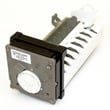
| Ice maker not producing | Whirlpool refrigerator ice maker D7824706Q |
Why it matters
A refrigerator that runs longer to hold temperature uses more energy and puts extra wear on the sealed system (compressor, evaporator, condenser). Simple upkeep and timely replacement of wear parts often adds years of reliable cooling.
Last updated: February 2026
Do they make a 34 in refrigerator?
Yes. 34-inch wide refrigerators are a common “in-between” size (between 33-inch and 36-inch models), and multiple brands make them in both standard-depth and counter-depth styles. For fit planning around your Amana AFF2534FEB1, we recommend confirming your exact opening and required clearances in the AFF2534FEB1 owner's manual.
How to measure so a 34-inch refrigerator actually fits
Measure the opening in three places (top, middle, bottom) and use the smallest number.
- Width: cabinet opening side-to-side
- Height: floor to the lowest cabinet or trim
- Depth: wall to the front edge of counters (if you want counter-depth alignment)
- Door swing space: extra room on the hinge side so doors and drawers open fully
- Ventilation clearance: leave space above and behind for airflow
The manual guidance for this style of refrigerator calls for about 1/2 inch of space at the top and behind for ventilation, plus extra space behind if you have an ice maker water line; it also notes leaving about 2 1/2 inches minimum on the hinge side when next to a fixed wall so the door can swing open. Use the exact clearances listed in your manual for your installation.
What “34-inch” usually means (quick comparison)
Manufacturers often list a “nominal” width; the actual cabinet width can be slightly under or over.
| Listed size | Typical actual cabinet width | Common fit note |
|---|---|---|
| 33-inch | ~32 3/4 to 33 1/2 inches | Often fits tighter openings |
| 34-inch | ~33 1/2 to 34 1/2 inches | Great option when 36-inch is too wide |
| 36-inch | ~35 1/2 to 36 1/2 inches | Usually needs more door-swing room |
Why it matters
A refrigerator that is “34-inch” on paper can still bind on cabinets, scrape walls, or run warmer if ventilation is tight. Planning for door swing, drawer clearance, and airflow helps prevent cooling complaints and premature wear on the compressor and fans.
Last updated: February 2026
How to fix Amana refrigerator not cooling?
If your Amana AFF2534FEB1 bottom-mount refrigerator is not cooling, we fix it fastest by checking power, control settings, and airflow first. Then we look for frost buildup (defrost problem) and confirm the evaporator fan is running to move cold air.
Quick checks first
- Make sure the unit is plugged into a grounded 3-prong outlet and the outlet has power.
- Confirm the temperature controls are ON and not set to OFF (some control styles shut down both compartments).
- Wait a full 24 hours after plugging in or changing settings for temperatures to stabilize.
- Check that air vents between freezer and refrigerator are not blocked by food packages.
- Verify doors close fully and gaskets seal; warm air leaks cause warm temps and frost.
Cooling problem decision guide
| What you notice | Most likely cause | What to check next |
|---|---|---|
| Freezer cold, fridge warm | Airflow or damper issue | Vents, then refrigerator electronic damper WPW10196393 |
| Frost on back freezer wall | Defrost system issue | Defrost components such as refrigerator defrost bi-metal thermostat WP67003426 |
| No airflow from freezer | Evaporator fan issue | Fan blade and motor, including evaporator motor WPW10128551 |
| Neither section cools | Power/control or sealed system | Controls ON, condenser airflow, then service diagnosis |
Most common fixes
Airflow and damper
If the freezer cools but the fresh-food section is warm, cold air is not getting through. Clear vents and listen for damper movement; a stuck damper is a common failure.
Frost buildup (defrost)
Heavy frost on the evaporator blocks airflow. A manual defrost can restore cooling short-term; if frost returns, test the defrost thermostat and heater circuit.
Why it matters
Most “not cooling” complaints are airflow-related. Restoring proper airflow and defrost operation prevents food spoilage and reduces compressor run time.
For control operation details and temperature-setting guidance, use the AFF2534FEB1 owner's manual.
Last updated: February 2026