Owner’s manual
 Error Codes





What brand of washer has the least problems?
No washer brand can be identified as having the “least problems” based on Whirlpool WTW5100HW2 model-specific information; the manual focuses on installation, care, and operating practices, not brand-to-brand reliability rankings. For fewer issues overall, we recommend choosing a brand with strong parts support and then following the setup and maintenance steps in the WTW5100HW2 installation & care manual.
What usually causes “problems” in real homes
Many service calls are driven by setup, water supply, and routine care rather than the brand name.
- Washer not level; leads to vibration, noise, and “walking”
- Old or kinked fill hoses; can cause slow fill or leaks
- Drain hose installed incorrectly; can cause siphoning or drain errors
- Too much detergent or non-HE detergent; causes residue and odor
- Lid left closed between loads; traps moisture and can create odors
What the WTW5100HW2 manual specifically recommends
These are model-relevant practices called out in the WTW5100HW2 documentation.
| Practice | What to do | Why it helps |
|---|---|---|
| Use HE detergent | Use High Efficiency (HE) detergent and avoid overdosing | Reduces residue buildup and odor risk |
| Monthly cleaning | Run the Clean Washer cycle monthly or every 30 cycles | Helps keep the tub fresh and performing well |
| Lid ventilation | Leave the lid open between uses | Helps the interior dry out |
| Hose replacement | Replace inlet hoses every 5 years | Reduces risk of hose failure and leaks |
If you are shopping brands: what to compare (practical checklist)
We suggest comparing these factors because they directly affect how many problems you will deal with over time.
- Local service coverage and parts availability for the brand
- Warranty terms on major components (motor, control, transmission)
- Washer type that fits your habits (top-load vs front-load, impeller vs agitator)
- Simplicity vs features (more electronics can mean more diagnostics)
- Proper installation requirements (space, drain height, electrical)
Parts that commonly relate to “problem” symptoms on this model
If your WTW5100HW2 is acting up, these are examples of components that often tie to common complaints.
- Filling issues: washer water inlet valve W11165546
- Draining issues: pump assembly, drain W11399437
- Won’t start or won’t spin: lid lock-sol W11700916
Why it matters
“Least problems” usually comes down to two things: choosing a washer that is easy to service in your area and preventing the most common installation and care issues that trigger leaks, odors, vibration, and cycle interruptions.
Last updated: January 2026
What is the average lifespan of a Whirlpool washing machine?
Whirlpool washing machines, including model WTW5100HW2, typically last 10 to 14 years with normal household use. Consistent maintenance (especially cleaning and hose care) is what most often determines whether you land closer to 10 years or closer to 14.
What helps a Whirlpool washer reach the high end of its lifespan
We see these habits make the biggest difference over time:
- Use HE detergent and avoid over-dosing (extra detergent can cause residue and odor)
- Run the washer’s Clean Washer cycle regularly
- Leave the lid open between loads so the tub can dry
- Avoid chronic overloading (it strains the drive system and suspension)
- Keep the washer level to reduce vibration and wear
- Inspect hoses periodically and replace them on schedule
For the model-specific cleaning and care steps, follow the routine in the WTW5100HW2 installation & care manual.
Maintenance intervals to plan for
The WTW5100HW2 manual calls out a key preventive item: replacing inlet hoses every 5 years to reduce the risk of hose failure.
| Item | Recommended interval | Why it matters |
|---|---|---|
| Water inlet hoses | Every 5 years | Helps prevent leaks and sudden hose failure |
| Clean Washer cycle | Monthly or every 30 cycles | Reduces odor and residue buildup |
| Level check | As needed (after moving or vibration) | Reduces noise and component wear |
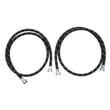
If you need new hoses, use a compatible set such as the washer fill hose set 8212545RP.
Why it matters
A washer that is kept clean, not overloaded, and protected from leaks usually avoids the most common early-life failures (odor issues, vibration wear, and water damage). That is the simplest path to getting a full 10 to 14 years from a Whirlpool top-load washer.
Last updated: January 2026
How do I find the model number on my WTW5100HW2?
Your Whirlpool washer’s model number is printed on the appliance’s model and serial tag; for WTW5100HW2, check the tag on the washer cabinet opening area (around the lid opening) before ordering parts or using troubleshooting steps in the WTW5100HW2 owner's manual.
Where to look on a Whirlpool top-load washer
We typically see the model and serial tag in one of these spots:
- Under the lid, along the top rim of the cabinet near the tub opening
- On the underside of the lid
- On the rear panel of the washer cabinet
- Inside the cabinet opening near a corner (visible with the lid open)
How to read the tag (and why it matters)
The tag usually lists both a model number and a serial number. Use the model number to match diagrams and ensure parts fit your exact configuration.
Why it matters
- Ensures the correct fit for parts like a lid lock, drain pump, or water inlet valve
- Helps avoid ordering the wrong revision of a control or harness
- Speeds up troubleshooting when you reference cycle and care information
Quick checklist before you order parts
- Write the model number exactly as shown (letters and numbers)
- Confirm the full model is WTW5100HW2 (not a similar WTW5100 series model)
- Keep the serial number handy for reference
Common mix-ups
| What you see | What it is | What to do |
|---|---|---|
| Model number | Identifies the washer design | Use this to select parts |
| Serial number | Identifies your specific unit | Keep for records |
| Series name (marketing) | Not a parts identifier | Do not use for ordering |
If the tag is worn or hard to read, gently clean it with a damp cloth and good lighting; avoid abrasive cleaners that can remove the print.
Last updated: March 2026