Installation guide
 Owner’s manual
 Error Codes


Is 4.5 cu ft a large capacity washer?
Yes. A 4.5 cu. ft. washer is considered large capacity; it typically handles bulky loads like a king comforter or roughly 2 to 3+ laundry baskets in one cycle. For your Kenmore 41741042000, use the cycle and load guidance in the owner's manual to avoid overloading.
What “large capacity” means in real laundry terms
Most 4.5+ cu. ft. washers are designed to wash bigger, fewer loads. In day-to-day use, that usually means:
- 11 to 21 bath towels in one load (depending on towel thickness)
- A king-size comforter (often best on a bulky/bedding cycle)
- A full family mixed load without packing the drum tight
- Fewer loads per week compared to smaller-capacity machines
How to load a front-load washer correctly (so it cleans well)
Even with a large-capacity drum, overloading reduces tumbling action and can cause poor rinsing.
- Load items loosely; do not compress laundry to “make it fit”
- Keep the top of the load below the top of the drum
- Mix large and small items to balance the load
- Use HE detergent and measure carefully to prevent oversudsing
- If the washer shakes or struggles to spin, reduce the load size
Quick capacity guide
| Washer capacity | Typical fit | Best for |
|---|---|---|
| 3.5 to 4.4 cu. ft. | Medium to large loads | Everyday loads, queen bedding |
| 4.5 to 5.0+ cu. ft. | Large to extra-large loads | King bedding, towels, fewer weekly loads |
Why it matters
Choosing the right load size helps your Kenmore 41741042000 wash better, rinse cleaner, and spin out more water. It also reduces vibration and wear on components like the suspension and door lock system.
Last updated: February 2026
How to read Kenmore model numbers?
Kenmore model numbers are structured so the first 3 digits identify the manufacturer behind the Kenmore brand, and the remaining digits narrow down the exact product design and feature set. For your Kenmore washer model 41741042000, the 417 prefix is the key identifier to start with; confirm the full number on the ID plate and use it when selecting parts.
Where to find the model number on this washer
On Kenmore 41741042000 front-load washers, the model and serial number are printed on an identification plate located at the top, inside the door opening. The owner's manual also points to this location.
How the number is typically broken down
Most Kenmore model numbers follow this pattern:
- Prefix (first 3 digits): identifies the manufacturer (example: 417)
- Core model digits: identify the base platform and major design
- Suffix/ending digits: identify variations such as color, control style, or minor revisions
Quick reference table
| Section of model number | Example from 41741042000 | What it tells you |
|---|---|---|
| Manufacturer prefix | 417 | Who built the unit for Kenmore |
| Base model digits | 41042 | Main design/platform family |
| Variation digits | 000 | Specific version/revision |
Why it matters when ordering parts
Using the complete model number helps us match parts that fit your exact door, tub, and control configuration. For example, door-related parts can vary by revision; common matches for this model include the door catch 131763256 and door strike 131763302.
Tips to avoid a wrong part match
- Copy the model number exactly as printed (all digits)
- Record the serial number too; it can help confirm production variation
- If the model tag starts with 417, use Kenmore 417-series resources for troubleshooting
- Use the model number when looking up diagrams and part lists
- Keep your purchase date recorded for your own records (as shown in the manual)
Last updated: February 2026
What is the average lifespan of a Kenmore washer?
A Kenmore washer typically lasts 10 to 15 years with normal household use. For your Kenmore 41741042000 washer, regular cleaning, correct installation, and fixing small issues early (like door lock or vibration problems) are the biggest factors in reaching the high end of that range; see the owner's manual for care and operating guidance.
What affects washer lifespan the most
- Load size and frequency: frequent oversized loads wear the drive system, tub bearings, and shocks faster.
- Installation and leveling: an unlevel washer increases vibration and stress on the suspension.
- Water quality and detergent use: too much detergent can cause residue and odors that lead to extra wear.
- Door seal and door lock condition: leaks or a door that will not latch can cause repeated cycle interruptions.
- Maintenance habits: wiping the door area and running periodic cleaning cycles reduces buildup.
Signs your washer is nearing end of life
| Symptom | What it often points to | What to do next |
|---|---|---|
| Loud banging or walking | Worn suspension or leveling issue | Check leveling; consider level shock 5304485917 if vibration persists |
| Door will not lock or stay shut | Door latch/strike wear | Inspect/replace door catch 131763256 or door strike 131763302 |
| Water leaking at the door | Door boot (bellows) damage or clamp issue | Inspect the boot; replace if torn |
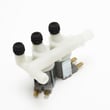
| Frequent no-fill or fill errors | Water supply restriction or inlet valve issue | Check screens/hoses; consider washer valve 134190200 |
How we recommend extending the life of a Kenmore 41741042000
- Keep the washer level and stable; re-check after moving or flooring changes.
- Use HE detergent and measure carefully to prevent oversudsing and residue.
- Leave the door slightly open between loads to help the tub dry.
- Address vibration early; worn shocks can accelerate wear on the tub and cabinet.
- If the door takes extra force to close, replace the latch parts before they damage the door area.
Why it matters
Most washer failures start as small symptoms (extra vibration, a finicky door latch, minor leaks). Correcting those early helps protect high-wear components like the suspension, tub seal, and drive system, which is the difference between a washer that lasts 8 years and one that reaches 15.
Last updated: February 2026
How to force a Kenmore 41741042000 washer to drain?
If your Kenmore 41741042000 washer is stuck full of water, we force a drain by switching to a Spin setting and running it for about 1 minute so the drain pump evacuates the tub. This matches the manual’s winterizing drain method and is the safest “forced drain” approach.
Fast ways to force a drain
- Try a Spin-only drain: Set the cycle selector knob to a spin setting, then pull out the knob to start; let it run 1 minute to drain.
- Stop and restart if needed: Push the knob in to stop, then pull it out again to restart.
- Check the drain hose setup: Make sure the hose is not kinked and is installed with a U shape at the end.
- Prevent siphoning: Keep an air gap around the drain hose; a snug fit in a standpipe can cause siphoning.
- If the door is locked: During spin, push in the knob and wait 1 to 2 minutes for the lock to release; do not force the door.
What to check if it still will not drain
A “won’t drain” problem is usually a restriction, a siphon condition, or a pump issue.
| Symptom | Most likely cause | What to do next |
|---|---|---|
| Hums but drains slowly | Partial clog or kinked hose | Straighten hose, verify U shape and air gap |
| Drains then refills or water returns | Siphoning | Reposition hose to maintain air gap |
| No drain action at all | Drain pump not running or control issue | Run Spin again; if still no drain, plan a repair |
Parts that commonly relate to draining issues
If the washer is not draining because it cannot complete the cycle safely (for example, the door is not staying latched), these model-matched parts are common suspects:
- Door catch 131763256 (helps the door stay secured during operation)
- Door strike 131763302 (mates with the latch so the lock can engage)
Why it matters
Forcing a drain the right way protects the washer from overflow and helps you avoid door damage. Proper drain hose routing (U shape plus air gap) also prevents siphoning that can mimic a drain failure.
For the exact control steps and safety notes for your washer, follow the owner's manual and the drain hose routing details in the installation guide.
Last updated: February 2026