Owner’s manual



Is a 150 PSI air compressor good for car tires?
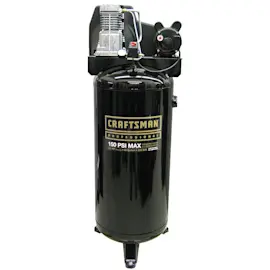
Yes. A 150 PSI air compressor is more than enough for inflating car tires because most passenger tires run far below 150 PSI; on your Craftsman 919165510, you set the outlet pressure with the regulator, so you can safely inflate tires without using the tank’s full pressure (see the 919165510 owner's manual).
What matters more than “150 PSI” for tires
For tire inflation, the key is controlled, accurate outlet pressure, not the maximum tank pressure.
- Use the regulator to set the outlet pressure to your tire’s recommended PSI
- Confirm the tire’s PSI on the door-jamb sticker (not the tire sidewall max)
- Use a tire air chuck and a reliable gauge for accuracy
- Inflate in short bursts and recheck pressure often
- Keep the compressor within its recommended duty cycle (many units are intended for about 50% duty cycle)
How to set it up on the Craftsman 919165510
The manual’s operating steps are built around letting the tank fill, then adjusting the regulator to the pressure you actually need at the hose.
- Turn the On/Auto/Off lever to AUTO and let tank pressure build until the motor stops at cut-out.
- Pull the regulator knob out.
- Turn the knob clockwise to increase outlet pressure until you reach your target.
- Push the knob in to lock.
Quick reference: tank pressure vs. outlet pressure
| Item | What it is | Why it matters for tires |
|---|---|---|
| Tank pressure | Stored air in the tank (can be high) | Helps deliver airflow; not what you set for the tire |
| Regulated outlet pressure | Pressure delivered to the hose/tool | This is what you match to the tire’s recommended PSI |
Safety checks we recommend
Too much outlet pressure can damage tools and accessories, so we always treat the regulator setting as the safety control point.
- Never set the regulator above the tire’s recommended PSI
- Check the max pressure rating on your hose, inflator, and tire chuck
- Drain moisture from the tank regularly to reduce internal corrosion
Why it matters
A “150 PSI” rating gives you headroom, but safe tire inflation depends on using the regulator correctly and staying within accessory pressure ratings. For parts and accessories for your Craftsman 919165510, start with the model’s parts list, or search by model on Sears PartsDirect.
Last updated: February 2026
What does 4.0 scfm at 90 PSI mean?
“4.0 SCFM at 90 PSI” means the air compressor can deliver 4 standard cubic feet of air per minute while maintaining 90 PSI at the outlet. For the Craftsman 919165510 specifically, the rated output is 6.4 SCFM at 90 PSIG, which is the airflow you can expect for tool sizing and run-time planning (see the 919165510 owner's manual).
How to use SCFM @ 90 PSI when choosing tools
We use SCFM at a stated pressure to match the compressor to the air demand of a nailer, impact wrench, spray gun, or blow gun.
- Find your tool’s required SCFM at 90 PSI (or at its stated operating PSI)
- Compare it to the compressor’s SCFM @ 90 PSIG rating
- If the tool requires more SCFM than the compressor can supply, the compressor will run continuously and pressure will drop
- If the tool requires less SCFM, the compressor cycles normally and maintains steadier pressure
- Always compare ratings at the same pressure, not SCFM at 40 PSI vs 90 PSI
What “standard” means (why it’s called SCFM)
SCFM is airflow measured under standardized conditions so you can compare compressors more fairly. CFM without the “S” can vary based on temperature, altitude, and test method.
Craftsman 919165510 quick spec snapshot
| Spec | What it tells you | Value for model 919165510 |
|---|---|---|
| SCFM @ 40 PSIG | Higher-flow, lower-pressure capability | 8.6 |
| SCFM @ 90 PSIG | Tool-use airflow at common shop pressure | 6.4 |
| Approx. cut-in | When the motor restarts | 120 PSI |
| Approx. cut-out | When the motor stops | 150 PSI |
Why it matters
Most air tools are rated around 90 PSI. Using the SCFM @ 90 PSI number helps us predict whether the compressor can keep up under load, avoid excessive pressure drop, and reduce overheating from nonstop running.
Related DIY help
- If the compressor struggles to keep up, use air compressor won't build tank pressure to pinpoint common causes like air leaks, restricted intake, or valve issues.
You can also look up diagrams and replacement items by model number on the parts list for this unit, or search more broadly on Sears PartsDirect.
Last updated: February 2026
What is the average lifespan of an air compressor?
Most homeowner-grade air compressors like the Craftsman 919165510 typically last 10 years with normal use and routine maintenance; heavy use, heat, moisture, and running beyond the recommended duty cycle shortens life. Following the maintenance schedule in the 919165510 owner's manual keeps performance up and wear down.
Typical lifespan by compressor type
Lifespan depends heavily on design and how hard the compressor works.
| Compressor type | Typical lifespan | Best fit for |
|---|---|---|
| Small portable (DIY) | 10 years | Inflation, brad nailers, light air tools |
| Mid-size shop (belt drive) | 15 years | Frequent tool use, larger tanks |
| Industrial rotary screw | 20 years | Continuous production air |
What extends (or shortens) lifespan on the 919165510
These are the biggest factors we see affecting service life.
- Stay under a 50% duty cycle (maximum about 30 minutes of pumping per hour) to prevent overheating and premature wear.
- Drain the tank regularly to reduce internal corrosion and water carryover.
- Check the safety valve on schedule so the tank is protected from over-pressurization.
- Keep the air filter clean; restricted airflow makes the pump run hotter and longer.
- Fix air leaks quickly; leaks force longer run time and shorten motor and pump life.
Maintenance schedule that matters most
The manual’s routine schedule is designed to maximize efficiency and longevity.
- Before each use: quick visual inspection, listen for leaks
- Daily or after each use: drain tank
- Regular intervals: check safety valve, service air filter (more often in dusty or humid areas)
Why it matters
Air compressor life is mostly about run time and moisture. When the unit runs too long (undersized tool demand, leaks, clogged filter) or stores water in the tank, wear and corrosion accelerate. Keeping run time reasonable and the tank dry is the fastest way to get the full 10-year lifespan.
If you need to look up maintenance steps, troubleshooting, or repair part diagrams for this model, use the 919165510 owner's manual. For broader part searches by model number, use Sears PartsDirect.
Last updated: February 2026