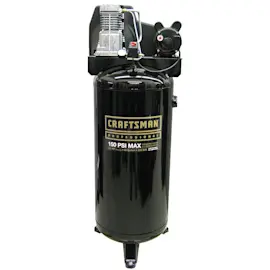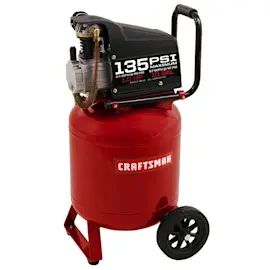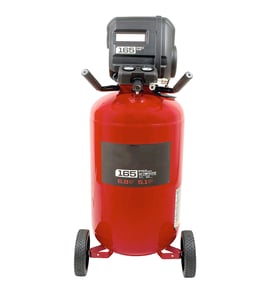

How do I find my compressor model number?
Your Craftsman air compressor model number is printed on the unit’s identification label (data plate). On model 919176450, check the air tank and the frame areas first; the label typically lists both the model number and serial number.
Where to look on a Craftsman air compressor
Check these common label locations (look for a sticker or metal plate):
- Air tank: front, side, or near the bottom seam
- Frame or base rail near the wheels/feet
- Pump housing or shroud area (near the motor/pump assembly)
- Control panel area near the pressure switch and gauges
- Handle area (especially on portable units)
If the label is dirty or painted over, wipe it with a damp rag and mild cleaner so the numbers are readable.
What the model number looks like
Craftsman air compressor model numbers are usually a series of digits (often 9 digits), like 919176450. The serial number is different and is used for manufacturing tracking.
| Label item | What it’s used for | Example |
|---|---|---|
| Model number | Finding the correct parts list and diagrams | 919176450 |
| Serial number | Identifying the production run | Varies |
Why it matters
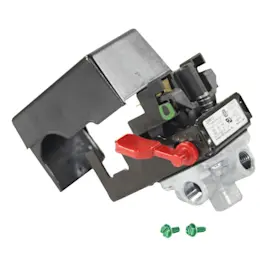
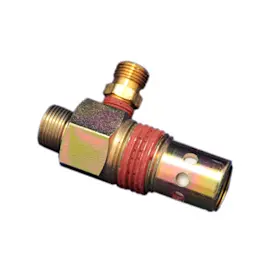
Using the exact model number helps us match the correct parts diagrams and repair information for your specific air compressor, especially for components like the pressure switch, check valve, regulator, and gauges.
If you still can’t find it
- Look for a second label on another side of the tank or under the handle
- Check the underside of the tank (use a flashlight)
- Search by the closest matching number on the label, then confirm by comparing the diagram layout
- Use our DIY troubleshooting content like air compressor common questions to identify your compressor style and typical label locations
Last updated: February 2026
Is it worth it to repair a compressor?
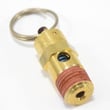
For a Craftsman air compressor model 919176450, repair is worth it when the problem is limited to common service parts (pressure switch, check valve, regulator, gauges, safety valve) and the tank and pump are in good shape. Replacement makes more sense when the tank is compromised or the pump is badly worn.
Quick decision checklist
- Repair if the compressor still builds pressure, but has a control issue (won’t start, won’t shut off, won’t regulate output).
- Repair if the issue is a leak at fittings, drain valve, regulator, or unloader line.
- Repair if the motor runs but performance is down due to a valve or gasket issue.
- Replace if the air tank shows heavy rust, pitting, or any sign of structural damage.
- Replace if the pump has severe scoring, broken reed valves repeatedly, or low compression after a rebuild.
- Replace if repair cost approaches about half the price of a comparable new unit.
Typical repair vs. replace scenarios
| What you’re seeing | Most likely area | Usually worth repairing? |
|---|---|---|
| Won’t start, hums or trips breaker | pressure switch, capacitor, unloader/check valve | Yes |
| Runs but won’t build tank pressure | pump valves, head gasket, intake filter | Often |
| Tank pressure builds but outlet pressure won’t adjust | regulator | Yes |
| Gauge reads wrong or sticks | tank or regulator gauge | Yes |
| Safety valve pops early | pressure switch setting, safety valve | Often |
| Tank won’t hold air and leak is from tank body | tank | No |
Why it matters
A failing control part can mimic a “bad compressor” and is usually a straightforward fix. A compromised tank or severely worn pump can turn into repeat downtime and higher total cost, so replacement is the practical choice.
What we recommend for model 919176450
- Confirm the symptom first (no-start, no-pressure, leaks, can’t regulate).
- Use a symptom guide to narrow the likely parts and tests before buying anything.
- If you’re considering a pump rebuild, compare parts cost and time to the value of the compressor.
Helpful DIY guides:
- Air compressor won't start
- Air compressor won't build tank pressure
- Air compressor air leaks
- How to rebuild an air compressor pump
Last updated: February 2026
What company makes Craftsman air compressors?
Craftsman air compressors (including model 919176450) have been made by multiple manufacturers over the years; Craftsman is the brand name, and the actual maker varies by model and production era. The most reliable way to identify the maker for a specific unit is to use the model and data plate details, then match that to the correct parts and repair information.
Who actually manufactures Craftsman air compressors?
Craftsman has historically sourced air compressors from different OEMs (original equipment manufacturers). Depending on the time period, common OEMs have included:
- DeVilbiss Air Power (many older Craftsman compressor lines)
- Campbell Hausfeld (some older units)
- Other contract manufacturers used for specific model families and years
Because OEM sourcing changes, two Craftsman compressors can look similar but use different pumps, pressure switches, regulators, or check valves.
How to identify the maker for your specific compressor
Use these checks on your Craftsman 919176450:
- Read the data plate on the tank or frame (often lists a manufacturer name, code, or location)
- Record the full model number and any type/code numbers printed near it
- Compare the pump and control layout (pressure switch style, regulator style, gauge placement)
- Use symptom-based troubleshooting to narrow down which system is failing (start circuit, pressure control, air delivery)
If you are diagnosing a problem rather than identifying the OEM, start with air compressor common questions to confirm what each control does and what “normal” operation looks like.
Quick guide: brand vs. manufacturer
| Item on the compressor | What it tells you | Why it matters |
|---|---|---|
| “Craftsman” name | Brand | Helps you find the correct model page and parts diagrams |
| Model number (919176450) | Model identity | Best key for matching parts and repair steps |
| Data plate maker/code | Actual OEM | Helps confirm compatible pump and control components |
Why it matters
The manufacturer affects which parts fit and which repair steps apply. For example, a no-start issue can involve the pressure switch, check valve, unloader valve, or motor circuit; the exact design varies by OEM and model family. For targeted troubleshooting, use air compressor won't start.
Last updated: February 2026
What is the most common cause of air compressor failure?
The most common cause of failure on a Craftsman air compressor like model 919176450 is poor maintenance that leads to heat and wear: restricted airflow (dirty intake/filter area), moisture left in the tank, and leaks that force the pump to run longer and overheat.
Most common failure patterns we see
- Overheating from restricted airflow (dust buildup around the pump/motor, blocked cooling fins, poor ventilation)
- Running too long because of air leaks (fittings, hose coupler, regulator, drain valve)
- Moisture corrosion from not draining the tank regularly
- Pressure switch or check valve problems that cause hard starting and repeated cycling
- Worn pump components (valves, piston seal, cylinder) after extended run time or overheating
Quick checks that prevent the big failures
- Listen and look while it runs: hissing indicates a leak; slow build indicates pump wear.
- Confirm it stops at cut-out pressure: if it never shuts off, it overheats and wears out faster.
- Drain the tank after use: moisture left inside shortens tank life and can clog valves.
- Keep the pump and motor clean: blow off dust; keep vents clear.
Leak check cheat sheet
| What you notice | Likely cause | What to do next |
|---|---|---|
| Constant hiss at fittings | Loose fitting or bad seal | Tighten, reseal, re-test |
| Air leaks from unloader area after shutoff | Check valve leaking | Inspect/replace check valve |
| Tank pressure drops sitting overnight | Leak in tank, drain, or plumbing | Soap-test all joints |
Why it matters
Heat and moisture are the two biggest enemies of an air compressor. Leaks and restricted airflow make the unit run hotter and longer; moisture causes internal corrosion. Fixing small issues early prevents pump damage and nuisance no-start problems.
Helpful DIY guides
- Use our troubleshooting steps for air compressor air leaks to pinpoint where pressure is escaping.
- If the unit struggles to build pressure, follow air compressor won't build tank pressure to narrow it to leaks vs. pump wear.
- For deeper pump wear issues, see how to rebuild an air compressor pump.
Last updated: February 2026