Installation guide
 Owner’s manual
 Error Codes



Can the bottom freezer drawer be removed?
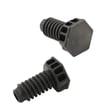
Yes. On the Frigidaire LFHG2251TF6 bottom-mount refrigerator, the bottom freezer drawer can be removed by taking out the four hex-head drawer screws and lifting the drawer up off the slide hooks. Use caution because the drawer is heavy; see the LFHG2251TF6 installation guide for the illustrated steps.
- Pull the freezer drawer open far enough to access the slide areas.
- Remove the 4 hex-head drawer screws (2 on each side).
- Lift the drawer straight up to disengage it from the slide hooks, then lift it away from the unit.
Tips we recommend:
- Empty the drawer and baskets first to reduce weight.
- Support both sides evenly while lifting so the rails do not twist.
- Do not loosen or remove any other screws on the slide assemblies.
- Keep the screws together so reinstallation is faster.
- Extend the freezer slides fully.
- Align the support pin with the hooks at the ends of the slides.
- Lower the drawer onto the slides.
- Reinstall and tighten the 4 hex-head screws.
| Item | Why you need it |
|---|---|
| Hex-head driver or socket | Removes and reinstalls the 4 drawer screws |
| Work gloves | Improves grip and helps protect hands |
| Helper (recommended) | Makes lifting safer and prevents rail damage |
Removing the freezer drawer on LFHG2251TF6 is often necessary to move the refrigerator through narrow doorways, clean the slide rails, or access lower components without stressing the door seals and drawer alignment.
Last updated: January 2026
What is the bottom part of a refrigerator called?
On the Frigidaire LFHG2251TF6 bottom-mount refrigerator, the “bottom part” is most often the toe grille (the vented kickplate at the lower front). Behind and below that area are key cooling-system components like the compressor and condenser area; inside, the lowest section is the freezer drawer and baskets. See the LFHG2251TF6 use & care manual for the labeled “features at a glance.”
Depending on what you mean (outside vs. inside), you may hear these terms:
- Toe grille / kickplate: the vented panel at the lower front (helps airflow)
- Machine compartment: the lower rear area where the compressor and condenser fan run
- Freezer drawer: the bottom storage drawer on a bottom-mount design
- Freezer baskets: bins inside the freezer drawer
- Crisper drawer: the lowest produce drawers in the fresh-food section (above the freezer)
| If you mean… | It’s usually called… | Where it is |
|---|---|---|
| Vented panel at the very bottom front | Toe grille (kickplate) | Outside, lower front |
| Cooling parts area | Machine compartment | Outside, lower rear |
| Bottom storage section | Freezer drawer | Inside, bottom |
| Produce drawers | Crisper drawer(s) | Inside, fresh-food section |
Knowing the right name helps you find the correct diagram, instructions, or replacement part. For example, airflow through the toe grille area is important for normal cooling performance, and the freezer drawer area is where you would look for basket and rail components.
- For labeled component locations and feature names, use the LFHG2251TF6 use & care manual.
- If you are dealing with airflow or access at the lower front, the toe grille itself is a replaceable part on some configurations (example: ikea refrigerator toe grille 242054804).
Last updated: January 2026
Do I need to empty the refrigerator drain pan?
For the Frigidaire LFHG2251TF6 bottom-mount refrigerator, you typically do not need to empty the drain pan. During normal defrost operation, water drains into the pan near the compressor and evaporates from condenser heat. Check it only if you have leaks, odors, or overflow.
We recommend inspecting the drain pan if you notice any of the following:
- Water puddles under or behind the refrigerator
- Sour or musty odors that seem to come from the lower rear area
- Recent freezer defrosting, power outage, or door left open causing heavy meltwater
- A clogged defrost drain (water collecting inside the fresh food section or freezer)
- Pet hair or dust buildup around the toe grille and condenser area
For model-specific safety and access guidance, follow the steps in the LFHG2251TF6 use & care manual.
- Do unplug the refrigerator before reaching near the compressor area.
- Do clean the pan with warm water and mild detergent if it smells.
- Do not remove the pan unless your design allows it; many pans are not meant for routine removal.
- Do not ignore repeated overflow; it usually points to a drain or door-seal issue.
If you are seeing water or odors, these checks usually solve it:
| Symptom | Most likely cause | What we do next |
|---|---|---|
| Water on floor | Defrost drain restricted | Clear the drain path and flush with warm water |
| Bad smell | Spills or debris in pan | Clean pan and surrounding area |
| Excess condensation | Door not sealing | Inspect gaskets and door alignment |
If you suspect a door seal problem, a worn gasket can let humid air in and create extra condensation. For this model, see the Frigidaire refrigerator freezer door gasket (gray) 5304537408 if your freezer gasket is torn or not sealing.
A drain pan that is constantly full is usually a symptom, not the root problem. Catching a clogged drain or poor door seal early helps prevent water damage, odors, and temperature swings that can affect food storage.
Last updated: January 2026
What is the most common problem with Frigidaire refrigerators?
For the Frigidaire LFHG2251TF6 bottom-mount refrigerator, the most common customer-reported issues we see are cooling performance problems (warm fresh-food section, freezer frost buildup) and ice maker or water dispenser troubles. Many of these start with airflow restrictions, dirty condenser coils, or water supply and filter issues; see the LFHG2251TF6 use & care manual.
- Refrigerator warm, freezer OK: restricted airflow, evaporator fan issue, or a control/sensor problem
- Freezer frost buildup: door not sealing, door left ajar, or a defrost system issue
- Ice maker not making ice: water supply off/low pressure, clogged filter, or inlet valve problem
- Slow water dispensing: clogged filter, air in the line, or low household water pressure
- Temperature alarms or “high temp” warnings: door ajar, recent power interruption, or cooling system struggling
Start with the items that fix the highest percentage of “not cooling” and “no ice” complaints:
- Confirm fresh food is set near 37°F and freezer near 0°F (recommended settings)
- Make sure air vents inside are not blocked by food packages
- Clean dust from the condenser area and verify the unit has proper clearance
- Check door gaskets for gaps, tears, or areas not sealing
- If you have an ice maker/dispenser, confirm water supply pressure is adequate and the line is not kinked
If troubleshooting points to a specific component, these are common “fix” parts for this model family:
| Problem area | Part to consider | What it affects |
|---|---|---|
| Water/ice issues | Frigidaire refrigerator water filter and filter cap EPTWFU01 | Low flow, bad-tasting water, small/slow ice production |
| No ice or weak fill | Frigidaire refrigerator water inlet valve assembly 242252702 | Water entering the ice maker and dispenser |
| Frost or warm temps | Frigidaire refrigerator freezer door gasket (gray) 5304537408 | Air leaks that cause frost and poor cooling |
Cooling and ice maker complaints often share the same root causes: restricted airflow, poor heat removal at the condenser, or restricted water flow. Fixing the simple causes first can prevent food spoilage, reduce frost buildup, and help the refrigerator run more efficiently.
Last updated: January 2026