Owner’s manual
 Error Codes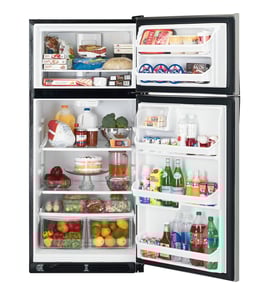




What are the disadvantages of a top mount fridge?
A top-mount refrigerator like the GE GTL17JBWARBS puts the freezer on top and the fresh-food section below; the main disadvantages are more bending to reach everyday items, fewer convenience features on many models, and less flexible organization compared with bottom-freezer designs. For model-specific features and storage setup, use the owner's manual.
Common drawbacks you may notice
- More bending and reaching: fresh-food items are lower, so you bend more often.
- Less “eye-level” fresh-food access: the most-used compartment is not at chest height.
- Fewer built-in convenience options on many top-mounts: external ice and water dispensers are less common.
- Tighter organization in the freezer: top freezers often rely on shelves and baskets rather than pull-out drawers.
- Smaller door bins and shelf adjustability on some models: storage can feel less customizable.
Quick comparison: top-mount vs bottom-freezer
| Feature | Top-mount freezer | Bottom-freezer |
|---|---|---|
| Fresh-food access | Lower; more bending | Higher; easier daily access |
| Freezer access | Easy to reach | Lower; more bending |
| Organization style | Shelves, bins | Pull-out drawers common |
| Dispenser options | Less common | More common on many models |
Why it matters
Layout affects daily comfort and food visibility. If you open the refrigerator section frequently, a top-mount design can feel less convenient over time, even though it can be a solid, straightforward style for reliable cooling.
Tips to make a top-mount easier to live with
- Keep everyday items on the upper refrigerator shelves to reduce bending.
- Use clear bins to group snacks, deli items, and condiments.
- Avoid overpacking; airflow helps temperatures stay steady.
- Minimize long door openings (it helps reduce moisture and temperature swings).
- If doors do not close smoothly, check hinge alignment and leveling guidance in the owner's manual.
Last updated: February 2026
What is the most common problem with a GE refrigerator?
The most common GE refrigerator complaint is not cooling well, and on the GE GTL17JBWARBS top-mount refrigerator it is often tied to airflow restrictions, frequent door openings, or normal defrost-cycle behavior (cooling pauses for about 30 minutes during defrost). For model-specific checks and settings, use the owner's manual.
Most common symptoms we see (and what they usually point to)
- Refrigerator or freezer too warm: temperature control not set cold enough, door left open, package blocking an air duct
- Runs a lot: normal after plugging in, after loading warm groceries, during hot weather, or with frequent door openings
- Gurgling sound when closing the door: normal pressure equalization
- Water under the unit: defrost water melting and draining to the pan is normal; persistent leaking needs inspection
- Light not working: bulb failure is common
Quick checks for “not cooling” on GTL17JBWARBS
- Confirm the unit is fully plugged in and the breaker is not tripped.
- Make sure the temperature control dial is not set to 0 (off).
- Wait about 30 minutes if the refrigerator is in a defrost cycle.
- Check for food packages holding the door open.
- Make sure nothing is blocking the freezer air duct (airflow to fresh food depends on it).
- Clean the grille and condenser area; dirty coils can increase run time and reduce cooling.
Common causes and what to do (at a glance)
| Symptom | Most likely cause | What we do first |
|---|---|---|
| Fresh food too warm | Door left open or control not cold enough | Close door fully; adjust control 1 step colder |
| Freezer too warm | Air duct blocked by packages | Clear airflow paths in freezer |
| Runs constantly | Hot weather, frequent openings, dirty condenser | Reduce openings; clean condenser/grille |
| No interior light | Burned-out bulb | Replace with GE appliance light bulb, 40-watt 40A15 |
Why it matters
Cooling problems are usually simple (settings, doors, airflow, cleaning). Fixing those first prevents unnecessary parts replacement and helps the compressor and fans run normally.
Last updated: February 2026
Are top mount or bottom mount fridges better?
A top-mount refrigerator like the GE GTL17JBWARBS is usually the better pick for value, simpler design, and easier freezer access; a bottom-mount is usually better for fresh-food convenience because the refrigerator section sits at eye level. The “better” choice depends on how you use the freezer versus the fridge.
Quick comparison: top mount vs bottom mount
- Top mount (freezer on top): typically lower purchase cost and fewer complex parts
- Bottom mount (freezer on bottom): easier access to fresh food, often better organization for the refrigerator section
- If you use the freezer daily: top mount keeps frozen items higher and easier to reach
- If you cook from fresh ingredients often: bottom mount reduces bending for fridge items
- If you want simpler maintenance: top mount designs are often more straightforward
| Feature | Top mount (like GTL17JBWARBS) | Bottom mount |
|---|---|---|
| Fresh-food access | Lower (more bending) | Higher (less bending) |
| Freezer access | Higher (easier reach) | Lower (more bending) |
| Typical cost | Lower | Higher |
| Complexity | Often simpler | Often more features |
What matters most for day-to-day use
Choose a top-mount if you prioritize
- Lower upfront cost
- Straightforward layout
- Frequent freezer use
- Easier door closing and leveling adjustments (important for sealing and temps)
Choose a bottom-mount if you prioritize
- Less bending for refrigerator shelves and drawers
- Fresh-food organization and visibility
- Wider refrigerator section access (varies by model)
Why it matters (performance and operating cost)
“Better” is really about habits. Door openings, room temperature, and how well the doors seal all affect temperature stability and energy use. Proper clearances and leveling also help airflow and door sealing, which supports consistent cooling in either style.
For model-specific use and care details (shelves, drawers, clearances, and leveling guidance), use the owner's manual.
Last updated: February 2026
What is the life expectancy of a top freezer refrigerator?
A top-freezer (top-mount) refrigerator typically lasts 10 to 15 years. With steady maintenance and good airflow around the cabinet, many units reach the upper end of that range because the design is simpler than many newer, feature-heavy refrigerators. For model GTL17JBWARBS, follow the care and safety guidance in the owner's manual.
Typical lifespan and what affects it
Most top-freezer refrigerators land in the same general window, but these factors move the needle:
- Condenser cleanliness (dust buildup makes the compressor work harder)
- Door seal condition (air leaks cause longer run times and frost issues)
- Room temperature and ventilation (tight enclosures shorten component life)
- Usage habits (frequent door openings, overpacking, hot food loads)
- Electrical stability (proper grounded outlet, avoid extension cords when possible)
Maintenance that helps you reach 15 years
These are the highest-impact, low-effort habits for a GE top-mount refrigerator:
- Vacuum dust from the condenser area regularly
- Keep the door gaskets clean and sealing flat
- Leave space for air circulation around the refrigerator
- Set stable temps (typical targets: 37°F fresh food, 0°F freezer)
- Fix small issues early (noises, warm temps, heavy frost)
Common “wear” parts vs. “big ticket” parts
Here is a practical way to think about what usually fails first:
| Category | What you notice | Example parts for GTL17JBWARBS |
|---|---|---|
| Wear items | Dim/no light, poor sealing, rattles | GE appliance light bulb, 40-watt 40A15, refrigerator door gasket WR24X10238 |
| Airflow/defrost | Warm fridge, frost buildup, noisy fan | Refrigerator evaporator fan motor WR60X31522, refrigerator defrost heater WR51X10038 |
| Sealed system | Not cooling, long run times, clicking | Comp. repl. WR87X10224, 5sp overload WR09X10107 |
Why it matters
Knowing the typical life expectancy helps you decide whether to repair or replace. If your refrigerator is under 10 years old, repairing a fan motor, gasket, or defrost part often restores performance and extends service life.
Last updated: February 2026