Installation guide
 Owner’s manual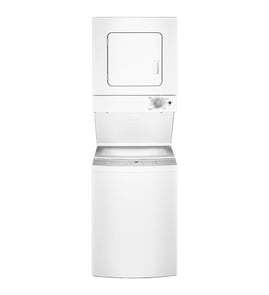



What is the downside to a stackable washer and dryer?
For a stacked laundry center like the Frigidaire FFLG1011MW2, the main downsides are smaller load capacity, tighter service access, and stricter installation requirements (especially dryer venting and gas shutoff placement). These tradeoffs come with the benefit of saving floor space.
Common downsides (what most owners notice)
- Smaller capacity than many full-size, side-by-side sets; bulky comforters and large family loads take more cycles.
- Harder access to the dryer controls and door; shorter users may need a step stool.
- More involved installation; venting must be correct and exhausted outdoors.
- Tighter repair space; servicing belts, bearings, or motors often requires more disassembly.
- More vibration sensitivity; leveling and a solid floor matter more in a tall, stacked unit.
Installation limitations that matter on this model
Your FFLG1011MW2 is a gas laundry center, so installation details can be less forgiving than a basic electric dryer setup. From the installation requirements:
- The dryer must be exhausted outdoors (not into a wall, attic, crawl space, or other concealed space).
- Avoid flexible plastic or foil venting; rigid or semi-rigid metal ducting is the standard.
- A manual gas shutoff valve needs to be installed within 6 ft of the dryer.
For the exact venting options and safety requirements, use the installation guide.
Quick comparison: stacked vs side-by-side
| Feature | Stacked laundry center (FFLG1011MW2 style) | Side-by-side set |
|---|---|---|
| Floor space | Lowest | Higher |
| Capacity | Typically smaller | Typically larger |
| Ease of use | Dryer can be harder to reach | Easier access |
| Repairs | Tighter access, more teardown | Usually easier access |
| Install sensitivity | Higher (venting, leveling) | Moderate |
Why it matters
Most “performance” complaints with stacked units trace back to space and airflow: restricted venting can increase dry times and heat stress, and tight clearances make routine cleaning and service harder. Following the venting and placement rules in the installation guide helps prevent those issues.
Last updated: February 2026
How do I get my Frigidaire washer to drain?
To get your Frigidaire FFLG1011MW2 washer to drain, first cancel the cycle and select a drain and spin option (if available), then confirm the drain hose is installed correctly so the unit can pump water out without siphoning or kinking. See the installation guide for the correct drain-hose setup.
Quick steps to force a drain
- Press Pause/Cancel (or Cancel) to stop the current cycle.
- Select Drain & Spin (or Spin Only) and start the cycle.
- If the tub is very full, wait a few minutes; the pump may need time to begin moving water.
- If the washer hums but water does not move, stop the cycle and check the drain path below.
Check the drain hose setup (most common cause)
A bad drain-hose setup can prevent draining or cause siphoning (water drains out, then flows back).
- Make sure the drain hose end is formed into a “U” hook and points toward the drain.
- Secure the hose to the standpipe or laundry tub with a tie so it cannot pop out under pump force.
- Do not crush, kink, or pinch the hose behind the unit.
- Keep the factory hose routing in place; do not remove the plastic clamp that secures the drain hose to the right side of the washer backsheet (it helps form a standpipe to prevent siphoning).
| What you see | Likely cause | What to do |
|---|---|---|
| Water stays in tub, pump sound is weak or humming | Hose kinked or drain path restricted | Straighten hose; re-seat the “U” hook; retry Drain & Spin |
| Water drains, then tub refills or gurgles | Siphoning due to improper standpipe setup | Reinstall hose with proper “U” shape; keep the plastic clamp in place |
| Unit vibrates heavily and seems to stop mid-drain | Not level, excessive movement | Level the laundry center and stabilize on all four legs |
Why it matters
Proper draining protects the washer pump and helps prevent odors, standing water, and incomplete spins. A correct standpipe and secured drain hose also prevents siphoning, which can look like a “won’t drain” problem.
Last updated: February 2026
How to get a Frigidaire stackable washer to unlock?
On the Frigidaire FFLG1011MW2 laundry center, the washer lid typically unlocks after the cycle ends and the tub stops moving. If it stays locked, cancel the cycle, wait 2 to 3 minutes for the lock to release, then unplug the unit for 1 minute and restore power to reset the control.
Quick steps to unlock the washer lid
- Press Cancel (or Pause/Cancel) to stop the cycle.
- Wait 2 to 3 minutes; the lid lock often releases on a delay.
- If the lid is still locked, unplug the laundry center for 1 minute, then plug it back in.
- Confirm the tub is fully stopped; the lock stays engaged while the washer is sensing or spinning.
- If the washer is full of water, run Drain/Spin (or a drain step) so the control can safely unlock.
If the washer will not drain (common reason the lid stays locked)
A lid can remain locked when the washer cannot pump water out. Check these items first:
- Kinked or crushed drain hose behind the unit
- Drain hose pushed too far into the standpipe (can cause siphoning)
- Clogged standpipe or slow household drain
- Coins, lint, or debris restricting the pump inlet
The installation instructions for this model also note that the drain hose is secured with a clamp to help form a standpipe and prevent siphoning; keep that hose routing intact when you pull the unit out. See the installation guide.
What to do if you need a manual release
Many Frigidaire laundry centers use a lid lock with a small mechanical release tab that can be accessed after removing the lower front access panel. Use the steps and safety notes in the owner's manual for your FFLG1011MW2 before attempting a manual release.
Why it matters
Forcing the lid open can break the lid lock or hinge and can also create a spill risk if the tub is full. Unlocking the correct way protects the lid lock switch, the control, and your flooring.
Unlocking outcomes (what you should see)
| What you do | What should happen | What it suggests if it does not |
|---|---|---|
| Cancel the cycle and wait | Lid unlocks after a short delay | Control still senses motion or water level |
| Unplug for 1 minute | Control resets; lid unlocks | Drain problem or failed lid lock mechanism |
| Run Drain/Spin | Water pumps out; lid unlocks | Pump/hose/drain restriction |
Last updated: February 2026
How long is the normal cycle on a Frigidaire washer dryer combo?
On the Frigidaire FFLG1011MW2 stacked laundry center, the Normal wash cycle typically runs about 60 to 80 minutes for the wash portion. Your actual time changes with load size and options; the most accurate cycle-time expectations are listed in the owner's manual.
What changes the Normal cycle time
Normal cycle length is designed to adjust for real-world conditions. These are the most common factors that add time:
- Larger or heavier loads (towels, denim, cotton)
- Extra rinse, higher soil level, or higher spin selections
- Low water pressure or slow fill from the faucets
- Slow draining (partial clogs, kinked drain hose)
- Out-of-balance corrections during spin
- Oversudsing from too much detergent
Typical time ranges to expect
Use these ranges to plan laundry time on a Frigidaire laundry center; your settings and conditions determine where you land.
| What you are timing | Typical range | What affects it most |
|---|---|---|
| Normal wash cycle (wash portion) | 60 to 80 minutes | Load size, options, balance corrections |
| Drain and final spin stage | 10 to 20 minutes | Balance corrections, drain flow |
| Dryer time after washing | 40 to 70 minutes | Vent restriction, load moisture, heat setting |
If the cycle suddenly takes much longer
A big change in cycle time usually points to fill, drain, or venting issues.
- Verify both hot and cold faucets are fully open
- Straighten inlet hoses and confirm screens are not clogged
- Make sure the drain hose is not kinked or shoved too far down the standpipe
- Cut detergent back to prevent oversudsing
- For long dry times, clean the vent path and confirm you are using rigid metal ducting where possible (see the venting guidance in the installation guide)
Why it matters
Knowing the expected Normal cycle time helps you spot problems early. Longer wash times often trace back to fill, drain, or balance issues; longer dry times often trace back to restricted venting, which can also overheat safety parts such as the dryer inlet thermal limiter 137032600.
Last updated: February 2026