Owner’s manual
 Error Codes



Where is the model number on a Kenmore side by side refrigerator?
On Kenmore side-by-side refrigerator model 10658214400, the model number is printed on the model and serial number label located on the inside wall of the refrigerator (fresh food) compartment. Use that label anytime you need parts, service, or manual information; it lists both the model and serial number. See the 10658214400 owner's manual for the exact label location description.
What to look for on the label
The label typically includes several fields. We recommend writing them down exactly as shown.
- Model number (for this unit: 10658214400)
- Serial number
- Purchase date (if you recorded it)
- Electrical ratings (varies by unit)
Quick steps to find it
- Open the refrigerator (fresh food) door.
- Look along the inside wall of the refrigerator compartment.
- Find the sticker or plate that says Model and Serial.
- Take a clear photo so you can zoom in later when ordering parts.
Why it matters
The model number ensures we match the correct Kenmore parts and diagrams for your exact configuration (ice maker, dispenser, door style, and internal shelving). Even small model-number differences can change which thermostat, door cam, or ice maker assembly fits.
Common uses for the model number
| What you are doing | Why the model number is needed |
|---|---|
| Ordering replacement parts | Confirms exact fit for your refrigerator |
| Looking up troubleshooting info | Matches the correct instructions and diagrams |
| Checking compatibility for ice maker or dispenser parts | Prevents ordering the wrong revision |
Last updated: February 2026
How many cubic feet is my Kenmore refrigerator by model number?
For Kenmore model 10658214400, the most accurate way to get cubic feet (total capacity) is to use the model and serial label inside the fresh food compartment and then confirm the capacity in the 10658214400 owner's manual. Model numbers in the 106 series do not reliably encode the exact cubic feet.
Fast ways to find your refrigerator’s cubic feet
We recommend using these options in this order:
- Check the model and serial label inside the refrigerator compartment (usually on an inside wall); record the full model number and serial number.
- Look up “capacity” or “specifications” in the 10658214400 owner's manual.
- Measure and estimate only if you cannot access the label or manual (useful for a rough comparison when shopping for bins, shelves, or a replacement unit).
Quick estimate method (when you need a rough number)
If you are estimating capacity, use this common approach:
- Measure the interior width, height, and depth of the refrigerator and freezer sections (in inches).
- Multiply to get cubic inches.
- Convert to cubic feet by dividing by 1,728.
Typical capacity range (side-by-side refrigerators)
| Refrigerator type | Typical total capacity range |
|---|---|
| Side-by-side refrigerator | 20 to 26 cu. ft. |
Why it matters
Cubic feet helps you compare storage space across models, but it does not tell the whole story. Shelf layout, door bin size, and ice maker space can change usable room even when two refrigerators list the same capacity.
Last updated: February 2026
What causes a side-by-side refrigerator to stop cooling?
A Kenmore 10658214400 side-by-side refrigerator usually stops cooling because airflow is blocked, the temperature controls are set incorrectly (including being set to OFF), or a cooling-system component like the evaporator fan is not moving cold air between compartments. Confirm the control settings and vent airflow first using the owner's manual.
Quick checks we recommend first (no tools)
- Make sure the refrigerator control is not set to OFF.
- Check that air vents are not blocked by food packages (blocked vents prevent proper airflow and temperature control).
- Keep door openings to a minimum; frequent openings warm the compartments.
- If you just loaded a lot of warm groceries, allow several hours for temperatures to recover.
- Listen for the evaporator fan; you should typically hear air movement when the unit is running.
Most common causes and what they look like
| What you notice | Likely cause | What to do next |
|---|---|---|
| Freezer cold, fresh food warm | Blocked return vents or weak airflow | Clear vents; rearrange items for circulation |
| Both sides warm, lights on | Controls set wrong or unit needs a reset | Verify settings; for digital controls, turn OFF then ON |
| Warm temps and no air movement sound | Evaporator fan issue | Inspect fan area; consider replacing the refrigerator evaporator motor 4389144 |
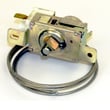
| Temps drift and never stabilize | Control/thermostat problem | Check settings; consider the refrigerator thermostat WP2198202 |
Why it matters
On side-by-side models like the Kenmore 10658214400, cold air is circulated between the freezer and refrigerator sections. When vents are blocked or the fan cannot circulate air, the controls cannot regulate temperature properly, so one or both compartments warm up.
When a part is a likely fix
If you have correct control settings and clear vents but still have poor cooling, these model-matched parts are common suspects:
- Refrigerator evaporator motor 4389144 (no airflow or fan not running)
- Refrigerator thermostat WP2198202 (temperatures not responding to control changes)
Last updated: February 2026
How to tell if a Kenmore refrigerator compressor is bad?
If your Kenmore 10658214400 side-by-side refrigerator is not cooling correctly and the compressor runs constantly, overheats, or makes abnormal noises (beyond normal operating sounds), the compressor or a sealed-system component is likely failing. Confirm airflow and defrost operation first, because those problems can mimic a bad compressor.
Quick checks before blaming the compressor
Unplug the refrigerator before removing panels or touching wiring.
- Verify the freezer is cold; weak freezer cooling usually points to a system-level problem.
- Listen for the evaporator fan; no airflow can cause warm temps even with a running compressor.
- Check for heavy frost on the freezer back wall; that often indicates a defrost failure.
- Clean dust from the condenser area; restricted heat release can cause long run times.
- Make sure doors seal and close fully; air leaks can make the unit run nonstop.
For model-specific normal sound descriptions and operating behavior, use the 10658214400 owner's manual.
What “normal” compressor noise looks like on this model
The manual notes that high-efficiency compressors and fans can run longer than older units and may produce pulsating or high-pitched sounds as they adjust for performance. That is normal when temperatures are stable and cooling is strong.
Normal vs. problem symptoms
| What you notice | Often normal | More likely a problem |
|---|---|---|
| Compressor runs a long time | After loading warm food or frequent door openings | Runs nearly nonstop and temps still rise |
| Sound | Mild hum, occasional higher pitch | Loud knocking, grinding, repeated clicking |
| Cabinet temps | Refrigerator 37 to 40°F, freezer 0 to 5°F | Refrigerator above 42°F or freezer above 10°F |
When the compressor is the likely cause
A bad compressor is most likely when:
- The compressor is running but both sections are warm.
- You hear repeated clicking (start attempt) followed by shutdown.
- The compressor is extremely hot and cooling performance is poor.
If you reach this point, the repair commonly involves sealed-system work. For compressor replacement parts tied to this model, see the refrigerator compressor W10309990.
Why it matters
Replacing a compressor is one of the highest-cost refrigerator repairs, so ruling out airflow issues (evaporator fan, frost buildup, dirty condenser) helps avoid replacing the wrong part.
Last updated: February 2026
What are the most common problems with Kenmore refrigerators?
The most common issues we see on Kenmore refrigerators like model 10658214400 are cooling problems, ice maker or dispenser failures, water leaks, unusual noise, and frost or moisture buildup. Many of these start with airflow restrictions, door sealing issues, or control settings that need adjustment (see the 10658214400 owner's manual).
Common problems and what to check first
- Not cooling or warming up: make sure air vents are not blocked, limit door openings, and allow several hours after loading groceries for temperatures to stabilize.
- Too cold or too warm: adjust the refrigerator or freezer control one setting at a time; rotary controls turn right for colder, left for warmer.
- Ice maker not working: confirm the freezer is cold enough, the ice bin is seated, and the dispenser chute is not blocked.
- Water leaking or puddles: check for a cracked reservoir, loose tubing, or a slow drip at the dispenser area.
- Noisy operation: fan-related noise is common when ice buildup or a worn fan blade interferes with airflow.
- Frost or interior moisture: reduce door openings, keep food wrapped, and keep vents clear to maintain proper air circulation.
Parts that commonly solve these symptoms (when they match your diagnosis)
If troubleshooting points to a failed component, these model-compatible parts are frequently involved:
| Symptom | Likely area | Example part on this model |
|---|---|---|
| Warm fridge or freezer, weak airflow | Evaporator airflow | Refrigerator evaporator motor 4389144 or refrigerator evaporator fan blade WP2169142 |
| Frost buildup, defrost issues | Defrost sensing | Refrigerator defrost bi-metal WPW10225581 |
| Water dispenser drips or warms | Water storage path | Refrigerator water reservoir WP2256126 or refrigerator water tube W10823511 |
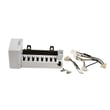
| Ice production stops | Ice maker system | Ice maker assembly - refrigerator ice maker by whirlpool 4317943 |
Why it matters
Cooling, ice, and water issues often share the same root causes: restricted airflow, frequent door openings, or a door gasket that is dirty or sticking. Fixing the basics first prevents unnecessary part replacement and helps your refrigerator hold steady temperatures.
Quick safety and care notes
- Use a sturdy glass when dispensing ice or water to help prevent cuts.
- Clean sticky door gaskets so doors close fully and temperatures stay stable.
- After any control change, give the refrigerator time to respond before adjusting again.
Last updated: February 2026