Error Codes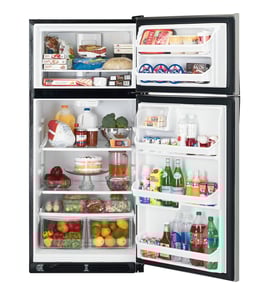

What is a top mount refrigerator?
A top-mount refrigerator is a classic refrigerator layout where the freezer compartment is on top and the fresh-food (refrigerator) compartment is below. Your Kenmore 1069730680 uses this design to keep everyday refrigerated items at easy reach while storing frozen foods above.
How a top-mount layout is set up
- Freezer on top: shelves/bins for frozen food and (often) an ice maker area
- Refrigerator below: main shelves, crisper drawers, and door bins
- Single cooling system (common): cold air is produced at the evaporator and distributed to both sections
- Separate temperature controls (varies): one control may regulate overall cooling while another adjusts airflow to the refrigerator section
Why people choose a top-mount refrigerator
Top-mount models are popular because they balance capacity, simplicity, and cost. They also tend to have fewer complex features than some French door or side-by-side designs, which can make basic maintenance and troubleshooting more straightforward.
| Feature | Top-mount refrigerator | Bottom-freezer refrigerator |
|---|---|---|
| Freezer location | Top | Bottom |
| Most-used section height | Refrigerator is mid to low | Refrigerator is higher |
| Typical design complexity | Lower | Moderate |
| Common ice maker location | Freezer compartment | Freezer compartment |
Parts that commonly relate to top-mount features
If your top-mount refrigerator has an ice maker or water supply, these parts are often involved in performance issues:
- Refrigerator ice maker 4317943 (ice production and harvesting)
- Refrigerator inlet valve WP2315576 (water supply to the ice maker)
- Refrigerator defrost bi-metal WP4387503 (helps protect the defrost system from overheating)
Why it matters
Knowing you have a top-mount design helps narrow troubleshooting. For example, ice maker problems usually trace to the freezer compartment (temperature, water fill, or ice maker components), while fresh-food warming often points to airflow from the freezer into the refrigerator section.
Last updated: January 2026
What is the upper part of a fridge called?
In a Kenmore top-mount refrigerator like model 1069730680, the upper section is typically the freezer compartment (also called the top freezer). It’s the coldest area, designed to keep foods frozen and, when equipped, to support an automatic ice maker.
What you’ll usually find in the upper (freezer) compartment
- Freezer shelves or a wire rack for frozen foods
- An ice bin or bucket (if the unit has an ice maker)
- Air vents that circulate cold air to the fresh food section
- A freezer light and door switch
- A temperature control area (varies by design)
If you mean “the upper part” on the outside
Sometimes people mean the top-front or top trim area of the cabinet or door. On this model, that can include cosmetic pieces such as an end cap or trim.
| What you’re pointing to | Common name | What it does |
|---|---|---|
| Inside the top door | Freezer compartment | Freezes food and helps cool the refrigerator section |
| Top edge/trim outside | End cap trim | Covers edges and helps finish the look |
| Inside freezer, back wall area | Air vent area | Moves cold air between freezer and refrigerator |
Why it matters
Using the right term helps you get the right repair part and instructions. For example, ice-making issues usually trace back to freezer-side components like the refrigerator ice maker 4317943 or water supply parts.
Related troubleshooting that often starts in the freezer
- Ice maker not making ice or making small cubes
- Frost buildup on the freezer back wall
- Refrigerator section warm but freezer seems cold
- Water leaking or freezing in the fill tube area
For ice maker symptoms, we also recommend reviewing common refrigerator ice maker problems and solutions.
Last updated: January 2026
How to tell cubic feet of Kenmore refrigerator by model number?
For Kenmore model 1069730680, the model number alone usually does not state the exact cubic-foot capacity. The most reliable way is to look up the model’s published specs; if you cannot find them, you can calculate a close estimate by measuring the usable interior space and converting cubic inches to cubic feet.
Fast ways to find the capacity
- Check the rating label inside the fresh food section (often on a side wall or ceiling); some units list capacity there.
- Search the model number 1069730680 in a spec listing (capacity is typically shown as “cu. ft.”).
- If you have an ice maker installed, confirm you are matching the correct refrigerator configuration when comparing specs.
- Use a measurement-based estimate (next section) when you need an answer right away.
How to estimate cubic feet by measuring
- Empty the compartment enough to measure the main open box area.
- Measure the fresh food interior: width x depth x height (in inches).
- Measure the freezer interior the same way.
- Add the two volumes and convert:
- Cubic feet = (total cubic inches) ÷ 1728
Quick conversion table
| What you have | What to do | Result |
|---|---|---|
| Inches (W x D x H) | Multiply to get cubic inches | Total in³ |
| Total in³ | Divide by 1728 | Approx. ft³ |
Why the model number is not enough
Kenmore model numbers can identify the product line and manufacturer family, but capacity can vary by cabinet design, insulation thickness, and interior features (bins, ducts, ice maker housing). Measuring gives a practical estimate of usable space.
Related parts and troubleshooting notes
If you are comparing capacities because you are adding or servicing an ice maker, these parts are commonly involved on this model:
- Refrigerator ice maker 4317943 (ice production assembly)
- Refrigerator inlet valve WP2315576 (supplies water to the ice maker)
- Tubing W10823511 (water line routing inside the cabinet)
For ice maker performance issues that can affect perceived “space” or storage needs, use common refrigerator ice maker problems and solutions.
Last updated: January 2026
What does er if mean on a Kenmore refrigerator?
On Kenmore refrigerator model 1069730680, ER IF is used on many Kenmore refrigerators to indicate an ice maker area airflow problem, most often tied to the ice room or evaporator fan not moving air because of frost/ice buildup or a fan circuit issue. Clearing the airflow restriction typically stops the code.
What to do first (safe checks)
- Reset power: unplug the refrigerator or turn off the breaker for 2 minutes, then restore power.
- Check for ice blockage: remove the ice bin and look for frost or ice around the fan cover, air ducts, and vents.
- Confirm door sealing: make sure the freezer door closes fully and the gasket is sealing all the way around.
- Verify temperatures: set the freezer to about 0°F and the fresh food section to about 37°F.
- Listen for the fan: with the freezer door switch held closed, listen for a steady fan sound.
Common symptoms and what they point to
| Symptom | What it usually means | What we do next |
|---|---|---|
| Ice maker slows or stops, freezer still cold | Air is not reaching the ice maker area | Clear vents, defrost frost buildup |
| Rattling or buzzing near the ice maker | Fan blade hitting ice | Remove ice, recheck airflow |
| Code returns after a day or two | Ongoing moisture leak or recurring frost | Inspect door gasket and venting |
| Freezer warming and no ice | Broader cooling/airflow problem | Check condenser cleanliness and airflow paths |
Parts that can be involved (when water or ice production is also affected)
If airflow is clear but ice production is still poor, we focus on the ice maker and water supply components:
- Refrigerator ice maker 4317943 (ice production assembly)
- Refrigerator inlet valve WP2315576 (controls water flow to the ice maker)
- Refrigerator door gasket 2188460A (helps prevent warm air leaks that cause frost)
Why it matters
When cold air cannot circulate to the ice maker area, the ice maker temperature rises and frost builds faster. That combination reduces ice production and can trigger repeated airflow-related error messages.
Last updated: January 2026