Owner’s manual

What size blade is a craftsman 137415020 table saw?
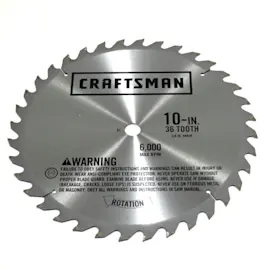
The Craftsman 137415020 is a 10-inch table saw, so it uses a 10 in. blade. For the exact blade and arbor requirements (including kerf and any dado guidance), we recommend confirming the specifications in the owner's manual.
What to match when buying a replacement blade
To fit and cut correctly on a Craftsman 137415020 table saw, match more than just diameter:
- Blade diameter: 10 in.
- Arbor hole size: match the saw’s arbor (check the manual before buying)
- Blade type: rip, crosscut, combination, or plywood/finish
- Kerf: thin-kerf vs full-kerf (thin-kerf can reduce load on the motor)
- Max RPM rating: blade rating should meet or exceed the saw’s no-load speed
Quick blade selection guide
| What you’re doing | Recommended blade style | Typical tooth count |
|---|---|---|
| Fast ripping (2x lumber) | Rip blade | 24T to 30T |
| General purpose | Combination blade | 40T to 50T |
| Smooth crosscuts | Crosscut blade | 60T to 80T |
| Plywood and veneers | Fine-finish/plywood blade | 60T to 80T |
Dado note for this model
The parts list for the Craftsman 137415020 references a dado insert plate (not included). If you plan to use a dado stack, use the correct insert and follow the setup limits and instructions in the owner's manual.
Why it matters
Using the correct 10-inch blade and the right arbor fit helps prevent vibration, burning, slow cutting, and inaccurate cuts. It also helps the blade guard and table insert fit properly for safer operation.
For step-by-step replacement and tightening tips, use our guide: how to replace a table saw blade.
Last updated: February 2026
Can you use an 8 inch blade on a 10 inch table saw?
Yes. On the Craftsman 137415020 table saw, an 8-inch blade is commonly used as an 8-inch stacked dado set for non-through cuts (dados and rabbets). Our manual specifies not to use a dado larger than 8 inches in diameter, and to use only stackable dadoes.
What’s allowed on model 137415020
- Standard blade size is 10 inches (the saw is supplied with a 10-inch blade).
- Dado sets must be stackable (stacked dado), not wobble/adjustable.
- Maximum dado diameter: 8 inches.
- Maximum dado width: 13/16 inch.
| Blade type | Typical use | Allowed on 137415020? | Key limit |
|---|---|---|---|
| 10-inch standard saw blade | Through cuts (rip, crosscut) | Yes | Match riving knife requirements |
| 8-inch stacked dado set | Non-through dado/rabbet cuts | Yes | 8-inch max diameter; 13/16-inch max width |
| Wobble/adjustable dado | Non-through cuts | No | Not permitted |
Important fit and safety checks before you cut
- Use the correct insert: dado cuts require a dado insert plate (the manual notes an insert plate is required).
- Set up for non-through cuts: remove the blade guard and anti-kickback assembly, and lower the riving knife to the non-through cut position.
- Keep the work guided: use the rip fence or the miter gauge (never both at the same time).
- Use a push stick or push block to keep hands away from the blade path.
For the step-by-step procedure and the exact non-through cut setup, follow the owner's manual.
Why it matters
An 8-inch stacked dado set is shorter than a 10-inch blade, so it changes cutting depth and requires the correct non-through cut configuration. Using the wrong dado type or exceeding the 8-inch limit increases kickback risk and can damage the saw.
Last updated: February 2026
What not to do with a table saw?
Never do freehand cuts, never stand in line with the blade, and never defeat the guard and anti-kickback safety devices on your Craftsman 137415020 table saw; these are the fastest ways to trigger kickback, lose control of the workpiece, or put your hands in the blade path. Follow the safety rules in the owner's manual.
What to avoid (the big “don’ts”)
- Don’t cut freehand; always guide the work with the rip fence or miter gauge (as intended).
- Don’t stand directly behind the blade or in the workpiece path; offset your stance.
- Don’t use the rip fence as a cut-off gauge when crosscutting.
- Don’t rip lumber that is warped, twisted, or bowed; it increases binding and kickback.
- Don’t try to “back out” of a cut with the blade running.
- Don’t try to free a stalled blade until the saw is switched OFF.
- Don’t leave the saw running unattended; wait for the blade to stop completely.
Ripping vs. crosscutting: use the right guide
Using the wrong guide is a common cause of binding and kickback.
| Cut type | Use this | Do not use this |
|---|---|---|
| Ripping (with the grain) | Rip fence (locked and parallel) | Miter gauge while ripping |
| Crosscutting (across the grain) | Miter gauge or sled | Rip fence as a cut-off gauge |
Quick pre-cut safety check
Before you start the motor, we recommend:
- Confirm the fence is locked and aligned for ripping.
- Verify the blade guard is installed and working.
- Keep hands out of the blade path; use a push stick when the cut gets narrow.
- Support long or wide boards at the rear and sides of the table.
- Wear safety glasses and keep the tabletop clear of offcuts.
Why it matters
Most table saw injuries and “bad surprises” come from kickback and loss of control. Keeping the blade sharp, the fence parallel, and the riving knife, anti-kickback pawls, and guard in place helps the workpiece track straight and reduces the chance it gets thrown back toward you.
Last updated: February 2026
Are craftsman 137415020 table saws any good?
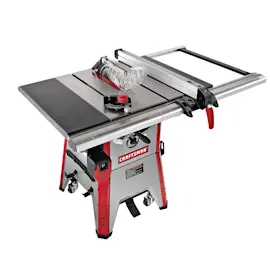
Yes; the Craftsman 137415020 is a solid 10-inch jobsite table saw for DIY and hobby use when it’s set up and maintained correctly. It’s a practical choice for basic ripping and crosscuts, but it’s not built for production-level precision like a cabinet saw.
What “good” means for this model
We judge a jobsite saw like the Craftsman 137415020 on safety, repeatable accuracy, and how well it holds adjustments.
- Good for: weekend projects, trim and sheet goods breakdown, learning table saw fundamentals
- Not ideal for: daily jobsite abuse, furniture-grade joinery without tuning, heavy hardwood ripping all day
- Big plus: it’s a common, serviceable design with a full operator’s manual and parts list in the owner's manual
How to get the best results (accuracy and cut quality)
Most “mixed reviews” come down to setup and alignment. These steps make the biggest difference:
- Verify the blade is parallel to the miter slot and fence
- Confirm the bevel and height mechanisms move smoothly and lock firmly
- Use a sharp, correct-tooth-count blade for the material
- Support long stock with outfeed support to prevent binding
- Use the guard, riving knife (if equipped), and a push stick for narrow rips
If your cuts are consistently off-angle, use our troubleshooting steps in table saw bad angle cuts.
Quick expectations checklist
| Area | What to expect on a jobsite saw | What to do if it falls short |
|---|---|---|
| Fence repeatability | Acceptable after tuning | Re-square and re-check before critical cuts |
| Cut smoothness | Depends heavily on blade | Upgrade to a quality blade and keep it clean |
| Power feel | Adequate for most DIY cuts | Slow feed rate; avoid forcing thick hardwood |
| Safety | Must be used with proper technique | Follow push stick guidance in the manual |
Why it matters
A table saw can feel “bad” when it’s simply out of alignment or using the wrong blade. Dialing in setup improves safety (less kickback risk) and makes the Craftsman 137415020 perform like it should.
Last updated: February 2026