 Installation guide
 Owner’s manual



What is the difference between a regular GE and GE profile?
GE Profile is GE’s step-up line; compared with standard GE, it typically adds more premium design, upgraded wash features, and more advanced controls or connectivity options. For your GE dishwasher model GDF570SSJ0SS, the exact feature set is listed in the GDF570SSJ0SS owner's manual.
GE Profile dishwashers commonly include more of these upgrades (varies by model and series):
- More wash options and cycle customization
- Quieter operation packages (additional insulation and sound control)
- More premium rack features and adjustability
- More advanced drying features (often paired with a stronger heating system)
- More advanced controls, indicators, or smart features on some models
Use these quick checks on the GDF570SSJ0SS:
- Look at the badge on the door or control panel: it will typically say GE or GE Profile
- Check the model number on the tub wall just inside the door
- Compare the listed cycles and options in the manual to what you see on your control panel
These are the differences customers notice most often.
| What you care about | Standard GE (typical) | GE Profile (typical) |
|---|---|---|
| Features | Core essentials | More premium options and flexibility |
| Controls | Straightforward | More advanced interface on many models |
| Noise | Varies by model | Often quieter packages |
| Price | Lower | Higher |
If you are comparing parts, troubleshooting steps, or cycle behavior, the product line (GE vs GE Profile) helps narrow down which features and control logic your dishwasher uses. For example, drying performance can depend on the heater and settings; the manual spells out what your model supports.
Last updated: January 2026
Is GE profile considered high end?
Yes. GE Profile is generally considered GE’s higher-end line; it typically adds more premium features, upgraded styling, and more advanced controls than standard GE models. Your GE dishwasher model GDF570SSJ0SS is a GE model (not GE Profile), but it still uses many of the same core dishwasher design principles.
GE Profile products are positioned above standard GE models in features and finish. In dishwashers, that often shows up as:
- More wash options and specialty cycles
- Quieter operation (lower dBA ratings on many models)
- More advanced drying features and sensors
- More premium rack features and adjustability
- More upscale exterior styling and control layouts
For model-specific feature details and cycle options on your dishwasher, use the GDF570SSJ0SS owner’s manual.
| Line | Typical positioning | What you usually get |
|---|---|---|
| GE | Mainstream | Solid core cleaning performance, fewer premium extras |
| GE Profile | Higher end | More features, quieter designs, more premium styling |
| GE Café | Premium design-forward | High-end styling focus plus premium features |
Knowing whether a dishwasher is GE or GE Profile helps set expectations for noise level, cycle options, and rack features. It also helps when you are comparing replacement parts, because control layouts and feature sets can differ by line even when the tub size looks similar.
We recommend confirming the full model number from the tub wall just inside the door, then matching it to the documentation. The GDF570SSJ0SS installation guide is also useful if you are comparing built-in fit, mounting, and insulation placement.
Last updated: January 2026
Can a clogged drain cause an FTD error?
Yes. On the GE GDF570SSJ0SS dishwasher, an FTD (fail to drain) error commonly happens when water cannot pump out because the drain path is restricted, such as a clogged air gap, disposer connection, filter area, or a kinked/blocked drain hose.
- Turn off power at the breaker before inspecting under the sink.
- If your dishwasher uses an air gap, remove the cap and clean it out.
- Run the garbage disposal (if the dishwasher drains through it) and confirm the sink drains normally.
- Inspect the drain hose for kinks, crushing, or a blockage.
- Verify the drain line routing is correct (high loop or air gap setup) per the installation guide.
A clog is the most common cause, but a drain failure can also be caused by a pump or control issue.
- Listen for the drain pump during the drain portion of the cycle.
- Check for standing water in the tub after canceling and draining.
- If the hose and air gap are clear, the drain pump may be jammed or failing.
| What you notice | Likely cause | What we do next |
|---|---|---|
| Water standing in the bottom | Air gap clogged or drain routing issue | Clean air gap; confirm high loop/air gap install |
| Humming but little or no draining | Pump impeller jam or blockage | Clear obstruction; consider pump replacement |
| No drain sound at all | Electrical/control or pump failure | Check wiring; test components |
If you confirm the drain path is clear but the unit still will not pump out, the drain pump is a common next suspect for this model.
When the dishwasher cannot drain, dirty water can remain in the tub and the cycle may stop early. Clearing the drain path (air gap, disposer connection, and hose routing) restores normal draining and helps prevent repeat FTD errors.
Last updated: January 2026
What is the most common problem with GE dishwashers?
The most common GE dishwasher problems are draining issues (water left in the tub), a no-start condition (often door-latch related), and poor cleaning from restricted water flow. On GE model GDF570SSJ0SS, we start by checking the filter area, drain path, and door latch, then move to wash components.
- Not draining: clogged filter/sump area, kinked drain hose, blocked disposal inlet, or a weak drain pump
- Won’t start: door not fully latched, latch switch not closing, control not responding, or a stuck cycle
- Not cleaning well: spray arm holes clogged, loading blocking spray, low water heating, or circulation issue
- Not drying: rinse aid empty, heater issue, or cycle selection
- Leaks or odors: food debris buildup, door seal issues, or improper loading
- Confirm the door latches firmly; a weak latch can prevent the cycle from starting.
- Check for standing water and clear obvious debris from the bottom of the tub.
- Inspect the drain hose routing for kinks and ensure the high loop/air gap setup is correct.
- Look at the lower spray arm for clogged jets or damage.
- Reset a stuck cycle by pressing and holding Start for about 3 seconds (common GE control behavior).
| Symptom | Common suspect | What it affects |
|---|---|---|
| Won’t start | Door latch | Confirms door is closed so the control will run |
| Not cleaning | Lower spray arm | Water distribution to the lower rack |
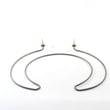
| Not drying | Heating element | Water heating and drying performance |
| Not draining | Drain hose | Water exit path to disposal or drain |
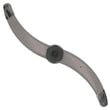
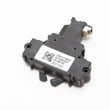
If the door feels “closed” but the dishwasher still will not run, the GE dishwasher door latch lock WD21X10490 is a common starting point. If dishes are coming out dirty and the bottom rack is worst, inspect the dishwasher spray arm, lower WD22X33499 for clogged holes or wobble.
Drain and wash problems usually start small (debris, blocked spray, poor loading) but can lead to repeat cycle failures, odors, and poor results. Following the loading and care guidance in the GDF570SSJ0SS owner’s manual helps prevent many of the most common GE dishwasher complaints.
Last updated: January 2026





