Owner’s manual
 Error Codes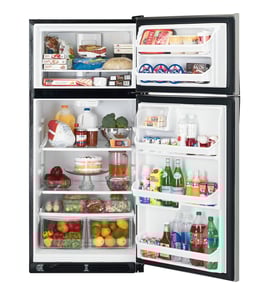

What is the most common problem with a GE refrigerator?
The most common GE refrigerator complaint is a cooling problem (fresh food too warm, freezer not cold enough, or temperatures swinging). On the GE GTS18GTHJRBB, many “cooling” calls trace back to airflow restrictions, dirty condenser coils, doors left ajar, or a fan/defrost issue rather than a control setting.
Quick checks we recommend first
- Confirm the controls are not set to OFF and adjust to a colder setting if needed.
- Make sure no package is holding a door open (this can drive long run times and warm temps).
- Allow up to 24 hours to fully cool after plugging in or after a major load of groceries.
- Listen for normal operating sounds (humm, whoosh, brief gurgle) that can be mistaken for a problem.
- Verify the refrigerator is level so doors close easily; adjust leveling legs as needed (details in the GTS18GTHJRBB owner's manual).
Most common causes and what they look like
| Symptom | Likely cause | What to do next |
|---|---|---|
| Fresh food warm, freezer OK | Weak airflow in refrigerator section | Check vents for blockage; inspect evaporator fan operation; consider refrigerator evaporator fan WR60X31522 if the fan is noisy or not running. |
| Both sections warm | Dirty condenser area, door not sealing, or sealed-system issue | Clean condenser area; check door closure and gasket seal; if still warm, schedule service. |
| Runs a lot | Door left open, warm food load, or normal cycling | Recheck door closure; wait 24 hours after changes; confirm temps stabilize. |
| Frost/ice buildup affecting cooling | Defrost system problem | Inspect for heavy frost on the evaporator cover; a failed heater is common; consider refrigerator defrost heater WR09X21107 if testing confirms it is open. |
Why it matters
Cooling issues can spoil food and also make the compressor run longer than necessary. Simple fixes (door closure, leveling, airflow, cleaning) often restore normal temperatures without replacing major parts.
Helpful related guides
Last updated: January 2026
Are top mount or bottom mount fridges better?
Top-mount (top-freezer) refrigerators like the GE GTS18GTHJRBB are usually the better pick for value and efficiency, while bottom-mount models are usually better for everyday comfort because fresh food sits at eye level. The “best” choice depends on your kitchen habits, budget, and mobility needs.
Quick comparison
| Feature | Top-mount (top-freezer) | Bottom-mount (bottom-freezer) |
|---|---|---|
| Fresh-food access | Lower; more bending | Higher; less bending |
| Freezer access | Higher; easier reach | Lower; more bending |
| Typical cost | Lower | Higher |
| Typical energy use | Often lower | Often higher |
| Repairs/complexity | Often simpler | Often more features to service |
When a top-mount is the better choice
- You want strong value and a simpler design.
- You use the freezer often and prefer it at chest level.
- You want a layout that is commonly more energy-efficient.
- You have a smaller kitchen and want a straightforward footprint.
- You prefer fewer premium features (which can mean fewer parts to troubleshoot).
For model-specific features and care tips (including cleaning and maintenance), use the GTS18GTHJRBB owner's manual.
When a bottom-mount is the better choice
- You use fresh food more than frozen food and want it at eye level.
- You want less bending for daily items like milk, produce, and leftovers.
- You prefer wider refrigerator shelves and drawers (common on many bottom-mount designs).
Why it matters
Choosing the right layout affects daily comfort, energy costs, and how often you open each compartment. If you open the refrigerator section far more than the freezer, a bottom-mount can feel more convenient; if you want lower upfront cost and solid efficiency, a top-mount is often the practical win.
Last updated: January 2026
What are the disadvantages of a top mount fridge?
Top-mount refrigerators like the GE GTS18GTHJRBB are reliable and efficient, but the main disadvantages are convenience and features: fresh-food access is lower (more bending), freezer space is at eye level (less ideal for daily use), and many models skip premium options like in-door ice and water.
Common drawbacks you may notice
- Less convenient fresh-food access: the refrigerator section is below the freezer, so you bend more for everyday items.
- Fewer organization upgrades: many top-mount designs have simpler bins and shelf layouts than newer bottom-freezer styles.
- Limited dispenser options: top-mount models often do not include external water or ice dispensing.
- Smaller freezer usability for bulky items: the top freezer can feel tighter for pizza boxes or wide containers.
- More temperature swings if overloaded: packing the freezer or blocking vents can reduce airflow to the fresh-food section.
What to check on your GTS18GTHJRBB (quick wins)
We recommend these checks because they reduce the most common “top-mount” complaints (warm fridge, uneven temps, poor organization):
- Confirm the fresh-food temperature control is set correctly (this model’s main temperature control is in the refrigerator compartment).
- Adjust the freezer airflow control so enough cold air moves down to the fresh-food section.
- Keep packages from blocking the freezer air tower/vents.
- Make sure shelves are seated on the supports so they do not tilt or slide.
- Clean dust from the condenser area periodically for better cooling efficiency.
Top-mount vs bottom-freezer (at a glance)
| Feature | Top-mount refrigerator | Bottom-freezer refrigerator |
|---|---|---|
| Fresh-food access | Lower, more bending | Higher, easier daily access |
| Typical features | Simpler, fewer add-ons | More “premium” options |
| Cost and complexity | Often lower and simpler | Often higher and more complex |
Why it matters
Most “disadvantages” come down to ergonomics and airflow. If the freezer vents are blocked or the airflow control is set poorly, a top-mount can feel inconsistent even when the sealed system is fine. For model-specific control locations and use tips, follow the GTS18GTHJRBB owner's manual.
Last updated: January 2026