 Owner’s manual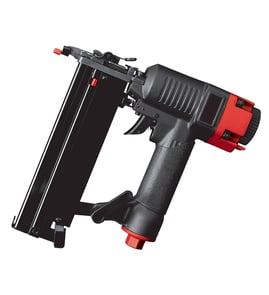

How to load a pneumatic nailer?
To load your Craftsman pneumatic nailer model 351181750, disconnect it from the air supply first, then insert the nail strip into the end-loading magazine and reset the pusher so it feeds nails forward; reconnect air only after the magazine is latched and you are ready to nail (see the 351181750 owner's manual).
Safe loading steps (model 351181750)
- Disconnect the tool from the air supply before loading.
- Keep your finger off the trigger; do not depress the contact trip while loading.
- Point the nose of the nailer away from yourself and others.
- Insert the nail strip into the slot at the end of the magazine.
- Slide the nail strip forward until it is past the nail stop.
- Depress the pusher latch, pull the pusher fully behind the nail strip, then release it so it pushes the strip to the front.
Nail and air specs to match while loading
Use the correct fasteners and air pressure so the magazine feeds smoothly and the tool cycles correctly.
| Item | What to use on 351181750 | Why it matters |
|---|---|---|
| Nail type | 16 gauge finish nails | Prevents jams and misfeeds |
| Nail length range | 3/4 in. to 2-1/2 in. | Avoids magazine and driver interference |
| Operating pressure | 60 to 100 PSI (regulated) | Reduces misfires and tool damage |
| Air safety limit | Never exceed 200 PSI | Prevents unsafe over-pressurizing |
Quick checks if nails will not feed after loading
- Confirm the nail strip is fully past the nail stop.
- Make sure the pusher is pulled completely behind the strip before releasing.
- Verify you are using clean, dry, regulated air in the rated range.
- Inspect the magazine for bent nails or debris; clear any jam with the tool disconnected.
Why it matters
Loading with the air hose connected or with the contact trip depressed can cause an accidental cycle. Loading correctly also keeps the pusher tension even, which helps prevent double-feeds, jams, and inconsistent depth of drive.
If you need to look up diagrams or search for replacement items by model number, start with the model parts list and then use Sears PartsDirect for broader parts searches.
Last updated: February 2026
What pressure for a trim nail gun?
For the Craftsman power nailer model 351181750, set your regulated air supply to 60 to 100 PSI for trim and finish work. Start near 70 to 90 PSI, then fine-tune using the depth-of-drive adjustment so nails sit flush without overdriving.
Recommended PSI settings for trim work
Use the lowest pressure that consistently drives the fastener to the depth you want.
- Start point: 70 to 90 PSI for most interior trim
- Increase PSI if nails stand proud or the tool “skips”
- Decrease PSI if nails overdrive, dent trim, or the tool feels harsh
- Use clean, dry, regulated air in the tool’s rated range
- Never connect to a supply that could exceed 200 PSI
Quick setup checklist (best results)
- Set the compressor regulator to about 80 PSI
- Load the correct 16-gauge finish nails (the manual lists 3/4 inch to 2-1/2 inch lengths)
- Test-fire into scrap of the same wood species and thickness
- Adjust depth of drive first; adjust PSI second
- Keep hands clear of the discharge area; disconnect air before clearing jams or adjusting
PSI vs. results (what you will see)
| Air pressure (PSI) | Typical result on trim | What to do |
|---|---|---|
| 60 to 70 | Light drive, may leave nail heads high | Increase PSI slightly or reduce depth setting |
| 70 to 90 | Best balance for most trim | Fine-tune depth-of-drive |
| 90 to 100 | Strong drive, higher risk of overdrive | Lower PSI if you dent wood or sink nails too deep |
Why it matters
Correct air pressure protects your trim and your nailer. Running too low causes inconsistent driving and jams; running too high increases wear on seals and can overdrive fasteners, especially in softwoods.
For model-specific operating pressure, air supply guidance, and safety steps, use the 351181750 owner's manual. If you need to look up additional parts or diagrams by model number, search on Sears PartsDirect.
Last updated: February 2026
What is the best finish nailer on the market?
The “best” finish nailer depends on how you work (pneumatic vs. cordless), what nail gauge you need, and how often you’ll use it. For trim and cabinetry, the Craftsman 351181750 is a solid pneumatic 16-gauge finish nailer that drives 3/4-inch to 2-1/2-inch nails at 60 to 100 PSI; use our owner's manual to match nails, air pressure, and operating mode to your job.
How to choose the best finish nailer for your projects
A finish nailer is usually the right pick when you want strong holding power with smaller holes than framing nails.
- Gauge: 15-gauge holds harder (bigger hole); 16-gauge balances strength and hole size; 18-gauge is lighter-duty for smaller trim
- Power source: pneumatic (lighter tool, needs compressor) vs. cordless (fast setup, heavier tool)
- Nail length range: make sure it covers your trim thickness and backing material
- Depth-of-drive control: helps prevent proud nails or blow-through
- Jam access: quick-release nose makes clearing fasteners easier
Where the Craftsman 351181750 fits in the “best” category
This model is built for finish work and repeatable results: it supports single and rapid-fire operation, has adjustable depth of drive, and includes a safety contact trip that must be pressed to fire.
| Feature | Craftsman 351181750 (pneumatic) | Typical cordless finish nailer |
|---|---|---|
| Nail gauge | 16-gauge | 15-, 16-, or 18-gauge |
| Nail length | 3/4 in. to 2-1/2 in. | Varies by platform |
| Air/Power | 60 to 100 PSI compressed air | Battery + motor |
| Best for | Shop or jobsite with compressor | Punch-list work, quick setups |
Quick buying checklist (what to compare across brands)
- Nail gauge and angle (straight vs. angled magazine)
- Nail availability and cost in your area
- Tool balance and nose visibility for precise placement
- Depth adjustment style (tool-free is faster)
- Serviceability (seals, O-rings, driver/piston parts)
Why it matters
Choosing the right gauge and power type reduces split trim, minimizes filling, and improves holding strength. Matching the tool to your workflow also prevents misfires, jams, and inconsistent depth.
For parts and accessories, start with the parts list for model 351181750; for broader searching by model number, use Sears PartsDirect.
Last updated: February 2026
How do electric brad nailers work?
An electric brad nailer uses an electric motor and internal drive mechanism to push a brad out of the magazine, through the nose, and into the workpiece; the driver then resets so the next brad can feed into position. For Craftsman model 351181750, the manual also highlights a contact-trip safety that must be pressed to fire (see the 351181750 owner's manual).
What happens during a shot (step by step)
Most brad and finish nailers follow the same basic cycle:
- Fasteners feed: a spring-loaded pusher keeps the brad strip tight in the magazine.
- Safety engages: the tool won’t fire until the contact trip is pressed against the workpiece.
- Trigger fires: pulling the trigger releases the driver to push the brad through the nose.
- Driver resets: the internal mechanism returns the driver so the next brad can advance.
- Depth control fine-tunes: many nailers (including this Craftsman finish nailer) use an adjustable depth-of-drive control to set how flush the nail sits.
Key parts involved
| Part or feature | What it does | What you notice when it’s off |
|---|---|---|
| Magazine and pusher | Feeds brads/nails forward | Misfeeds, double-feeds, or no feed |
| Nosepiece and contact trip | Aligns the fastener and enables firing only when pressed | Tool won’t fire, or fires inconsistently |
| Driver/striker | Pushes the fastener into the material | Weak drive, nails proud, frequent jams |
| Depth-of-drive control | Adjusts how deep the fastener sets | Overdriving or underdriving |
Why it matters
Knowing the firing cycle helps you troubleshoot common complaints like “won’t fire,” “nails not sinking,” or “jams.” For model 351181750, the contact-trip safety is a frequent “no-fire” cause if it is not fully pressed or is sticking.
Safe, practical tips we use when diagnosing feed or firing issues
- Disconnect power (and air, if your tool is pneumatic) before clearing a jam or inspecting the nose.
- Load fasteners with the nose pointed away from you and others.
- Wear ANSI Z87.1-rated safety glasses.
- If the tool has a depth setting, test on scrap and adjust in small steps.
- If you need replacement components, use the model number 351181750 to search parts on the model page or on Sears PartsDirect.
Last updated: February 2026