Owner’s manual
 View engine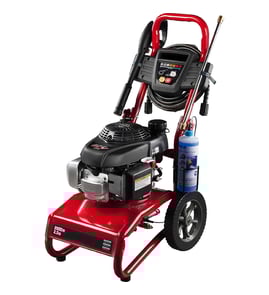



What is a good PSI for a gas pressure washer?
A good PSI for a gas pressure washer depends on what you’re cleaning. For typical home jobs, 1,300 to 2,800 PSI covers most needs. Your Craftsman model 580762202 is rated at 2200 PSI, which is a solid all-around pressure for decks, siding, and driveway rinsing (use the right nozzle and distance). See the owner's manual for the exact rating and safe operating limits.
Quick PSI guide by task
- 1,300 to 2,000 PSI: cars, patio furniture, grills (use a wider spray and more distance)
- 2,000 to 2,800 PSI: decks, fences, siding, concrete rinsing (common homeowner range)
- 2,800 to 3,500 PSI: heavy concrete cleaning, paint prep (higher risk of surface damage)
- 3,500+ PSI: commercial and specialty cleaning (not typical for most homes)
What your Craftsman 580762202 is designed to do
From the specifications, this unit is 2200 PSI and 2.2 GPM. That combination is aimed at general-purpose outdoor cleaning with good rinsing power.
| Spec | What it means | Why it matters |
|---|---|---|
| PSI (pressure) | How hard the spray hits | Too high can etch wood, strip paint, or damage siding |
| GPM (flow) | How much water moves | Higher GPM rinses faster and clears debris better |
| Water temp limit | Not to exceed 140°F | Hotter water can damage the pump and seals |
How to choose the “right” PSI in real use
- Start with a wider fan nozzle and step up only if needed
- Keep the tip farther away on wood, vinyl siding, and painted surfaces
- Avoid “zero-degree” pinpoint spraying on soft materials
- Never exceed the washer’s rated pressure; use only properly rated hose, gun, and fittings
Why it matters
Using more PSI than the surface can handle causes gouging, etching, and water intrusion. Using too little PSI wastes time. Matching PSI (and nozzle choice) to the job gives faster cleaning with less damage risk.
Last updated: February 2026
What kind of gas goes in a Craftsman 3000 PSI pressure washer?
Use clean, fresh, unleaded gasoline in your Craftsman pressure washer; for model 580762202, the fuel tank capacity is 1.5 U.S. quarts. For best starting and smooth running, use 87 octane (87 AKI) or higher and avoid old fuel. See the fuel and operation notes in the 580762202 owner's manual.
What to use (and what to avoid)
- Use unleaded gasoline, 87 octane (87 AKI) or higher.
- Use fresh fuel (especially after storage).
- Avoid gasoline that has been sitting for weeks or smells sour.
- Avoid overfilling; leave room for fuel expansion.
- Wipe up spills before starting the engine.
Quick fuel specs for Craftsman 580762202
| Item | What to use |
|---|---|
| Fuel type | Unleaded gasoline |
| Octane | 87 AKI (or higher) |
| Tank capacity | 1.5 U.S. quarts |
| Storage tip | Drain old gas and refill with fresh fuel if it has been stored |
If it runs rough or won’t start after refueling
Old fuel and restricted airflow are common causes. We recommend these checks:
- Drain the tank and refill with fresh unleaded gas.
- Check the spark plug condition and gap (per the manual).
- Clean or replace the air filter (a clean filter helps the fuel-air mixture).
- Confirm the throttle and choke are set correctly for starting.
- Make sure the water supply is connected and flowing before you start the engine.
Why it matters
Using the right gasoline helps the Tecumseh 4-cycle engine maintain a stable fuel-air mixture, start easier, and reduce stalling under load when you squeeze the trigger on the wand.
Last updated: February 2026
Why does my gas pressure washer have no pressure?
If your Craftsman 580762202 gas pressure washer runs but has little or no spray pressure, the most common causes are trapped air in the pump, a restricted water supply, or a nozzle/wand issue. Purging air and confirming full water flow usually restores pressure.
Quick fixes to try first
- Connect the garden hose and turn the water on fully before starting the engine (running dry can damage the pump).
- Remove the spray tip and hold the trigger open to purge air until water flows smoothly.
- Check and clean the inlet screen at the water connection.
- Verify the high-pressure hose connections are tight at the pump and spray gun.
- Keep the throttle control in the Fast position while washing (low engine speed reduces pressure).
What to check next (common no-pressure causes)
| Symptom | Most likely cause | What to do |
|---|---|---|
| Pressure surges or sputters | Air trapped in pump | Purge with tip removed; keep trigger open until steady flow |
| Weak pressure all the time | Low water supply or clogged inlet screen | Use household water supply; clean screen; avoid long/kinked hoses |
| Good flow with tip off, weak with tip on | Clogged or wrong spray tip/wand issue | Clean/replace tip; inspect wand for blockage |
| Pressure drops when you release trigger | Pump check valve sticking | Inspect pump valves; replace worn valve parts if needed |
Parts that can affect pressure on this model
If you find leaks, restrictions, or valve problems, these model-compatible parts are commonly involved:
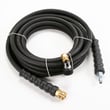
- Hose 84006753 (high-pressure water hose; leaks or internal damage can reduce pressure)
- Check valve B1879GS (a sticking or worn check valve can cause low or no pressure)
- Wand B2370 (a blocked or damaged wand can restrict flow)
Why it matters
A pressure washer depends on steady inlet water flow and a fully primed pump. Starting the engine without water on, or operating with air in the pump, can prevent pressure buildup and can shorten pump life.
For model-specific operating steps and safety guidance (including purging pressure after shutdown), follow the owner's manual.
Last updated: February 2026