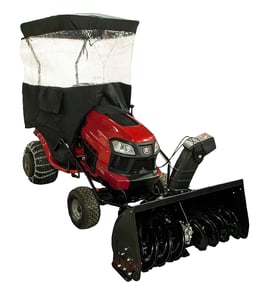

Are snow blower attachments universal?
Snow blower attachments are not universal. For the Craftsman model 180260210 snowblower attachment, fit depends on the tractor’s mounting/hitch system, drive method (belt and pulley routing), and lift linkage; you must match the attachment to the tractor platform and the correct mounting hardware.
What “universal” means in real-world fitment
Even when an attachment is marketed as universal, it still has to match the tractor’s connection points and power transfer setup.
- Mounting interface: front hitch, subframe, or model-specific brackets
- Drive system: belt-driven pulley/PTO arrangement and correct belt path
- Lift method: manual lift handle, cable lift, or tractor lift linkage
- Clearance: hood, frame, and front axle clearance at full steering lock
- Controls: chute rotation and deflector control style (manual, cable)
Quick compatibility checklist
Use this to confirm whether a snow blower attachment will mount and operate correctly.
| What to match | Why it matters | What to verify |
|---|---|---|
| Tractor model and frame series | Mount points vary by platform | Tractor model number and frame style |
| Hitch/subframe type | Determines physical fit | Existing front hitch or required kit |
| Pulley/PTO location | Prevents belt misalignment | Pulley position, idlers, belt routing |
| Lift linkage | Ensures safe raise/lower | Lift handle/cable/linkage compatibility |
Why it matters
A mismatched attachment can cause belt slip, poor auger/impeller performance, and premature wear on pulleys, idlers, and bearings. Correct fit also keeps the blower at the right height for clean scraping and consistent throwing distance.
Best next step
Confirm your tractor’s exact model number and compare its hitch/subframe and belt-drive layout to what the Craftsman 180260210 requires. If you need help locating the tractor’s model tag, use how to find your appliance model number (and what it means for parts).
Last updated: February 2026
Should I spray my snowblower with WD-40?
Yes; for a Craftsman 180260210 36-inch snow blower attachment, we use a light spray on the chute and inside the auger housing to reduce snow sticking and help prevent surface rust. Keep WD-40 off belts, pulleys, and any friction-drive surfaces so you do not cause slipping.
Where to spray (and where not to)
Use a light coat and wipe off excess so it does not attract grit.
- OK to spray: discharge chute (inside), chute deflector, auger housing (inside), impeller area (light coat), exposed metal fasteners
- Do not spray: belts, pulleys, idlers, shear pins (threads can get messy), bearings that are meant to be greased, painted decals you want to preserve
- Avoid: spraying near any hot surfaces; let everything cool first
Better options for non-stick performance
WD-40 works as a short-term water-displacing protectant, but a silicone-based spray typically lasts longer for snow shedding.
| Product type | Best use | Notes |
|---|---|---|
| Silicone spray | Prevent snow sticking in chute and housing | Usually the best all-around non-stick choice |
| WD-40 | Light rust protection and short-term water displacement | Reapply more often; wipe excess |
| Dedicated snow-thrower non-stick spray | Maximum snow shedding | Good for wet, heavy snow conditions |
Quick application steps
- Shut the tractor/attachment down and let it cool completely.
- Brush out packed snow and ice; dry the chute and housing.
- Spray a thin, even coat on the chute and auger housing interior.
- Run the attachment briefly to distribute, then re-wipe any drips.
Why it matters
A non-stick coating helps reduce chute clogging in wet snow and lowers the load on the auger and impeller, which can help protect shear pins, belts, and drive components from sudden jams.
For more DIY safety basics before working around moving parts, follow our guidance in are diy appliance repairs safe.
Last updated: February 2026
Why do I keep breaking shear pins on my snowblower?
On the Craftsman 180260210 36" snow blower attachment, shear pins keep breaking when the auger hits hidden obstructions (ice chunks, gravel, curb edges), the auger is binding from packed snow or misalignment, or the wrong shear pins are installed. Fix the root cause first; shear pins are designed to fail to protect the gearbox.
Most common causes
- You are ingesting debris (stones, sticks, frozen newspaper, edging)
- You are taking too deep of a cut (high ground speed, full-width bite in heavy snow)
- Auger or impeller is binding from ice buildup
- Shear pin holes in the auger hub are elongated (slop lets the pin hammer and snap)
- Auger shaft bearings/bushings are worn, letting the auger run out of true
- Wrong pin type or hardness (a standard bolt is not a shear pin)
What we recommend (quick checks)
- Shut the tractor off, remove the key, and wait for all movement to stop.
- Clear packed snow and ice from the auger housing and around the auger ends.
- Rotate the auger by hand (with gloves) to feel for tight spots or scraping.
- Inspect the shear pin holes; if they are ovaled out, the new pin will fail early.
- Verify you are using the correct shear pins for a 36-inch Craftsman attachment (correct diameter and length, with the proper locking method).
Setup changes that reduce shear pin failures
| Condition | Better approach | Why it helps |
|---|---|---|
| Heavy, wet snow | Slower ground speed, smaller bite | Reduces shock load on the auger |
| Gravel drive | Raise skid shoes, keep intake higher | Prevents rock ingestion |
| End-of-drive plow berm | Take it in layers | Avoids sudden stall loads |
Why it matters
A shear pin is a mechanical “fuse.” If it breaks often, it is warning you about impact or binding that can damage the auger drive, bearings, or gearbox if ignored.
Helpful related reading
Last updated: February 2026