Owner’s manual
 Error Codes




How wide is a 29 cubic foot refrigerator?
Most 29 cu. ft. refrigerators are about 35 to 36 inches wide. For your Samsung RH29H9000SR, the exact cabinet width and required clearance are listed in the RH29H9000SR owner's manual; use that measurement when planning a fit between cabinets or through doorways.
Typical width ranges (what you can expect)
Capacity (cu. ft.) does not map to one exact width; it varies by style (side-by-side vs French door) and insulation design.
- Most 29 cu. ft. units: 35 to 36 in. wide
- Common “counter-depth” 29 cu. ft.: often closer to 35 to 36 in. wide, but shallower front-to-back
- Some wide-body designs: can run slightly over 36 in.
- Door swing matters: handles and door arc can add several inches of space needs
- Ventilation clearance: you typically need extra space at the sides and top for airflow
Measure the right way (cabinet vs. doors)
Use the manual’s spec definitions so you compare apples-to-apples.
| What you’re measuring | What it includes | Why it matters |
|---|---|---|
| Cabinet width | Main box only | Determines if it fits between cabinets |
| Overall width | Doors and often handles | Determines if it clears trim and adjacent walls |
| Clearance for door swing | Door arc space | Prevents doors from hitting walls or islands |
| Delivery path width | Doorways and hallways | Prevents getting stuck during install |
Quick fit checklist before you buy or move it
- Measure the opening width in 3 spots (top, middle, bottom)
- Check for baseboards, trim, and uneven floors
- Confirm hinge-side clearance for full door opening
- Plan for water line routing to the dispenser/ice maker
- Leave room to pull the refrigerator out for service and cleaning
Why it matters
A “29 cu. ft.” label describes storage volume, not exterior dimensions. Using the RH29H9000SR spec width plus clearance helps prevent installation problems, poor airflow, and door-interference issues.
Last updated: February 2026
What is the most common problem with Samsung refrigerators?
The most common problem we see on Samsung refrigerators (including model RH29H9000SR) is a cooling complaint caused by airflow restriction from frost or ice buildup, often tied to the defrost system or evaporator fan. Ice maker and dispenser issues are also very common. For model-specific checks and settings, use the RH29H9000SR owner's manual.
Most common issues (and what they look like)
- Warm fresh food section, freezer still cold: restricted airflow, iced-up evaporator, or a fan problem.
- Temps swing up and down: door not sealing, damper issues, or control/sensor problems.
- Ice maker stops or makes small/hollow cubes: low water flow, freezing in the fill path, or ice maker faults.
- Water dispenser slow: clogged filter, kinked line, or frozen reservoir/line.
- Frost on walls or heavy ice behind panels: defrost heater/sensor issue or door left ajar.
Quick checks we recommend first
- Confirm set temps (typical targets: 37°F fridge, 0°F freezer).
- Make sure doors close fully and bins are not blocking closure.
- Check for obvious frost buildup in vents and on the back wall.
- Listen for the evaporator fan (you should hear airflow when the door switch is pressed).
- If the unit is warm and you hear clicking or repeated start attempts, check compressor start components such as the refrigerator compressor overload protector DA34-00004D.
Common symptoms and likely causes
| Symptom | Most likely cause | What to do next |
|---|---|---|
| Fridge warm, freezer OK | Frost/ice restricting airflow, fan not running | Defrost and inspect airflow path; verify fan operation |
| No ice | Ice maker fault, low water flow | Inspect fill tube for freezing; test ice maker |
| Clicking, not cooling | Overload/protector tripping, compressor issue | Check start components; evaluate sealed system |
| Slow water | Restriction in filter/line | Replace filter; inspect water line |
Why it matters
Cooling and ice maker problems often share the same root cause: airflow and temperature control. Fixing airflow (fans, defrost, damper, door seal) prevents food spoilage, reduces frost, and helps the ice maker keep up.
For model-family troubleshooting steps and display codes, use Samsung rh22 and rh29 models side by side refrigerator error codes and why your Samsung fridge stopped making ice and how to fix it.
Last updated: February 2026
What is the best side by side refrigerator brand?
There is no single “best” side-by-side refrigerator brand for everyone; the best choice depends on whether you prioritize long-term reliability, ice and water convenience, or smart features. For owners shopping around a Samsung RH29H9000SR, we recommend comparing serviceability, dispenser design, and parts availability before you buy.
Our practical brand guidance (what usually matters most)
When customers ask “best brand,” we focus on the things that most often drive satisfaction over 5 to 15 years.
- Reliability track record: fewer cooling and ice maker complaints over time.
- Simpler dispenser setup: fewer moving parts generally means fewer issues.
- Parts availability and cost: common items like door gaskets, control boards, and ice maker parts should be easy to source.
- Temperature stability: consistent fresh food and freezer temps with good airflow.
- Support and documentation: clear diagnostics and maintenance steps in the RH29H9000SR owner's manual.
Brand comparison (typical strengths)
These are broad patterns we see across side-by-side refrigerators, not guarantees for every model.
| Brand | Typical strengths in side-by-side fridges | Typical tradeoffs to watch |
|---|---|---|
| GE | Solid reliability, wide service network | Feature set can be simpler at a given price |
| Frigidaire | Good value, straightforward designs | Fit and finish varies by series |
| KitchenAid | Premium build, strong cooling performance | Higher purchase and repair costs |
| Samsung | Strong features and design, smart options | Dispenser and ice systems add complexity |
| LG | Feature-rich, efficient | Repairs can be more specialized depending on model |
If you want the “best” experience, choose based on your priorities
Use this quick filter to narrow your choice:
- Lowest hassle: pick a model with fewer dispenser features and easy-to-clean ice path.
- Best features: prioritize layout, capacity, and controls you will actually use daily.
- Best long-term value: compare common repair parts pricing (for example, a Samsung refrigerator compressor MKV190CL2BASH is a major-cost component if cooling ever fails).
Why it matters
Side-by-side refrigerators concentrate a lot of hardware in the door (dispenser, switches, ice chute, wiring). The more complex the door system, the more important it is to keep up with maintenance and follow the operating guidance in the manual.
For Samsung-specific ownership tips, we recommend reviewing why your Samsung fridge stopped making ice and how to fix it to understand the most common ice maker failure patterns and prevention steps.
Last updated: February 2026
What are the 4 types of ice Samsung?
Samsung uses “four types of ice” to describe certain refrigerator designs that can produce more than the standard dispenser options. On the Samsung RH29H9000SR, the everyday ice selections are the dispenser basics (cubed and crushed); use the RH29H9000SR owner's manual to confirm the exact ice and dispenser modes for your specific configuration.
What “four types of ice” usually means (Samsung marketing)
On models that truly support four ice styles, the four types are typically a mix of:
- Cubed ice
- Crushed ice
- A small-piece ice (often marketed as bite-size or nugget-style)
- A specialty shape (varies by model)
What RH29H9000SR owners should expect
Most Samsung side-by-side refrigerators with an in-door dispenser are set up for two outputs because the dispenser mechanism is built around cube and crush functions.
| Ice option | Where it comes from | What controls it |
|---|---|---|
| Cubed | Ice maker plus dispenser | Dispenser “Cubed” selection |
| Crushed | Dispenser auger/crusher | Dispenser “Crushed” selection |
If you are not getting cubed or crushed
These checks isolate whether the issue is ice production, storage, or dispensing:
- Verify freezer temperature is holding near 0°F
- Make sure the ice bucket is fully seated and not overfilled with clumped ice
- Check for a stuck dispenser chute door that lets humid air in and causes clumping
- Inspect the ice maker for stalled harvest cycles or a jam
- Confirm the dispenser switch and user interface respond when pressed
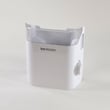
If you suspect a mechanical issue, model-matched parts that commonly affect dispensing include the Samsung refrigerator ice container DA97-14263A (feeds ice to the auger) and the kenmore pro refrigerator dispenser ice chute door DA97-00883E (helps prevent clumping and warm air intrusion).
Why it matters
Matching the “ice types” claim to your actual dispenser and ice maker setup prevents ordering the wrong ice maker or bin and keeps troubleshooting focused on the cube/crush system your RH29H9000SR uses.
Last updated: February 2026