Installation guide
 Owner’s manual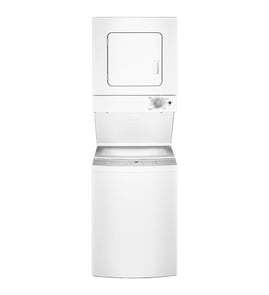




Are all washers 27 inches wide?
No. Many full-size washers are about 27 inches wide, but washer widths vary by design (compact, full-size, stackable, and laundry centers). For your GE WSM2780HBWWW stacked laundry center, use the dimensions listed in the installation guide to confirm the exact fit in your space.
Typical washer width ranges (what to expect)
Most washers fall into a few common size groups:
- Compact washers: about 24 inches wide
- Full-size washers: about 27 inches wide (most common)
- Large-capacity models: often 27 to 29 inches wide
- Stacked laundry centers: commonly around 27 inches wide, but not always
How to measure correctly (so you do not get surprised)
Measure the opening and the appliance footprint before you plan a move or replacement:
- Measure width at the narrowest point of the doorway or alcove
- Measure depth including hoses, venting, and power cord clearance
- Measure height to confirm overhead cabinet or shelf clearance
- Leave space so the unit can sit level on all four legs (prevents rocking and vibration)
Clearance checklist for a laundry center
Laundry centers need more than just the cabinet width.
| What you are checking | What to include | Why it matters |
|---|---|---|
| Width | Cabinet opening and door swing | Prevents binding during install/removal |
| Depth | Hoses, vent duct, cord | Avoids kinks and airflow restrictions |
| Leveling | All four legs solid | Reduces vibration and noise |
Why it matters
Assuming every washer is 27 inches wide can lead to a unit that will not slide into the space, or one that fits but pinches the inlet hoses and drain hose. A pinched hose can cause fill problems or leaks, and poor leveling can cause excessive vibration.
Last updated: February 2026
How to reset GE washer deep fill?
On the GE WSM2780HBWWW laundry center, there is no separate “Deep Fill reset” button. To reset the washer’s cycle and water-level selection, stop the washer, then reselect your cycle and water level and restart; a full power reset also clears the controls.
Quick reset options (WSM2780HBWWW)
- Change the cycle after it starts: push the cycle selector knob in and wait for the washer to stop; then turn to the new cycle and pull the knob out to restart.
- Reset the interrupted cycle: turn the cycle selector to a new position (not the end of the cycle), then restart.
- Power reset (clears the control state): unplug the laundry center (or switch off the breaker) for about 2 minutes, then restore power and start a new cycle.
- Reconfirm water level: set LOW, MED, or HIGH based on load size before restarting.
How “deep fill” works on this model
This model uses a manual water level selector, not an electronic deep-fill feature. Use the water level knob to match the load:
| Water level setting | Best for | What to expect |
|---|---|---|
| LOW | Less than 1/3 full | Lowest fill level |
| MED | 1/3 to 2/3 full | Medium fill level |
| HIGH | Over 2/3 full | Highest fill level |
For the exact control layout and cycle chart, follow the operating steps in the owner's manual.
Why it matters
If the cycle selector is not fully reset, the washer can pause, stop advancing, or refill at an unexpected level. Resetting the cycle and reselecting the correct water level helps prevent poor cleaning, out-of-balance spin, and overly wet loads.
Last updated: February 2026
What is the most common problem with a GE dryer?
On the GE WSM2780HBWWW laundry center, the most common dryer complaint is “tumbles but won’t heat.” In many cases the root cause is a failed heating circuit component, but airflow restrictions (lint filter or venting) and a tripped breaker can create the same no-heat symptom; check the basics first using the owner's manual.
Quick checks we recommend first (no parts yet)
- Confirm the dryer door fully closes; the dryer will not run with the door open.
- Check the lint filter is clean and seated correctly.
- Verify household power: many electric dryers use two fuses or breakers; one can trip and the drum will still tumble with no heat.
- Make sure the exhaust duct is metal and not kinked or crushed; restricted venting causes poor or no heating.
- Avoid overloading; dry one washer load at a time for proper tumbling and heat exposure.
Most common causes of “runs but no heat”
| Symptom | What it usually points to | What to do next |
|---|---|---|
| Drum tumbles, clothes stay cold | Heating circuit issue or power supply issue | Check breakers first; then test heat components per the manual |
| Long dry times, clothes warm but damp | Airflow restriction (lint, duct, outside damper) | Clean lint path and inspect venting end-to-end |
| Heat comes and goes | Vent restriction or failing control/timer | Verify airflow; then evaluate controls |
Parts that can be involved on this model
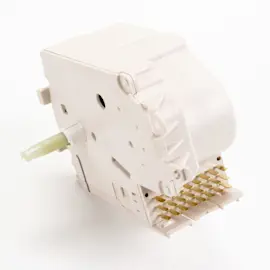
If your troubleshooting indicates a control issue (for example, heat never energizes in any timed setting), a failed timer can be a factor. For this model, we list the dryer timer WE04X10005 as a replacement option.
Why it matters
A dryer that tumbles without heat is often misdiagnosed as a “bad heater” right away. On a stacked laundry center like the GE WSM2780HBWWW, simple issues like a partially tripped breaker or restricted metal venting can stop heating and also increase drying time and lint buildup.
Last updated: February 2026
Are washing machine and dryer combos any good?
Yes, washer and dryer combos can be a good fit when you need one compact appliance, but they usually trade speed and capacity for convenience. With the GE WSM2780HBWWW stacked laundry center, you typically get solid washing performance; drying can take longer than a full-size, standalone dryer.
What “good” means for a laundry center like GE WSM2780HBWWW
A stacked laundry center is different from many all-in-one (single-drum) combo units. You have a dedicated washer and a dedicated dryer in one frame, so performance is usually closer to a traditional set, but with smaller capacity and tighter service access. For operating and care details, use the owner's manual.
Pros and cons (quick checklist)
Pros
- Saves floor space; ideal for closets, condos, and tight laundry rooms
- Separate washer and dryer functions (no waiting for one drum to switch modes)
- Simpler day-to-day use; familiar cycle selectors and controls
Cons
- Smaller loads; you often need to dry one washer load at a time
- Drying can take longer if loads are too wet or airflow is restricted
- Repairs can be more involved because components are stacked
What affects drying time the most
The manual guidance for this style of unit points to a few common causes of long dry times:
- Lint filter not cleaned before each load
- Venting issues (kinked flex duct, blocked wall cap damper)
- Overloading or mixing heavy items with lightweight items
- Household power issues (some dryers can tumble without heat if one breaker trips)
Common symptoms and likely causes
| Symptom | Most common cause | What to check first |
|---|---|---|
| Dryer tumbles but no heat | Electrical supply issue or heat system problem | Breakers/fuses, then heat components |
| Dryer takes too long | Airflow restriction or load issues | Lint filter, vent path, load size |
| Washer will not spin | Lid open or cycle interrupted | Lid closed; do not leave lid up during cycle |
Why it matters
Choosing a combo or stacked laundry center is mostly about matching your space and laundry habits. If you run frequent small loads and keep the venting clean, a unit like the WSM2780HBWWW is a practical, space-saving solution.
Last updated: February 2026
What is code 278?
On a GE WSM2780HBWWW stacked laundry center, “code 278” is not a standard washer or dryer error code; it is most often a reference to the model series (WSM2780) or a number shown on a control/timer dial rather than a fault. For model-specific operating details, use the owner's manual.
What “278” usually means on this laundry center
In real-world troubleshooting, we see “278” show up in a few non-error ways:
- Part of the model number (WSM2780HBWWW) on the rating label or paperwork
- A number printed on a timer chart or cycle guide (not a diagnostic code)
- A number you noted from a part label (for example, a timer, knob, or wiring harness tag)
- A misread of a different indicator (cycle position, minutes remaining, or a marking on the console)
Quick checks to identify what you are seeing
Use these steps to narrow it down fast:
- Look at the display area: this model commonly uses mechanical timers, so “codes” are uncommon.
- Note when “278” appears: at power-up, during a cycle, or only when you turn the knob.
- Check the model and serial label to confirm you have WSM2780HBWWW.
- If the issue is “won’t advance” or “won’t start,” inspect the timer knob fit and timer operation.
Parts that commonly relate to timer or dial confusion
If the number is tied to the dryer timer or knob behavior, these parts are commonly involved:
| Symptom you notice | Commonly related part | Example part for this model |
|---|---|---|
| Knob slips, cracks, or won’t turn timer shaft | Timer knob | Laundry center dryer timer knob WE01X10160 |
| Dryer cycle does not advance or stops early | Dryer timer | Dryer timer WE04X10005 |
| Washer cycle does not advance | Washer timer | Laundry center washer timer WH12X10164 |
Why it matters
Treating “278” like a fault code can send you toward the wrong repair. Confirming whether it is a model reference, a timer marking, or a true symptom (no heat, no tumble, no drain) helps you choose the right diagnostic path and the right GE replacement part.
Last updated: February 2026