Installation guide
 Owner’s manual
 Error Codes



How do I find the model number on my JGS650SEF4SS?
On the GE gas range JGS650SEF4SS, the model number is printed on a rating label on the range body. We use that exact model number to match the correct parts, diagrams, and instructions in the JGS650SEF4SS owner's manual.
Where to look on a GE freestanding gas range
Check these common label locations (in order):
- Oven door frame: open the oven door and look along the frame edge.
- Storage drawer area: pull the lower drawer out and look on the frame behind it.
- Broiler drawer area (if equipped): open the drawer and check the frame.
- Back panel: label may be on the rear of the range.
What to write down (so parts match)
- Model number (example: JGS650SEF4SS)
- Serial number (helps confirm production run)
- Gas type listed (natural gas or LP)
Quick ID checklist
| If you see | It means |
|---|---|
| Letters and numbers like JGS650SEF4SS | Model number for parts lookup |
| A longer code plus date info | Serial number |
| “NG” or “LP” | Gas type configuration |
Why it matters
Small model-number differences can change burner parts, igniters, and control components. Using the exact label information prevents ordering the wrong surface burner cap, igniter, or valve.
Last updated: March 2026
What is the average lifespan of JGS650SEF4SS?
A GE gas range like model JGS650SEF4SS typically lasts 13 to 15 years with normal household use and basic maintenance (keeping burners clean, avoiding spills into the oven bottom, and addressing ignition issues early). Use the JGS650SEF4SS owner's manual for care steps that help it reach that lifespan.
What affects lifespan the most
- Ignition health: weak igniters make the oven work harder and can lead to no-heat problems.
- Heat and spill management: baked-on spills can damage finishes and restrict airflow.
- Gas flow consistency: dirty burner heads/caps cause uneven flames and overheating.
- Door seal and glass condition: heat loss makes longer bake times and stresses components.
- Cleaning habits: harsh abrasives can damage stainless and enamel surfaces.
Typical lifespan by component (what to expect)
| Component | Typical service life | Common symptom when failing |
|---|---|---|
| Oven igniter | 3 to 8 years | Oven won’t heat or heats slowly |
| Surface burner parts | 5 to 10 years | Uneven flame, clicking, poor ignition |
| Temperature sensor | 8 to 12 years | Overbakes or underbakes |
| Gas valve/regulator | 10+ years | Inconsistent heat or gas odor concerns |
Why it matters
Knowing the expected lifespan helps you decide whether a repair is cost-effective. On a 13 to 15 year product, replacing a wear item (like an igniter) often restores reliable baking; multiple major issues at once can signal end-of-life.
Last updated: March 2026
What replacement parts are most commonly needed for the JGS650SEF4SS?
For the GE JGS650SEF4SS gas range, the most commonly replaced parts are ignition and burner components (for no-heat, slow preheat, or uneven flames), plus a few wear-and-tear hardware items. Use the JGS650SEF4SS owner's manual to confirm symptoms and safe operating checks before replacing parts.
Commonly needed replacement parts (and what they fix)
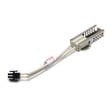
- Oven igniter WB13K21: oven will not heat, slow preheat, weak ignition
- Range broil igniter WB13X25261: broil will not light or takes too long to ignite
- GE wall oven temperature sensor WB23X5340: oven temperature inaccurate, overbaking/underbaking
- Range surface burner head WB16K10062: uneven flame, poor ignition, clogged ports
- Range surface burner cap WB28K10222: unstable flame pattern, burner won’t light consistently
- Range surface burner valve WB21X20612: burner won’t adjust properly, stuck high/low flame
Fast troubleshooting guide (before you order)
- Surface burner clicks but won’t light: clean and dry the burner head/cap; verify cap is seated.
- Oven won’t bake but broil works: bake igniter is the first check.
- Oven heats but food is off: confirm rack position and test temperature accuracy; sensor is a common fix.
- One burner flame is weak: check for clogged ports or a misaligned cap.
Parts and symptoms at a glance
| Symptom | Most likely part category | Example part on this model |
|---|---|---|
| No bake / slow bake ignition | Oven ignition | Oven igniter |
| No broil | Broil ignition | Broil igniter |
| Uneven surface flame | Burner head/cap | Burner head or cap |
| Temperature swings | Sensing/control | Temperature sensor |
Why it matters
Replacing the correct part restores safe, efficient cooking and prevents repeat failures. Ignition and burner parts are the highest-wear items on gas ranges because they face heat, spills, and frequent cycling.
Last updated: March 2026