Owner’s manual
 View engine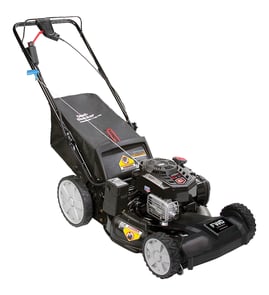


What model number is the Craftsman 917371570?
The model number for this Craftsman gas walk-behind rotary lawn mower is 917.371570 (often written without the dot as 917371570). You’ll see it printed on the mower’s model label and on the cover page of the owner's manual.
Check these common locations on Craftsman walk-behind mowers:
- On the rear of the mower deck (housing) near the discharge area
- Near the height adjuster area on the deck
- On a label near the handle mounting points
- In the documentation that came with the mower (manual cover and parts list)
Both formats refer to the same mower; the dot is just a formatting style used in manuals and labels.
| Format you may see | What it means | Use it for |
|---|---|---|
| 917.371570 | Same model number with a dot | Reading the manual and model label |
| 917371570 | Same model number without a dot | Searching parts lists and ordering parts |
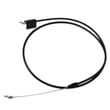
Using the exact model number ensures you get the correct Craftsman walk-behind mower parts (like the blade, blade adapter, or control cable) and the right diagrams for maintenance and repairs.
Last updated: February 2026
What kind of gas do you put in a Craftsman push mower?
For the Craftsman walk-behind mower model 917371570, use unleaded regular gasoline; the owner’s manual lists the fuel type as “Unleaded Regular” with a 1.6-quart tank capacity. For best small-engine performance, avoid high-ethanol fuels.
- Use fresh unleaded regular gasoline.
- Choose fuel with 10% ethanol or less (E10) when available.
- Avoid E15 (15% ethanol) and E85 (85% ethanol); these fuels are not suitable for most small engines.
- Do not use old gas that has been sitting for weeks or months.
- Keep the gas can clean and sealed to prevent water contamination.
| Fuel label at pump | Ethanol content | Use in model 917371570? |
|---|---|---|
| Unleaded regular (often E0 to E10) | 0% to 10% | Yes |
| E15 | 15% | No |
| E85 | Up to 85% | No |
Using the right gasoline helps your mower start easier, run smoother, and reduces carburetor and fuel-system problems caused by stale fuel or excess ethanol.
The fuel type and capacity are listed in the Product Specifications section of the owner's manual.
Last updated: February 2026
What year is Craftsman Model 917371570?
The Craftsman lawn mower model 917.371570 does not have a single built-in “model year.” We date it by the serial number stamped on the mower housing; the serial number includes a date code that identifies the manufacturing date. Use the steps in the owner's manual to find where the serial number is recorded.
- Locate the serial number label/stamp on the mower housing (deck area).
- Write down the full serial number exactly as shown.
- Decode the date portion of the serial number (many Craftsman walk-behind mowers use a MMDDYY style date code).
If the serial number begins with 072811, that reads as:
| Code | Meaning | Result |
|---|---|---|
| 07 | Month | July |
| 28 | Day | 28 |
| 11 | Year | 2011 |
Some serial labels include extra characters or a different layout. These checks still get you to the correct year:
- Look for a 6-digit run that resembles a date (often near the start of the serial).
- Check for a separate “Date” field printed on the label.
- Compare the serial label to the “Record serial number and date of purchase” section in the owner's manual.
- If the mower has had major repairs, use the serial number on the deck, not a replacement engine tag.
Knowing the build date helps us match the correct Craftsman 917371570 parts and diagrams, especially for wear items like the lawn mower 21-in deck mulching blade 532406706 and blade adapter 532418373.
Last updated: February 2026
What are the common problems with Craftsman lawn mowers?
Common problems on the Craftsman 917371570 walk-behind mower include loss of power, poor or uneven cutting, excessive vibration, a starter rope that’s hard to pull, a grass catcher that won’t fill, and a mower that’s hard to push. Most issues trace back to cutting height, airflow, blade condition, or debris buildup; use the owner's manual troubleshooting chart to match symptoms to fixes.
- Loss of power: cutting too low, dirty air filter, grass and debris packed under the deck, oil level too high, walking speed too fast
- Poor or uneven cut: worn or bent blade, loose blade hardware, uneven wheel height settings, deck buildup
- Excessive vibration: loose or damaged blade, damaged blade adapter, bent crankshaft (stop using the mower until inspected)
- Starter rope hard to pull: blade dragging in grass, brake engaged when control bar is released, damaged blade adapter
- Grass catcher not filling (if equipped): cutting too low, worn blade lift, catcher not venting
- Hard to push: grass too tall, cutting height too low, bag too full, handle height not comfortable
- Set the cutting height higher and slow your walking pace in heavy grass.
- Tip the mower safely and clean the underside of the deck (packed clippings cause power loss and poor cut).
- Inspect the blade for bends, heavy nicks, or rounded edges; replace if damaged.
- Check blade mounting parts for looseness or damage; a worn adapter can cause vibration.
- Verify the oil level is correct (overfilled oil can reduce power).
| Symptom | Most likely wear item | Example part for this model |
|---|---|---|
| Poor cut, ragged grass | Blade | Lawn mower 21-in deck mulching blade 532406706 |
| Vibration, blade won’t stay tight | Blade adapter | Blade adapter 532418373 |
| Hard to push, uneven height | Height adjust hardware | Husqvarna lawn mower height adjuster knob 532701037 |
A dull or loose blade and a clogged deck make the engine work harder, reduce airflow for bagging and mulching, and can create unsafe vibration. Fixing the basics first prevents bigger repairs and improves cut quality immediately.
Last updated: February 2026