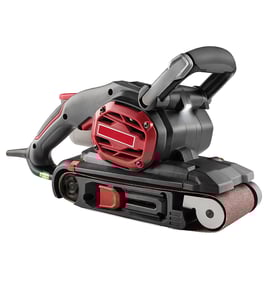

Which is better, an orbital sander or a detail sander?
A random orbital sander is better for sanding large, flat surfaces quickly with fewer visible swirl marks, while a detail (mouse) sander is better for tight corners, edges, and small touch-ups. For most DIY projects, we treat them as complementary tools, not direct replacements.
- Large panels, tabletops, doors: random orbital sander
- Inside corners, trim profiles, spindles, small repairs: detail sander
- Fast paint or finish removal: random orbital (with the right grit and dust control)
- Final touch-ups in hard-to-reach spots: detail sander
- If you only buy one: choose random orbital for the widest range of work
Your Delta 31-780 is an oscillating spindle sander, so it fills a different role than either tool: it is designed for curves, inside radii, and shaped cutouts where a flat-pad sander cannot maintain consistent contact.
| Tool type | Best at | Weak at | Typical use case |
|---|---|---|---|
| Random orbital sander | Flat surfaces, broad smoothing | Tight corners, sharp inside angles | Tabletops, cabinet sides |
| Detail (mouse) sander | Corners, edges, small areas | Large surfaces (slow) | Trim, stair parts |
| Oscillating spindle sander (Delta 31-780) | Curves, inside cutouts, radii | Large flat panels | Arches, templates, curved aprons |
- Start with 80 to 120 grit for shaping or removing old finish; move to 150 to 220 grit for smoothing.
- Let the sander do the work; heavy pressure slows sanding and can leave uneven spots.
- Vacuum or blow off dust between grits; leftover coarse grit causes scratches.
- Sand with the grain on the final pass when possible (especially on visible hardwood).
Choosing the right sander saves time and reduces rework. A random orbital sander speeds up flat-surface prep, a detail sander finishes the spots it cannot reach, and the Delta 31-780 handles curves and inside radii cleanly.
For more DIY help and tool know-how, we recommend starting with must have tools for appliance repair (the checklist applies well to power-tool troubleshooting and basic electrical testing, too).
Last updated: February 2026
What is a Delta 12 in disc sander 31-780?
The Delta 31-780 is an oscillating spindle sander (not a 12-inch disc sander). It sands curves and inside radiuses using a vertical sanding drum that oscillates up and down to reduce burning and wear; it is commonly used for woodworking shaping and finish sanding. For help confirming you have the right model before ordering parts, use how to find your appliance model number (and what it means for parts).
An oscillating spindle sander like the Delta 31-780 is built for controlled sanding on contoured workpieces.
- Sands inside curves (cutouts, holes, arcs)
- Sands outside curves (rounded edges, templates)
- Uses interchangeable sanding sleeves/drums (size varies by kit)
- Oscillation helps reduce heat marks and extends sleeve life
- Typically used with a dust collection port to manage fine sanding dust
| Feature | 12-inch disc sander | Oscillating spindle sander (Delta 31-780) |
|---|---|---|
| Best for | Flat edges, bevels, straight shaping | Curves, radiuses, inside cutouts |
| Sanding surface | Large rotating disc | Vertical drum with sanding sleeve |
| Motion | Rotates only | Rotates plus oscillates |
| Common work | Squaring ends, flattening | Pattern sanding, smoothing curves |
Delta made multiple sanders with similar numbering, and “disc sander” and “spindle sander” parts are not interchangeable. Matching the exact model number 31-780 helps you get the correct items such as sanding sleeves, spindle assemblies, switches, belts, or dust fittings.
- Confirm the ID plate shows 31-780
- Note whether your unit is bench-mounted or stand-mounted
- Check the spindle size and sleeve size you use most
- Inspect common wear areas: sanding sleeve, bearings, drive belt, switch, power cord
Last updated: February 2026
How much is the 31-780 drum sander?
The Delta 31-780 is an oscillating spindle sander, not a drum sander; pricing varies widely by condition (new old stock vs. used) and what accessories are included. For the most accurate price, match the tool type and model number before you compare listings.
It is common to mix up Delta model numbers because Delta also made drum sanders with similar numbering.
- Confirm the data plate says Delta 31-780
- Verify it is an oscillating spindle sander (spindle and throat plate, not a conveyor drum)
- Check whether the listing includes spindle sleeves, inserts, and wrenches
- Compare condition: motor noise, table flatness, and spindle play
- Factor in shipping; power tools can cost more to ship than to buy
Because this is an older power tool, most pricing is driven by the used market and completeness.
| Condition | What’s usually included | Typical price range (USD) |
|---|---|---|
| Used, tool only | Sander with minimal accessories | $100 to $250 |
| Used, complete | Multiple sleeves/inserts, wrenches | $200 to $400 |
| Refurbished or collector-grade | Cleaned, tuned, very complete | $300 to $600 |
If you compare a drum sander price to an oscillating spindle sander price, you will get a misleading number. Matching the exact model (31-780) and tool type helps you avoid overpaying and ensures you can still source replacement parts when needed.
Use the model number to search and cross-check diagrams so you order the correct components for your exact configuration: how to find your appliance model number (and what it means for parts).
Last updated: February 2026
What size belt is a Delta 31-780?
The Delta 31-780 is an oscillating spindle sander, so it does not use a sanding belt. It uses sanding sleeves (drums) that fit over a rubber sanding drum on the spindle; belt sizes apply to belt sanders, not this model.
Check the model tag on the tool base or housing and match it to Delta 31-780. This matters because Delta model numbers that look similar can be completely different sanders.
- Look for 31-780 on the data plate, not just “Delta”
- Confirm the tool type says spindle sander (not belt/disc)
- Verify the spindle and drum are present (a belt sander has rollers and a tracking knob)
- If you are shopping parts, search by the full model number for the best match
Helpful reference: how to find your appliance model number (and what it means for parts)
For a spindle sander, the key “size” is the sanding sleeve and drum diameter, plus sleeve length.
| Item to measure | What to look for | Typical range on spindle sanders |
|---|---|---|
| Sleeve inside diameter | Matches drum diameter | Multiple drum sizes (varies by kit) |
| Sleeve length | Height of the sanding surface | Often around 4 to 5 inches |
| Spindle thread | Nut and washer fit | Model-specific |
- Measure the drum diameter with a ruler or caliper
- Measure sleeve length from top to bottom of the abrasive
- Match grit (coarse to fine) to the job and wood type
Ordering a “belt” for a spindle sander leads to the wrong part and wasted time. Matching the sanding sleeve diameter and length keeps the sleeve tight on the drum, improves sanding control, and reduces slipping and burning.
Last updated: February 2026