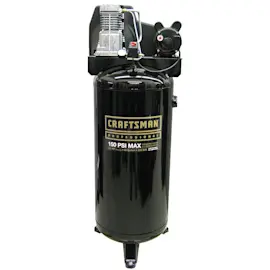
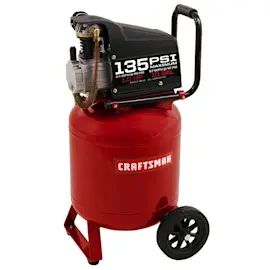
Owner’s manual

What is the average lifespan of an air compressor?
Most homeowner-grade air compressors last about 5 to 10 years, while heavier-duty shop or industrial units often run 10 to 20 years with consistent maintenance. For your Craftsman 919167200 oil-free compressor, lifespan depends most on heat, moisture control, and how hard it is cycled; follow the maintenance schedule in the owner's manual.
Typical lifespan ranges (what to expect)
| Compressor type | Typical lifespan | What usually ends its life |
|---|---|---|
| DIY / portable (oil-free) | 5 to 10 years | Overheating, worn pump seals, valve issues |
| Prosumer / shop (often oil-lubricated) | 10 to 15 years | Wear from high duty cycle, poor oil or filtration |
| Industrial (rotary screw, etc.) | 10 to 20 years | High hours, neglected service intervals |
What extends the life of a Craftsman 919167200
- Keep it in a clean, dry, well-ventilated area with the head/shroud unobstructed.
- Maintain clearance (commonly at least 12 inches) from walls or obstructions for cooling.
- Inspect and replace the air filter on schedule.
- Drain moisture from the tank routinely to reduce internal corrosion.
- Fix air leaks promptly so the motor does not short-cycle.
- Use extra air hose instead of long extension cords to reduce voltage drop and motor heat.
Quick “wear and tear” checklist
Use this to judge whether your compressor is near end-of-life or just needs service.
- Hard starting or frequent breaker trips: often electrical supply, pressure switch, or motor strain.
- Won’t build tank pressure: commonly check valve, reed valves, or pump wear.
- Runs constantly: air leak, regulator issue, or pump efficiency loss.
- Noisy operation: loose mounts, worn components, or vibration issues.
Why it matters
Air compressors usually fail faster from heat and moisture than from age alone. Good airflow, correct circuit protection, and routine filter and tank care reduce cycling stress and help your Craftsman 919167200 reach the upper end of the typical 5 to 10 year range.
Related DIY help
Last updated: February 2026
Is it worth it to repair a compressor?
Yes, it’s worth repairing a Craftsman air compressor model 919167200 when the problem is a single, serviceable failure (like a pressure switch, check valve, or leaking fitting) and the tank is sound. If the air tank itself leaks or has damaged welds, replacement is the better choice.
Quick decision checklist
- Repair makes sense when the compressor:
- Won’t shut off at cut-out pressure (often a pressure switch issue)
- Leaks air at fittings, the pressure switch release valve, or the manifold/check valve area
- Won’t start due to a common electrical or pressure-related cause
- Replace makes sense when the compressor:
- Leaks from the air tank or tank welds (the manual treats this as a defective tank condition)
- Has multiple major issues at once (motor + pump + controls)
- Has repeated safety valve popping tied to uncontrolled pressure
Safety and repair boundaries (important)
Before any troubleshooting or repair, we follow the manual’s safety steps: turn the compressor off, bleed tank pressure, and unplug it. We also keep guards and covers in place; exposed moving parts and electrical components can cause serious injury.
- Unplug the unit before opening any covers
- Bleed off tank and hose pressure before loosening fittings
- Avoid touching hot metal parts (head and outlet tube can stay hot after use)
- Keep the unit stable on the floor (not on elevated surfaces)
Common “worth repairing” scenarios for this model
The troubleshooting guidance for this Craftsman 919167200 points to a few high-value fixes.
| Symptom | Likely area | Typical outcome |
|---|---|---|
| Safety valve pops, tank pressure too high | Pressure switch not shutting off | Repair is usually worthwhile if it’s just the switch/control issue |
| Air leaks at fittings | Tube fittings | Often a straightforward repair (tighten/ reseal) |
| Air leaks at pressure switch release valve | Pressure switch release valve | Often repairable by replacing the faulty component |
| Air leaks in tank or tank welds | Air tank | Replacement is the practical choice |
Why it matters
A compressor that does not shut off at the correct pressure or that has persistent leaks can become a safety issue and can also shorten the life of the motor and pump. Fixing a single control or valve problem early usually costs far less than replacing the whole unit.
For model-specific operating and safety guidance, use the owner's manual.
Last updated: February 2026
What company makes Craftsman air compressors?
Craftsman is a brand name, so Craftsman air compressors are built by different manufacturers depending on the model and production run. For the Craftsman 919167200 air compressor, the most reliable way to identify the maker is to match the data plate information and the documentation in the 919167200 owner's manual.
How to identify who made your Craftsman 919167200
Use the compressor’s ID label and the manual details together; this avoids guessing based on the Craftsman name alone.
- Check the data plate for the model number 919167200 and any additional codes
- Compare the label wording to the manual’s product description (for example, “permanently lubricated tank mounted air compressor”)
- Note whether the unit is described as oil-free/permanently lubricated in the documentation
- Keep the model number handy when ordering parts or requesting service
What the manual tells us about this model
The documentation for this unit is branded for Sears and identifies it as a “permanently lubricated tank mounted air compressor,” which is the key product family description used for service and parts identification.
| Item to check | Where to find it | Why it helps |
|---|---|---|
| Model number (919167200) | Data plate and manual | Confirms the exact compressor family |
| Product description | Manual cover/intro pages | Helps match the correct documentation |
| Part number and part description | Parts lookup/service notes | Needed to get the right replacement part |
Why it matters
Different OEM builders can use different pump designs, pressure switches, check valves, and regulator setups under the same Craftsman branding. Using the exact model number and documentation helps ensure you get compatible repair parts and correct troubleshooting steps.
Related troubleshooting help
If you are trying to identify the maker because the compressor is acting up, these guides often point you to the component that needs attention:
Last updated: February 2026
Is a 150 PSI air compressor good for car tires?
Yes. A 150 PSI air compressor is more than enough for car tires because most passenger tires are typically inflated to about 30 to 40 PSI (check the placard on the driver door jamb). With your Craftsman 919167200 air compressor, you set tire pressure using the regulator, not the tank’s maximum PSI; see the 919167200 owner's manual.
How to use a 150 PSI compressor safely for tires
- Set the OFF/AUTO lever to OFF before connecting the air hose.
- Attach a tire air chuck to the hose, then connect to the tire valve stem.
- Turn the OFF/AUTO lever to AUTO and let the tank build pressure.
- Open the regulator and adjust outlet pressure to your target tire PSI.
- Inflate in short bursts and re-check with a tire gauge for accuracy.
- When finished, set the lever to OFF, reduce regulator pressure to zero, and bleed air down.
Recommended pressure: tire vs. compressor
| Item | Typical value | What you should follow |
|---|---|---|
| Passenger car tire pressure | 30 to 40 PSI | Vehicle placard or tire label |
| Light truck or SUV (varies) | 35 to 80 PSI | Vehicle placard |
| Compressor tank maximum | Up to 150 PSI | Not a tire setting; it is tank capacity |
| Regulator outlet pressure | Adjustable | Set this to the tire’s target PSI |
Why it matters
Overinflation is the real risk with a high-capacity compressor. The manual warns that too much air pressure can create a bursting hazard, so we always recommend inflating through the regulator and confirming pressure with a separate tire gauge.
If inflation feels slow or pressure seems off
Use these quick checks before assuming a problem:
- Make sure the regulator is open and set above your target PSI.
- Listen for leaks at the hose fitting, chuck, or valve stem.
- Confirm the tank actually reached cut-out pressure (motor stops).
- Drain condensation from the tank after use to help prevent corrosion.
For deeper troubleshooting, use our guide: air compressor won't build tank pressure.
Last updated: February 2026
What is the most common cause of air compressor failure?
The most common cause of failure in a Craftsman air compressor like model 919167200 is poor maintenance that leads to overheating, air leaks, and premature wear. Keeping ventilation openings clear, draining tank water, and fixing leaks early prevents many no-start and low-pressure problems (see the owner's manual).
Most common failure causes (and what they look like)
- Restricted ventilation or airflow: unit runs hot, trips overload, or won’t restart.
- Water left in the tank: internal rust and tank weakening; also causes dirty, wet air.
- Air leaks (fittings, hoses, valves): compressor runs constantly or won’t build/hold pressure.
- Pressure switch or control issues: won’t shut off at cut-out, safety valve may pop.
- Restricted intake filter: low output, knocking noise, slow pressure build.
Quick prevention checklist for model 919167200
- Drain condensed water from the tank after use and before storage.
- Keep all compressor ventilation openings unobstructed to prevent overheating.
- With the unit unplugged and tank pressure bled off, check fittings for leaks and tighten as needed.
- Do not modify tank, pressure switch, or safety valve settings; keep factory pressure controls intact.
- Store the compressor in a clean, dry location and protect the power cord and air hose from damage.
Symptom-to-cause guide
| What you notice | Most likely cause | Best first step |
|---|---|---|
| Won’t start or won’t restart | Overload tripped, wiring/cord issues, check valve stuck | Verify power source and cord, then inspect check valve and airflow |
| Won’t build tank pressure | Intake restriction, leaks, check valve issues | Check intake filter and listen for leaks |
| Safety valve pops or tank pressure too high | Pressure switch not shutting off at cut-out | Turn OFF immediately; inspect/replace pressure switch |
| Constant hissing near switch/unloader | Release valve or check valve problem | Inspect unloader/check valve function |
Why it matters
Most “air compressor failure” starts as a small issue (restricted airflow, a slow leak, or water left in the tank) that forces longer run times. Longer run times increase heat and wear, which then triggers electrical trips, valve problems, and pressure-control failures.
Related DIY help
- Use our troubleshooting steps for air compressor won't start when the motor will not run or restart.
- If the unit runs but won’t reach pressure, follow air compressor won't build tank pressure.
- For pressure-control problems, see how to replace an air compressor pressure switch.
Last updated: February 2026