Installation guide
 Owner’s manual
 Error Codes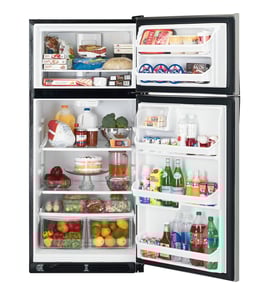



What are signs of a failing refrigerator?
Common signs your Frigidaire FFTR1821QS1 refrigerator is failing include warm temperatures, frequent frost buildup, water leaks, unusual noises, or the cabinet feeling hotter than normal around the compressor area. Catching these symptoms early helps prevent food spoilage and bigger repairs.
- Food in the fresh food section spoils faster than usual (not holding about 37°F).
- Freezer items soften or ice cream stays “scoopable” (not holding about 0°F).
- Frost or ice builds up quickly on the freezer back wall.
- You see water pooling under the refrigerator or inside the fresh food section.
- The refrigerator runs almost constantly or cycles on and off more than normal.
- New rattling, buzzing, clicking, or grinding noises start.
- Condensation forms heavily on shelves, packages, or around the door opening.
- Temperature settings: Confirm controls are set for normal cooling; see the FFTR1821QS1 owner’s manual for the recommended control positions.
- Door seal and closing: Make sure doors close fully and the gasket is clean and seated. A torn gasket can cause warm temps, frost, and long run times.
- Airflow: Do not block vents with food packages; poor airflow causes warm spots and freezing in the wrong areas.
- Condenser area: Clean dust from the condenser area and make sure there is clearance for airflow.
- Power quality: If lights dim or power is unstable, cooling performance can suffer; the manual notes voltage swings can affect performance.
| Symptom | Most common cause | What we recommend |
|---|---|---|
| Warm fridge and freezer | Dirty condenser, airflow issue, sealed system or compressor problem | Clean and recheck temps after 24 hours |
| Frost on freezer wall | Defrost system issue | Inspect defrost components; consider refrigerator defrost heater 242044008 if testing confirms failure |
| Water leaking | Clogged defrost drain, water line not drained after freezing move/storage | Clear drain; follow storage/moving guidance in the manual |
| Loud fan noise | Evaporator fan issue or ice hitting fan | Check for ice buildup; review how to fix your evaporator cooling fan |
A refrigerator that cannot hold safe temperatures can lead to food loss and can overwork major components like the compressor. Addressing door sealing, airflow, and defrost problems early often prevents a complete cooling failure.
Last updated: February 2026
Why is my Frigidaire refrigerator beeping and flashing H1?
On Frigidaire model FFTR1821QS1, a beeping alarm with H1 flashing indicates a high-temperature condition. Most often, the refrigerator or freezer temperature has risen too warm due to a door left ajar, warm food load, airflow blockage, or a cooling/defrost issue.
- Make sure both doors fully close and seal all the way around.
- Confirm nothing is holding the door open (bins, shelves, or a crisper).
- Press the door light switch to confirm the door switch is working.
- Allow 24 hours after temperature changes or heavy loading for temps to stabilize.
- Verify vents are not blocked by packages (air must circulate).
- Check that the refrigerator is plugged into a dedicated outlet and has steady power.
Use these targets to judge whether the alarm is justified:
| Compartment | Normal target | “Too warm” symptoms |
|---|---|---|
| Freezer | 0°F | Soft ice cream, frost melt, dripping |
| Fresh food | 37°F | Spoiling food, condensation, warm drinks |
If the freezer is warm, the fresh food section often warms shortly after.
If doors are closing properly and the alarm returns, check for these common causes:
- Heavy frost on the freezer back wall (points to a defrost system problem)
- No airflow sound from the freezer (evaporator fan issue)
- Temperatures swing widely (sensor/thermistor issue)
Parts that commonly relate to these symptoms on this model include the refrigerator defrost heater 242044008 and the refrigerator temperature sensor 240597220.
High temperatures can lead to food spoilage and can also indicate restricted airflow or a failing cooling/defrost component. Addressing the cause quickly helps the refrigerator recover and prevents repeat alarms.
For control locations, temperature setting guidance, and alarm behavior, follow the FFTR1821QS1 owner’s manual.
Last updated: February 2026
How do I find the model number on my FFTR1821QS1?
The model number for your Frigidaire top-mount refrigerator is printed on the appliance nameplate (rating plate). On FFTR1821QS1 units, the nameplate is typically inside the fresh food compartment on a side wall or near the top, and it lists the model and serial numbers.
Check these common nameplate locations first:
- Inside the refrigerator section on the left or right interior wall
- Along the top interior frame just inside the refrigerator door opening
- Behind the crisper drawers area (look on the liner wall above or beside the drawers)
- On the cabinet frame near the door gasket sealing surface
If you do not see it right away, use a flashlight and look for a small label that says “Model” and “Serial.” The FFTR1821QS1 owner's manual also references the “nameplate” as the identification label.
Write down the model number exactly as shown (letters and numbers) and compare it to what you are using to look up parts.
| What you’ll see | What it’s used for |
|---|---|
| Model number (example: FFTR1821QS1) | Ensures diagrams and parts match your exact refrigerator |
| Serial number | Helps identify production range and version changes |
Frigidaire refrigerators can have small design changes within the same series. Using the exact model number helps us match the correct door gasket, control board, shelves, and other components for proper fit and performance.
Last updated: March 2026