Installation guide
 Owner’s manual
 Error Codes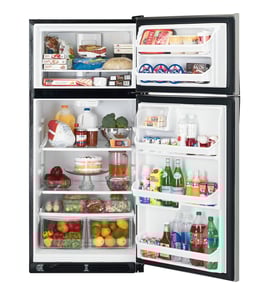

What is the upper part of a fridge called?
On the Kenmore 25368973802 top-mount refrigerator, the upper part is the freezer compartment. It is the section designed to keep food frozen (typically at 0°F or lower) and, on some models, it also houses the ice maker.
What the freezer compartment does
The freezer compartment is built for long-term frozen storage and for maintaining safe frozen temperatures.
- Keeps frozen foods at 0°F or lower for best performance
- Helps the refrigerator run efficiently when it is at least 2/3 full
- May include an automatic ice maker (if equipped)
- Uses airflow from the cooling system to maintain even temperatures
Freezer vs. fresh food compartment (quick comparison)
| Section | Typical target temperature | Main purpose |
|---|---|---|
| Freezer compartment (upper section on this model) | 0°F or lower | Freeze and store frozen foods |
| Fresh food compartment (lower section) | 34°F to 40°F (37°F ideal) | Keep refrigerated foods cold without freezing |
Why it matters
Knowing the correct name helps when you are looking up parts, reading temperature recommendations, or troubleshooting cooling issues. For example, a freezer that is too warm can affect ice production and can also lead to soft or thawing frozen food.
Helpful tips for better freezer performance
- Avoid overpacking; blocked vents can cause uneven cooling
- Keep the door closed as much as possible to prevent frost and temperature swings
- Wait 24 hours after changing temperature controls before making more adjustments
- Use the temperature guidance and control settings in the 25368973802 owner's manual
Last updated: January 2026
Where is the water line on a Kenmore refrigerator?
On Kenmore top-mount refrigerator model 25368973802, the water line connects at the water valve (ice maker inlet valve) on the back of the refrigerator, where the household water supply tubing attaches and is clamped to the rear panel. See the 25368973802 installation guide for the exact routing and connection steps.
Where to look (quick location guide)
- Pull the refrigerator straight out a few inches so you can access the rear lower area.
- Look for the water valve inlet on the back panel; the household water line connects there.
- The tubing is typically secured to the rear panel with a clamp.
- You should also see a coiled loop of extra tubing behind the unit so it can be moved out for cleaning.
- If your unit has an ice maker, the line feeds the ice maker inlet valve.
How the water line is typically routed
Most installations for this model follow this path:
| Section | What you will see | Why it is there |
|---|---|---|
| Household supply | Copper or plastic tubing coming from a shutoff valve | Supplies cold water to the refrigerator |
| Rear connection point | Compression nut and ferrule at the water valve inlet | Seals the connection to prevent leaks |
| Behind the refrigerator | 2 to 3 turns of coiled tubing | Lets you pull the refrigerator out without disconnecting |
Tips before you disconnect or move the line
- Unplug the refrigerator before working near wiring or the valve area.
- Turn off the household shutoff valve, then flush water into a bucket until clear.
- Tighten connections only as needed; over-tightening can damage the fitting.
- After reconnecting, turn water on and check every joint for leaks.
Why it matters
Finding the water line at the rear inlet valve helps you avoid kinking the tubing, prevents leaks at the compression fitting, and makes it easier to troubleshoot ice maker fill problems.
Last updated: January 2026
What are the disadvantages of a top mount fridge?
A top-mount refrigerator like Kenmore model 25368973802 is usually affordable and reliable, but the main disadvantages are less convenient fresh-food access (more bending), fewer organization features than many bottom-freezer designs, and fewer built-in dispenser options on many models. See the 25368973802 use & care manual for features specific to your unit.
Common disadvantages (what you will notice day to day)
- Fresh-food compartment is lower: you bend more to reach produce, deli items, and drinks.
- Freezer is at eye level: great for frozen foods, but it pushes the refrigerator section down.
- Typically fewer premium storage features: fewer full-width pantry drawers, adjustable bins, and specialty zones compared with many bottom-mount styles.
- Less common to have external water and ice: many top-mount models do not include a door dispenser.
- Door swing and clearance can be limiting: you may need extra space to fully open doors and remove bins.
Space and installation tradeoffs
Top-mount refrigerators are often easier to fit in tighter kitchens, but you still need proper clearance and a level cabinet for best performance.
Typical clearance guidance (from installation guidance):
| Area | Typical minimum clearance |
|---|---|
| Sides and top | 3/8 inch |
| Back | 1 inch |
If doors feel uneven or don’t self-close well, leveling the front rollers or leveling screws often helps. The steps and tool sizes are outlined in the 25368973802 installation guide.
When a “disadvantage” is actually a good fit
| If you prioritize… | Top-mount is usually a good choice |
|---|---|
| Lower purchase cost | Yes |
| Easy access to freezer | Yes |
| Easy access to fresh food | No (bottom-freezer is usually better) |
| Built-in dispenser features | Often no |
Why it matters
Ergonomics and storage layout affect how often the doors open, how quickly you find items, and how consistently the refrigerator holds temperature. A layout that matches how your household uses fresh vs. frozen food reduces wasted energy and food spoilage.
Last updated: January 2026