


What is the average lifespan of an ice maker?
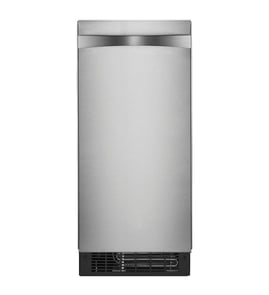
Most freestanding ice makers like KitchenAid model KUIX535HPA01 typically last 7 to 10 years with normal use and routine cleaning; units on hard water or with poor airflow often fail sooner, while well-maintained machines can reach 10 to 15 years.
What affects lifespan the most
- Water quality: hard water scale shortens pump, valve, and evaporator life.
- Cleaning and descaling frequency: mineral buildup forces longer run times.
- Ventilation and ambient temperature: heat makes the compressor work harder.
- Drain setup: slow drains can cause standing water and corrosion.
- Wear parts condition: pumps and cutter grids take the most abuse.
Typical lifespan by component (what usually wears out first)
| Component | Common role | Typical wear signs |
|---|---|---|
| Recirculation pump | Moves water over the evaporator | Weak flow, noisy operation, thin/slow ice |
| Water inlet valve | Controls fill water | No fill, overfilling, intermittent ice |
| Cutter grid | Cuts slab ice into cubes | Ice not cutting, uneven cubes |
| Compressor | Provides cooling | Warm cabinet, very low production |
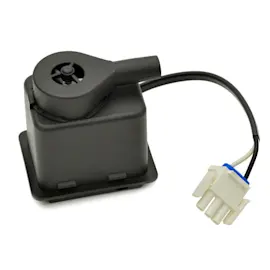
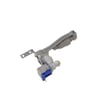
If you are seeing weak circulation or slow ice production, the pump-recircu W11542867 is a common wear item to check on this model.
How we recommend extending the life of your ice maker
- Keep the condenser area clean and maintain clear airflow around the cabinet.
- Use filtered water when possible to reduce scale.
- Descale on a regular schedule (more often with hard water).
- Empty and clean the bin periodically to prevent odors and clumping.
- Address leaks quickly so water does not reach electrical parts.
Why it matters
A freestanding ice maker can still “run” while producing poor ice; that extra run time accelerates wear on the compressor, pumps, and valve. Staying ahead of scale and airflow issues is the simplest way to get the full 7 to 10 year service life.
Last updated: January 2026
Is it worth replacing the ice maker on a refrigerator?
If your refrigerator is otherwise in good shape, replacing the ice maker is usually worth it when the repair is straightforward and costs well under half the price of a comparable new refrigerator. If the fridge is older or has multiple cooling issues, putting that money toward a dedicated unit like the KitchenAid KUIX535HPA01 freestanding ice maker often makes more sense.
Quick decision checklist
- Replace the refrigerator ice maker if the fridge cools normally and you just lost ice production.
- Replace the refrigerator ice maker if you use ice daily and the repair is a single-part fix.
- Consider a new refrigerator if you also have warm temps, frost buildup, or repeated leaks.
- Consider a freestanding ice maker if you want higher daily ice output and easier service access.
- Skip major repairs if the estimate approaches 50% of replacement cost.
Common fixes vs. bigger problems
Many “no ice” complaints come down to water supply or a failed valve, not the entire refrigerator.
| Symptom | Often points to | Typical next step |
|---|---|---|
| No ice, no water entering | Water inlet valve issue | Check/replace valve |
| Runs but makes no ice | Water flow, recirculation, or control issue | Diagnose pump/control |
| Leaking water | Drain or reservoir issue | Inspect drain path/pump |
| Ice not cutting well | Cutter grid issue | Inspect grid and harness |
If you choose a freestanding ice maker instead
With a freestanding unit like KitchenAid model KUIX535HPA01, the most common serviceable items are water handling and circulation components.
- For circulation problems, check the pump-recircu W11542867 (recirculation pump).
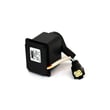
- For draining or standing water, check the pump, reservoir drain W11542868 (drain pump).
- For fill problems, check the valve W10897719 (water inlet valve).
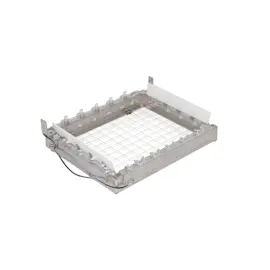
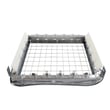
- For “not cutting ice,” inspect the cutter grid and consider the grid-assy, 2 W10919199.
Why it matters
A refrigerator ice maker repair can be a great value when it restores a single feature. But if you are chasing multiple symptoms, a dedicated freestanding ice maker can deliver more consistent ice production and can be simpler to troubleshoot and maintain.
Last updated: January 2026
Why is my KitchenAid icemaker not making ice?
If your KitchenAid KUIX535HPA01 freestanding ice maker isn’t making ice, the most common causes are no water supply, restricted water flow, a dirty/blocked water system, or a failed component that circulates or fills water. Start with water supply checks, then move to cleaning and part testing.
Quick checks (fastest fixes first)
- Confirm the unit is powered on and not in a cleaning or standby mode.
- Verify the water shutoff valve is fully open.
- Check the supply line for kinks, pinches, or freezing.
- Make sure the room has adequate airflow around the unit (poor ventilation reduces ice production).
- Empty the bin and confirm nothing is blocking the ice thickness sensor area (if equipped).
What to inspect next (common failure points)
If the basics look good, focus on the parts that fill and move water through the system:
- Water inlet valve: if it doesn’t open, the reservoir won’t refill.
- Recirculation pump: if it’s weak or not running, water won’t flow over the evaporator properly.
- Reservoir and drain system: scale buildup or debris can restrict flow and stall the cycle.
Helpful model-matched parts to consider:
Symptoms and likely causes
| What you notice | Most likely cause | What we recommend |
|---|---|---|
| Runs but no ice | No fill or poor water flow | Check valve W10897719 and supply line |
| Very small/slow ice | Restricted circulation or dirty system | Clean/descale; check pump-recircu W11542867 |
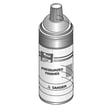
| Leaking water | Loose line, cracked reservoir, valve seep | Inspect fittings; check ice maker water reservoir W11614100 |
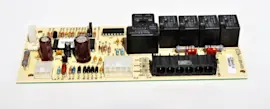
| Won’t run at all | Power issue or control problem | Check outlet, reset power; consider control diagnostics |
Why it matters
Freestanding ice makers like the KUIX535HPA01 depend on steady water flow over the evaporator. Even a small restriction (scale, a weak pump, or a sticking valve) can stop ice production or cause thin, slow batches.
For step-by-step troubleshooting by symptom, use freestanding ice maker troubleshooting.
Last updated: January 2026