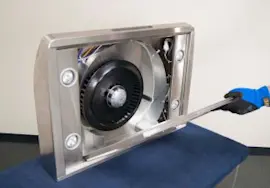
Installation guide
 Owner’s manual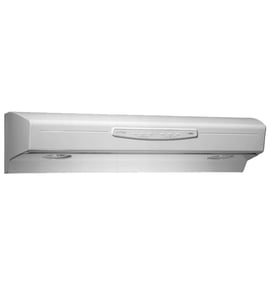




Is a downdraft vent worth it?
A downdraft vent can be worth it when you need ventilation but cannot run overhead ducting or fit a traditional range hood. For the Broan RMDD3604 downdraft blower system, it is built to exhaust cooking contaminants for gas or electric cooktops and can mount in island, peninsula, or wall locations; see the RMDD3604 owner's manual.
Downdraft ventilation is usually the right fit when kitchen layout and duct routing are the main constraints.
- You have an island or peninsula cooktop and do not want an overhead hood
- You have limited space for ductwork in a multi-level home or tight cabinet run
- You want a cleaner sightline (no canopy hood blocking views)
- You cook mostly everyday meals and want steady odor and steam capture
- You can keep duct runs short with fewer elbows (best performance)
The RMDD3604 is designed around 3-1/4 in. x 10 in. ductwork that can be transitioned to 6 in. round. For best performance, the duct option with the shortest run and the fewest elbows and transitions works best; the RMDD3604 installation guide walks through planning and duct routing.
| Factor | Downdraft vent (RMDD3604 style) | Typical impact |
|---|---|---|
| Duct length and elbows | More sensitive than many overhead hoods | Longer, twistier duct reduces airflow |
| Gas cooktop flame | High airflow can affect flame | Lower blower speed corrects it |
| Countertop space | Needs flat space behind cooktop | Impacts cooktop placement and cutout |
| Noise | Often reasonable at lower speeds | Higher speeds can be louder |
Ventilation is about capturing smoke, grease, and moisture before it spreads. With a downdraft, duct layout and cabinet clearances drive results as much as the blower itself, so planning the cutout, duct direction, and electrical outlet location is what makes the vent “worth it.”
If you are planning duct routing or replacing damaged venting components, these model-matched parts are commonly involved:
- Range hood vent duct, 6-in 406 (duct connection option)
- Transition S411 (helps adapt duct direction/shape)
- Range hood round vent damper S97010792 (helps prevent backdraft)
For ordering RMDD3604 replacement parts, use the parts list for this model or search by model number on Sears PartsDirect.
Last updated: February 2026
Is 36 inches too high for a range hood?
No, 36 inches is not too high for an overhead range hood; it is typically the maximum recommended mounting height above the cooking surface. If you mount an overhead hood higher than 36 inches, it captures less smoke and grease. For the Broan RMDD3604, this question usually does not apply because it is a downdraft ventilator installed behind the cooktop, not an overhead hood; use the RMDD3604 installation guide for the correct cutout and placement details.
Most wall and under-cabinet range hoods perform best when installed within a standard height window.
- Typical target height: 24 to 30 inches above the cooktop
- Common maximum height: 36 inches above the cooktop
- Higher than 36 inches: noticeably weaker capture of steam, smoke, and grease
- Gas cooking often benefits from staying closer to the lower end of the range (while following the hood’s instructions)
The RMDD3604 is designed to exhaust at the cooktop level and uses ductwork and cabinet planning instead of an overhead mounting height.
Key installation points we follow for this model:
- It fits standard 36-inch wide cabinets (model-specific)
- It plugs into a 120 VAC, 60 Hz grounded outlet (plan outlet location before installation)
- It uses a standard 3-1/4 inch x 10 inch duct connector
- Ducted fans must be vented outdoors and use metal ductwork
| Setup | What “36 inches” means | What happens if you go higher |
|---|---|---|
| Overhead range hood | Distance from cooktop to hood intake | Less effective ventilation and capture |
| RMDD3604 downdraft | Not a mounting-height spec | Focus is on cutout, duct routing, and clearances |
Ventilation works by capturing the cooking plume. With an overhead hood, too much distance lets smoke and grease spread before the fan can pull it in. With a downdraft like the RMDD3604, performance depends more on correct duct routing, cabinet clearances, and a proper outdoor vent.
If airflow seems weak after installation, these parts are often involved in the vent path (match parts to your exact configuration):
You can order replacement parts for your Broan RMDD3604 from the parts list for this model, or search by model number on Sears PartsDirect.
Last updated: February 2026
What are the disadvantages of recirculating hoods?
Recirculating (ductless) range hoods filter air and send it back into the kitchen, so they control smoke, heat, and moisture less effectively than venting outdoors. For the Broan RMDD3604 downdraft, our guidance is to vent to the outdoors per the RMDD3604 installation guide.
- Moisture stays indoors: steam can raise indoor humidity during boiling and simmering.
- Heat stays indoors: the cooking area feels warmer because heat is not exhausted outside.
- Odors can linger: charcoal filtration reduces odors but does not clear them like outdoor venting.
- More upkeep: odor-control filters require regular replacement to stay effective.
- Grease film can build up: more airborne residue can settle on cabinets and walls over time.
| Feature | Ducted (vented outdoors) | Recirculating (ductless) |
|---|---|---|
| Odor and smoke removal | Strongest | Moderate |
| Moisture and heat removal | Strongest | Limited |
| Maintenance | Lower | Higher (filter changes) |
| Best use case | Most cooking styles | Light cooking, no duct option |
The RMDD3604 is built around ducted exhaust. The installation and safety guidance for this type of downdraft setup calls for ducted fans to be vented outdoors and using proper metal ductwork. Choosing a recirculating hood instead is a performance tradeoff; it is not the intended configuration for this model.
- Use smooth, metal ductwork sized to the installation requirements.
- Keep the duct run as short and straight as possible.
- Seal duct joints to prevent air leaks.
- Make sure the damper opens freely and is not blocked.
- Replace damaged duct components such as the range hood vent duct, 6-in 406.
You can order RMDD3604 replacement parts from the parts list for this model, or search by model number on Sears PartsDirect.
Last updated: February 2026
What's the best CFM for a range hood?
For a range hood, the best CFM is the lowest airflow that reliably captures smoke and odors for how you cook. For the Broan RMDD3604 downdraft ventilator, the documentation for the internal blower lists 500 CFM; use that as the baseline and focus on ducting quality for real performance (see the RMDD3604 installation guide).
Use these ranges when comparing hoods and downdrafts:
- 100 to 250 CFM: light cooking, low smoke
- 300 to 450 CFM: typical daily cooking
- 500+ CFM: frequent frying, searing, high heat, strong odor control
Airflow ratings drop quickly when ducting is restrictive. For best results:
- Keep duct runs short and as straight as possible
- Minimize elbows; avoid crushed flex duct
- Match the duct connector size to the blower outlet
- Use a damper to reduce backdraft and outside air leaks
- Keep grease buildup under control so the blower can move air
The RMDD3604 is designed to connect to 3-1/4 inch x 10 inch ducting; it can also be routed to 6 inch round using a transition.
| Item | RMDD3604 guidance | Why it matters |
|---|---|---|
| Airflow baseline | 500 CFM (internal blower) | Sets expectations for capture and duct sizing |
| Primary duct | 3-1/4 inch x 10 inch | Best match to the unit connection |
| Alternate duct | 6 inch round (with transition) | Helps when routing around framing |
If you are correcting duct routing or backdraft issues, these model-compatible parts are commonly used:
Right-sized airflow clears grease, smoke, and odors faster. Good ducting preserves real-world CFM, reduces noise, and helps prevent backdrafting in tighter homes.
Last updated: February 2026