Error Codes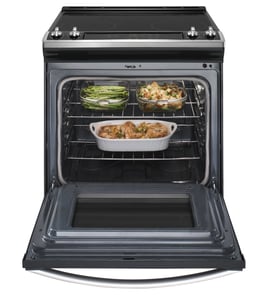




How long does a Samsung electric range last?
A Samsung electric range like model FER300SB typically lasts 13 to 15 years with normal household use and basic maintenance. Keeping the oven temperature accurate and fixing heating or control issues early helps you get the full lifespan from the range.
- Heat stress over time: frequent high-heat baking/broiling shortens element life.
- Power quality: loose terminal connections or voltage issues can damage wiring and controls.
- Cleaning habits: spills left to bake on can damage finishes and create hot spots.
- Door seal and door alignment: heat loss forces longer run times.
- Small failures left unfixed: a weak element or bad sensor can strain other components.
If cooking results change (slow preheat, uneven baking, temperature swings), these parts are common suspects:
- Samsung range oven temperature sensor DG32-00002B
- Range bake element DG47-00038A
- Samsung range broil element DG47-00037A
- Samsung range surface element control switch DG44-01002A
| Symptom | Most likely area | Common part to check |
|---|---|---|
| Oven temperature seems off | Temperature sensing | Oven temperature sensor |
| Oven will not heat or heats weakly | Oven heating | Bake element |
| Broil does not work | Broil heating | Broil element |
| One surface burner not regulating heat | Cooktop control | Surface element control switch |
A range can still “turn on” but cook poorly when temperature sensing or heating output drifts. Restoring accurate heat often improves baking results, reduces preheat time, and helps the range reach its normal 13 to 15 year service life.
Last updated: January 2026
What are the common problems with Samsung ranges?
Common Samsung electric range issues include the oven not heating correctly, uneven baking, surface elements not heating, and error codes on the display. On the Samsung FER300SB range, these symptoms most often trace back to a failed heating circuit (bake or broil), a temperature sensing problem, or a surface element control issue.
- Oven won’t heat or heats weakly: failed bake element, wiring issue, or control problem
- Oven temperature is inaccurate: drifting temperature sensor or control calibration issue
- Uneven baking: weak bake element, broil assist not working, or airflow obstruction
- Surface element won’t heat: failed radiant element or infinite switch
- Display shows an error code: a detected fault such as sensor, door lock/latch, or control issue
If you are troubleshooting by symptom, these model-matched parts are common starting points:
| Symptom | Common suspect part | What it affects |
|---|---|---|
| Oven temp swings, overheating, or error codes | Samsung range oven temperature sensor DG32-00002B | Tells the control board the oven temperature |
| No bake heat or long preheat | Range bake element DG47-00038A | Primary oven heating for bake |
| No broil heat | Samsung range broil element DG47-00037A | Top heat for broil and browning |
| Surface element not heating | Samsung range surface element control switch DG44-01002A | Sends power to the cooktop element |
- Confirm the cooking mode: Bake vs. Broil vs. Convection (if equipped)
- Look for visible damage: blisters, cracks, or burn marks on elements
- Test a different burner: helps separate a single-element failure from a power/control issue
- Check for tripped breaker: many electric ranges use a 240V double breaker
- Note any error code: it narrows the diagnosis fast
If your Samsung range is showing a code, use Samsung freestanding electric range error codes to match the code to the most likely failed circuit (sensor, latch, control, etc.).
A weak bake element or inaccurate sensor can cause undercooked food, long preheat times, and inconsistent results. Catching the failing part early also helps prevent heat damage to wiring and connectors.
Last updated: January 2026
What type of plug does a Samsung electric range use?
Most Samsung electric ranges (including model FER300SB) use a heavy-duty range cord that plugs into either a 3-prong (3-wire) or 4-prong (4-wire) range outlet, depending on your home’s wiring. The range typically connects to a 208/120V or 240/120V, 60 Hz single-phase supply.
In most homes, the outlet type determines the plug type:
- Homes built in 1996 or later: typically use a 4-prong (4-wire) range outlet and cord
- Older homes (often pre-1996): commonly have a 3-prong (3-wire) range outlet and cord
- The cord is usually not included with the range, so you match the cord to your outlet
- If you are changing the outlet type, have an electrician update the circuit to match
| Outlet/cord type | Prongs | Typical home wiring | When it’s used |
|---|---|---|---|
| 3-wire range cord | 3 | Older installations | When the home has a 3-slot range receptacle |
| 4-wire range cord | 4 | Newer installations | When the home has a 4-slot range receptacle |
Use this checklist so you get the right power connection for your Samsung range:
- Look at the wall outlet: 3-slot or 4-slot
- Confirm the circuit is a range circuit (not a standard 120V outlet)
- Verify the cord length reaches without stretching or pinching
- Make sure the strain relief is installed so the cord cannot pull on internal wiring
- If the cord or terminals are damaged, replace the cord rather than reusing it
If you need a replacement cord for FER300SB, we recommend using the correct range-rated cord such as the power cord DG96-00048A when it matches your installation.
Using the correct 3-wire or 4-wire range cord helps ensure proper grounding and safe operation, and it prevents nuisance power issues that can affect heating performance and control operation.
Last updated: January 2026