Owner’s manual
 Error Codes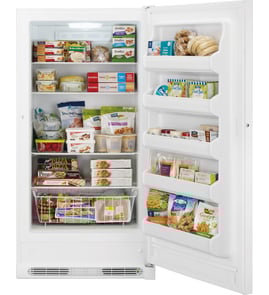



What is the average lifespan of an upright freezer?
Most upright freezers, including the GE FUF21SVDRWW, typically last 10 to 20 years, with 12 to 15 years being common in normal home use. Consistent airflow clearance, good door sealing, and routine cleaning are the biggest factors that help an upright freezer reach the high end of that range.
Typical lifespan range (what to expect)
- Average: 12 to 15 years
- Common overall range: 10 to 20 years
- Shorter lifespan is more likely when: the freezer runs in a hot garage, has restricted airflow, or has a leaking door gasket
| Usage and conditions | Typical outcome | What helps most |
|---|---|---|
| Normal indoor use, good maintenance | 12 to 15 years | Keep seals tight, keep airflow open |
| Hot or humid location (garage, basement) | 10 to 12 years | Improve ventilation, reduce heat load |
| Well maintained, stable environment | 15 to 20 years | Clean regularly, avoid overloading door area |
Maintenance habits that extend life
We recommend these practical steps for upright freezers like this GE model:
- Keep airflow clearance around the cabinet so the system can shed heat efficiently.
- Make sure the freezer is level so the door closes and seals easily.
- Avoid overpacking so food does not extend past the front of shelves and interfere with sealing.
- Clean the interior with a baking soda and warm water solution; avoid abrasive cleaners.
- If your model is No-Frost, it defrosts automatically, but it still benefits from occasional cleaning.
For model-specific care and operating details (temperature control, leveling, cleaning cautions), follow the FUF21SVDRWW owner's manual.
Why it matters
A freezer that seals well and can circulate air properly runs fewer hours per day. That reduces wear on the compressor and controls, helps maintain stable temperatures, and can prevent frost and moisture issues that shorten component life.
Last updated: January 2026
What are the three types of freezers?
The three main freezer types are upright freezers, chest freezers, and refrigerator-freezer combos. Your GE FUF21SVDRWW is an upright freezer, which typically offers easier organization and faster access to food than a chest-style unit (with slightly more door-opening air loss).
The 3 freezer types (quick breakdown)
- Upright freezer: Stands like a refrigerator; shelves, bins, and baskets help organize food.
- Chest freezer: Opens from the top; best for bulk storage and long hold times during power outages.
- Refrigerator-freezer combo: A standard refrigerator with a built-in freezer section (top, bottom, or side-by-side).
How they compare
| Type | Best for | Typical strengths | Typical tradeoffs |
|---|---|---|---|
| Upright | Everyday access and organization | Shelves/bins, smaller footprint | Loses cold air faster when door opens |
| Chest | Bulk storage and efficiency | Very energy efficient, holds temp longer | Harder to organize, requires floor space |
| Fridge-freezer combo | One appliance for fresh + frozen | Convenience, common sizes | Less freezer capacity than dedicated units |
Why it matters when choosing or using a freezer
Freezer type affects how you store food, how often you open the door, and how efficiently the unit maintains temperature. For example, upright models like the GE FUF21SVDRWW often include adjustable storage features (bins, shelves, baskets) and benefit from keeping items labeled and organized to reduce door-open time.
Tips we recommend for upright freezer performance
- Keep the freezer in a cool, dry, well-ventilated area away from heat sources.
- Let hot foods cool to room temperature before loading.
- Avoid overloading; it can force longer compressor run times.
- Do not line shelves with foil or paper; it restricts cold-air circulation.
- Organize and label food to minimize door openings.
For model-specific operating details (controls, alarms, storage features), use the FUF21SVDRWW owner’s manual.
Last updated: January 2026
What is the difference between an upright freezer and a garage ready upright freezer?
A standard upright freezer like the GE FUF21SVDRWW is designed for stable indoor temperatures, while a garage-ready upright freezer is built to keep food safely frozen through wider hot and cold ambient swings in an unconditioned garage. The key difference is reliable performance across extreme room temperatures.
What “garage-ready” changes (and why)
Garage-ready models are engineered to handle tougher conditions that can cause temperature problems in a typical freezer.
- Wider ambient operating range (hot summers and cold winters)
- More robust temperature sensing and control strategy
- Better tolerance for frequent door openings and warm air infiltration
- Components selected to perform consistently when the surrounding air is very cold or very hot
- Reduced risk of nuisance alarms or warming during extreme conditions
How to decide which one you need
If your freezer will live in a climate-controlled space (kitchen, basement, utility room), a standard upright freezer is usually the right fit. If it will live in a garage that can get very cold or very hot, garage-ready is the safer choice.
| Location | Typical conditions | Best choice |
|---|---|---|
| Kitchen or conditioned basement | Steady indoor temps | Standard upright freezer |
| Uninsulated garage | Big seasonal swings | Garage-ready upright freezer |
| Insulated garage with HVAC | Similar to indoors | Standard or garage-ready |
Why it matters for food safety and alarms
Your freezer needs to stay at safe freezing temperatures even when the surrounding air changes. The GE manual notes that if the freezer temperature rises above 25°F, a high-temperature light and alarm can activate until temperatures drop again. Checking the placement and operating guidance in the FUF21SVDRWW owner’s manual helps you avoid warm-ups and repeated alarms.
Setup tips that help either type perform better
- Leave clearance around the cabinet for airflow (top, back, and sides)
- Level the freezer so the door closes and seals easily
- Do not let packages extend past the front of shelves (helps the door seal)
- Keep the door gasket clean so it seals tightly
- If you see an error code on the display, follow the manual’s guidance for service
Last updated: January 2026