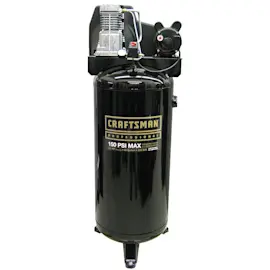
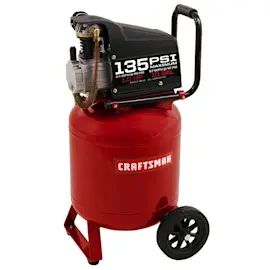
Owner’s manual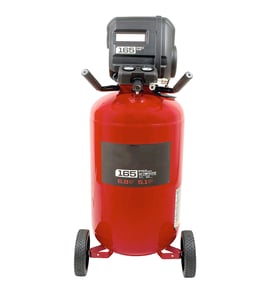

How do I find my compressor model number?
Your Craftsman air compressor’s model number is printed on the unit’s identification label or data plate; for this series, it appears in the format 919.167782. On model 919167782, you’ll typically find it on the tank or frame, and it matches the model number shown in the owner's manual.
Where to look on a Craftsman air compressor
Check these common spots first (clean dust and overspray off the label so you can read it):
- Air tank: front, side, or near the base weld seam
- Frame or handle area: near the wheels or carry handle
- Pump shroud or motor area: on or near the protective cover
- Near the power cord: sometimes close to the cord entry point
- Near warning labels: model and serial info is often grouped with safety labels
What the model number looks like (and why it matters)
Craftsman compressor model numbers are usually a 3-digit prefix plus a 6-digit suffix (example: 919.167782). Using the exact model number helps us match the correct repair parts list, diagrams, and specifications.
| What you see on the label | What it means | Use it for |
|---|---|---|
| Model No. 919.167782 | The full model identifier | Parts lookup and manual match |
| Serial No. (varies) | Your unit’s unique ID | Recordkeeping and service history |
Tips to avoid common mix-ups
- Write the model number exactly as shown, including the dot if it’s printed (919.167782).
- Don’t use numbers from the motor label; the motor part number is different from the compressor model.
- If the label is worn, look for the model number on the manual cover or parts list pages, then confirm it matches the tank label.
Why it matters
The model number is the fastest way to get the right pressure switch, check valve, gauges, and pump components for your exact compressor configuration. Once you have it, you can search by model on Sears PartsDirect to pull up the correct diagrams.
Last updated: February 2026
How to tell if an air compressor regulator is bad?
On a Craftsman 919167782 air compressor, a bad regulator shows up as outlet pressure that will not adjust smoothly, will not hold steady, or leaks air even when you are not using a tool. Confirm by setting the outlet pressure to zero, then raising it and watching for creep, droop, or constant hissing.
Quick symptoms checklist
- Outlet pressure will not change when you turn the regulator knob
- Outlet pressure “creeps” upward after you stop adjusting it
- Outlet pressure drops hard when you pull the trigger (pressure droop)
- Pressure fluctuates or pulses at the outlet gauge
- Audible hissing at the regulator body, gauge threads, or quick connect
- Tools run weak or inconsistent even with a full tank
Simple tests we use (safe, fast)
- Start with the outlet at zero: Pull the regulator knob out and turn it counterclockwise until it stops; push in to lock (this is the normal start-up method in the owner's manual).
- Build tank pressure: Turn the On/Auto/Off lever to AUTO and let the tank fill to cut-out.
- Set a mid-range outlet pressure: Pull the knob out, turn clockwise to a moderate setting, then push in to lock.
- Watch the outlet gauge: If the outlet pressure rises on its own (creep) or will not stabilize, the regulator is failing.
- Listen and feel for leaks: With no air tool connected, a steady hiss at the regulator usually points to a worn internal seal/diaphragm or debris in the valve.
What “normal” vs “bad” looks like
| What you see at the outlet gauge | Most likely meaning | What to do next |
|---|---|---|
| Holds steady at the set pressure | Regulator is working | Use as normal |
| Slowly rises after setting | Regulator creep | Replace regulator |
| Drops sharply under airflow | Restriction or weak regulator | Check hose/quick connect; replace regulator if OK |
| Won’t adjust at all | Stuck/failed regulator | Replace regulator |
Why it matters
The regulator controls downstream (tool) pressure. Too much outlet pressure can damage air tools and accessories; too little pressure causes poor performance. The manual also stresses keeping regulator outlet pressure within the tool’s maximum rating.
If replacement is needed
Your manual includes a regulator replacement procedure (depressurize the tank, unplug, remove the outlet gauge and quick connect, then reinstall with correct airflow direction). Use the owner's manual for the step-by-step sequence and orientation notes. For parts lookup by model number, search 919167782 on Sears PartsDirect.
Last updated: February 2026
What is the average lifespan of an air compressor?
Most homeowner and light shop air compressors last about 5 to 10 years with normal use and routine maintenance. For your Craftsman 919167782 air compressor, lifespan depends most on duty cycle, keeping the tank drained, and staying on a consistent service schedule in the owner's manual.
Typical lifespan by compressor type
These ranges reflect what we see most often in real-world use:
- DIY or homeowner portable compressors: 5 to 10 years
- Prosumer or contractor-grade portables: 8 to 15 years
- Industrial rotary screw systems: 10 to 20 years
What shortens lifespan fastest (and what to do instead)
The manual for model 919167782 calls out two big longevity factors: duty cycle and routine maintenance.
- Running past the duty cycle: Keep pumping time to 30 minutes per hour max (50% duty cycle)
- Skipping tank draining: Drain moisture to reduce internal corrosion
- Ignoring the safety valve: Check it regularly so the unit can protect itself from over-pressure
- Dusty or humid environments: Service the air filter and valves more often
- Electrical strain: Use the correct circuit protection and avoid undersized extension cords
Maintenance schedule that supports a longer life
The manual’s “Customer Responsibilities” section is a solid baseline. Here is a simplified version you can follow:
| Task | Frequency | Why it matters |
|---|---|---|
| Check safety valve | Before each use | Helps prevent over-pressure damage |
| Drain tank | After each use | Reduces rust and water contamination |
| Inspect/clean air filter | Often; more in dust/humidity | Protects pump and valves |
| Check intake/exhaust valves | Periodically | Maintains compression efficiency |
Why it matters
An air compressor usually “wears out” from heat, moisture, and overwork. Staying under the 50% duty cycle and keeping water out of the tank does more to extend service life than any single repair.
For step-by-step troubleshooting when the unit starts aging (hard starting, slow pressure build, frequent cycling), use our DIY guide: air compressor won't build tank pressure.
If you need to look up diagrams and part numbers for your model, start with the model list and diagrams, then expand your search on Sears PartsDirect.
Last updated: February 2026
Is it worth it to repair a compressor?
For a Craftsman 919167782 air compressor, repair is worth it when the problem is a single, serviceable failure (like a pressure switch, check valve, or leak) and the tank and motor are in good shape. If the tank is compromised or multiple major components are failing, replacement is the better value.
Quick decision checklist (919167782)
- Repair it if the unit still runs, builds pressure close to normal, and the issue is isolated (no-start, leaking, won’t regulate pressure).
- Replace it if the tank will not safely hold air, the motor repeatedly overheats, or repair costs stack up across several systems.
- Check warranty first: this model’s manual describes a full one-year warranty for defects in materials or workmanship (shorter for commercial or rental use). See the 919167782 owner's manual.
Common “worth repairing” problems (and why)
These are typically straightforward and parts-labor efficient compared with replacing the whole compressor:
- Won’t start (often electrical supply, pressure switch, or unloader related)
- Won’t build tank pressure (often valve, gasket, or pump sealing issue)
- Air leaks at fittings or regulator
- Output pressure won’t adjust (regulator or control issue)
- Gauge not reading correctly (gauge or blockage)
Helpful troubleshooting paths:
Cost and condition guide
Use this table to decide quickly based on what you’re seeing.
| What you observe | Typical best choice | Reason |
|---|---|---|
| Single symptom, otherwise normal cycling | Repair | One component usually restores performance |
| Multiple symptoms (leaks + won’t start + poor pressure) | Replace | Compounded failures raise cost fast |
| Tank won’t hold air or shows severe corrosion | Replace | The tank is the core safety component |
| Motor struggles, trips breakers, or overheats repeatedly | Replace (often) | Motor repairs can approach replacement cost |
Why it matters (safety and reliability)
Air compressors store high-pressure air and use line voltage. The manual warns that unqualified electrical repairs and operating with missing guards can cause serious injury. Before any maintenance or repair, disconnect power and bleed off all tank pressure; follow the 919167782 owner's manual.
Ordering parts
If you decide to repair, we recommend matching parts by the exact model number 919167782. You can search by model on Sears PartsDirect.
Last updated: February 2026
What is the most common cause of air compressor failure?
The most common cause of air compressor failure is poor maintenance that leads to overheating and accelerated wear. On the Craftsman 919167782 air compressor, restricted ventilation, a dirty intake filter, and not draining the tank can contribute to overheating, rust, leaks, and early component failure; see the 919167782 owner's manual.
Most common failure drivers (and what to do)
- Overheating from restricted airflow: Keep ventilation openings clear; don’t place objects against or on top of the compressor.
- Moisture left in the tank: Drain the tank daily or after each use to reduce internal rust and tank weakening.
- Dirty or restricted air intake filter: Clean or replace the intake filter; don’t run the compressor with the filter removed.
- Air leaks and check valve issues: Leaks force longer run times and extra heat; a restricted or defective check valve can also cause performance problems.
- Electrical supply problems: Use a properly grounded circuit with correct voltage and adequate fuse protection.
Quick troubleshooting checklist
- Verify the compressor sits in an open area with at least 12 inches of clearance for airflow.
- Drain condensation from the tank (daily or after each use).
- Inspect the intake filter; clean or replace if dirty.
- Listen for constant hissing after shutoff (often points to a leak or check valve problem).
- Confirm the outlet regulator is adjusted under flow (while a tool is running), not with no airflow.
Common symptoms and likely causes
| Symptom | Likely cause | What we recommend |
|---|---|---|
| Runs hot, trips, or smells hot | Blocked ventilation, long run time from leaks | Improve airflow clearance; check for leaks |
| Won’t build tank pressure | Leaks, restricted intake filter, valve issues | Check filter; inspect fittings and valves |
| Pressure drops when using a tool | Normal drop or regulator set wrong | Adjust regulator under flow |
| Tank won’t hold air | Tank leak or fitting leak | Tighten fittings; replace leaking tank (do not repair) |
Why it matters
Heat, moisture, and leaks compound each other: leaks increase run time, longer run time increases heat, and moisture left in the tank promotes rust. Staying on top of airflow clearance, tank draining, and filter condition prevents many “sudden” failures.
Helpful DIY guides
- Air compressor won't start
- Air compressor won't build tank pressure
- Air compressor air leaks
- How to replace an air compressor check valve
For model-based parts lookup and diagrams, start with the parts list for Craftsman 919167782, or search by model on Sears PartsDirect.
Last updated: February 2026