Owner’s manual
 Error Codes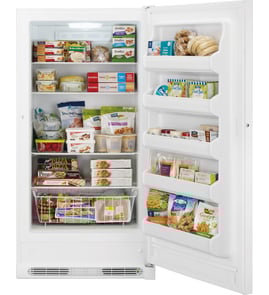



How many cubic feet is my upright freezer?
For Kenmore model 25322042410, the exact cubic-foot capacity is not stated in the model-specific information we have here, so we can’t confirm a single number for your unit. We can still help you estimate capacity by matching your freezer’s exterior size to common upright-freezer size ranges in the 25322042410 use & care manual.
Measure your freezer’s width, height, and depth (in inches), then compare to these typical ranges:
- Compact: 3 to 5 cu. ft. (about 20–24 in W, 31–37 in H, 20–25 in D)
- Small: 5 to 9 cu. ft. (about 21–25 in W, 55–60 in H, 22–26 in D)
- Medium: 10 to 16 cu. ft. (about 23–31 in W, 60–73 in H, 27–30 in D)
- Large: 17+ cu. ft. (about 27–34 in W, 64–76 in H, 29–30 in D)
- Measure cabinet width at the widest point (not the handle).
- Measure height from floor to top of cabinet.
- Measure depth from back to front of cabinet (exclude handle; include door if you want “overall depth”).
- If your freezer is in a tight spot, allow for airflow clearance; the manual commonly recommends space around the unit.
| What you’re doing | What you’ll get | Best for |
|---|---|---|
| Compare exterior dimensions to ranges above | A good estimate | Shopping for bins, planning storage |
| Find the model’s rated capacity on the data plate or specs | Exact cu. ft. | Matching to Energy Guide, resale listings |
Knowing approximate cubic feet helps you plan food storage, choose baskets/shelves, and avoid overloading. As a general rule, freezers perform best when air can circulate and the door seals well.
Last updated: January 2026
Where is the reset button on a Kenmore upright freezer?
Kenmore upright freezer model 25322042410 typically does not have a dedicated reset button. If you need to “reset” it, we recommend power-cycling the freezer (unplug briefly, then restore power) and then confirming the temperature control settings per the 25322042410 use & care guide.
A reset is usually just restoring normal control operation after a power issue, door left open, or a temperature alarm.
- Unplug the freezer (or switch off the breaker) for about 5 minutes.
- Plug it back in (or turn the breaker on).
- Set the temperature control back to your normal setting.
- Allow time for temperatures to stabilize (several hours).
- If the freezer was recently warm, allow up to 24 hours to fully return to normal temps.
If power-cycling does not help, the issue is usually power, airflow, or a failed cooling/defrost component.
- Make sure the temperature control is not set to OFF.
- Confirm the outlet has power (try a different small appliance).
- Check that the door closes and seals fully (warm air leaks can mimic “no reset”).
- Listen for the evaporator fan; if it is not running, cooling will suffer.
- If you see heavy frost buildup, a defrost problem may be preventing airflow.
| Symptom | What it can point to | Example compatible part for this model |
|---|---|---|
| Warm freezer, fan not running | Fan motor issue | Freezer evaporator fan motor 297309000 |
| Heavy frost, poor airflow | Defrost system issue | Freezer defrost timer 5304518034 |
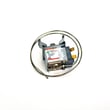
| Temps drift, control feels inconsistent | Temperature control issue | Temperature control 5304513033 |
A “reset” often temporarily clears a control hiccup, but if the freezer repeatedly warms up or alarms, it usually indicates an underlying issue (door sealing, airflow restriction, or a failing electrical/cooling part) that needs attention to prevent food loss.
Last updated: January 2026
What is the average lifespan of an upright freezer?
Kenmore doesn’t publish an “expected lifespan” for model 25322042410 in the product documentation; the 25322042410 use & care manual focuses on safe operation, care, and warranty terms. As a general industry guideline, many upright freezers last around 10 to 15 years, with longer life possible when maintenance and operating conditions are favorable.
The manual provides care and operating guidance that directly impacts longevity, including:
- Allowing airflow around the cabinet (the guide calls for clearance on all sides)
- Keeping the door aligned and sealing properly (leveling helps prevent sealing problems)
- Defrosting and cleaning when frost builds up (for units that are not frost-free)
- Using a dedicated, properly grounded electrical outlet
- Heat and poor ventilation: Higher room temps and tight clearances increase compressor run time.
- Door seal leaks: Warm air leaks cause longer run times and more frost.
- Frost buildup: Thick frost reduces efficiency and can lead to temperature swings.
- Power interruptions/voltage issues: Can stress electrical components.
- Usage patterns: Frequent door openings and warm food loads increase workload.
- Keep vents and airflow paths inside the freezer unobstructed.
- Level the freezer so the door closes and seals consistently.
- Defrost and clean before frost becomes heavy.
- Check the gasket for gaps, tears, or stiffness; replace if it won’t seal.
- Keep the condenser area free of dust buildup.
| If your freezer is… | Usually consider | Why it matters |
|---|---|---|
| Holding temp well with minor issues | Maintenance/repair | Often restores efficiency and reliability |
| Struggling with door sealing | Gasket/hinge inspection | Air leaks can mimic bigger problems |
| Not cooling consistently | Diagnosis first | Could be airflow, defrost, or sealed-system related |
As a freezer ages, small issues like poor sealing, frost buildup, or restricted airflow can raise energy use and put extra strain on the cooling system. Staying on top of basic care is one of the best ways to maximize service life.
Last updated: January 2026