Owner’s manual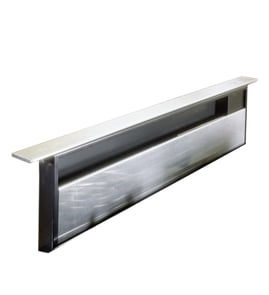




What are the cons of a downdraft range?
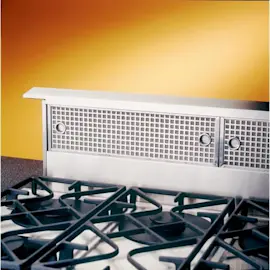
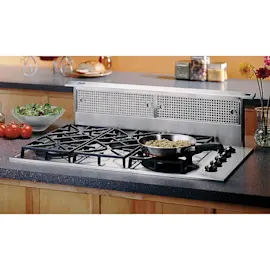
Downdraft ventilation (like the Broan 273003 system used with a cooktop) trades convenience and a clean sightline for weaker capture of smoke and steam compared with an overhead hood; it can also affect some gas flames at high speed, takes up cabinet space, and adds ducting complexity.
Main drawbacks to know
- Less effective for heavy smoke and tall cookware: Steam and smoke naturally rise, so pulling it downward is harder, especially with high-heat searing or large pots.
- Can disturb gas flames: The 273003’s high airflow can affect the gas flame on some cooktops; lowering blower speed typically corrects it (this is normal operation). See the owner's manual.
- Reduced cabinet storage: The chimney, blower, and duct path occupy space behind drawers or inside the base cabinet.
- More installation constraints: You need specific clearances behind the cooktop and inside the cabinet, plus careful duct routing to avoid joists, studs, wiring, or plumbing.
- More maintenance access planning: Grease and debris can collect in the intake area; access is tighter than with many wall hoods.
- Noise can feel more noticeable: The blower is closer to the cooktop surface and cabinet cavity.
Installation and performance trade-offs (quick comparison)
| Feature | Downdraft (273003-STYLE) | Overhead hood |
|---|---|---|
| Smoke capture | Best for light to moderate cooking | Best for heavy smoke and high heat |
| Space impact | Uses base-cabinet space | Uses upper-cabinet or wall space |
| Gas flame interaction | Possible at high speed | Typically minimal |
| Ducting | Often more complex (down and out) | Often more direct (up and out) |
What we recommend to reduce the downsides
- Use lower blower speed when cooking on gas if you see flame pull.
- Keep the intake area clean so airflow stays strong.
- Confirm duct size and routing; this system is commonly set up for 3-1/4 in. x 10 in. ducting and is rated around 500 CFM.
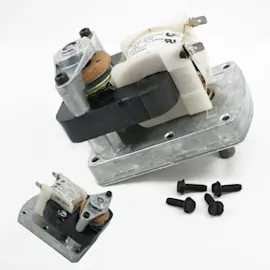
- If the vent does not raise/lower smoothly, inspect lift components such as the motor gear box 99080590 and linkage parts.
Why it matters
Downdraft systems work well for everyday cooking, but if you frequently sear, wok-cook, or generate heavy smoke, the capture limitations and installation constraints can be the deciding factors.
Last updated: February 2026
Do downdraft vents need to be vented outside?
Yes. For the Broan 273003 downdraft ventilation system, the ducted blower must be vented to the outdoors for safe, effective removal of smoke, grease, and odors. Use metal ductwork and follow the clearances and safety guidance in the 273003 owner's manual.
What “vented outside” means for a downdraft
A ducted downdraft pulls cooking fumes down into an air box and pushes them through ductwork to an exterior termination (typically through a wall or floor to an outside cap).
Key requirements to follow
- Vent the ducted fan to the outdoors (not into an attic, crawlspace, or inside wall cavity).
- Use metal ductwork to reduce fire risk.
- Provide adequate make-up air so other fuel-burning appliances vent properly (helps prevent backdrafting).
- Avoid damaging hidden wiring or utilities when cutting or drilling.
- Keep the activating switch location and clearances per the manual.
Ducted vs. ductless (recirculating): quick comparison
Some ventilation products can be configured to recirculate air through filters, but this Broan 273003 documentation calls out ducted fans venting outdoors.
| Setup | Where air goes | Odor/smoke removal | Typical use case |
|---|---|---|---|
| Ducted (recommended/required here) | Outside | Strongest | Most kitchens, frequent high-heat cooking |
| Ductless (recirculating) | Back into kitchen | Limited (filter-dependent) | Only when exterior ducting is impossible |
Why it matters
Venting outdoors is what actually removes heat, moisture, grease, and combustion byproducts from the kitchen. Recirculating setups can reduce some odor, but they do not remove humidity and can leave more grease residue on cabinets and walls.
Installation and performance tips
- Keep the duct run as short and straight as possible for better airflow.
- Seal duct joints properly to prevent leaks.
- If the vent rises but airflow is weak, check for crushed ducting, blocked exterior cap, or heavy grease buildup.
Last updated: February 2026
How much does downdraft ventilation cost?
A Broan downdraft ventilation setup like model 273003 typically costs about $900 to $2,000 for the downdraft unit itself, with total installed cost increasing based on ductwork, electrical, and countertop modifications. For planning details (power, duct size, clearances), use the 273003 owner's manual.
What drives the price up or down
Downdraft systems vary widely in cost because installation is often the biggest variable.
- Cabinet and countertop cutout work (labor and materials)
- Ducting complexity (long runs, elbows, roof or wall cap)
- Electrical work (dedicated outlet location, access)
- Finish and size (30-in vs. 36-in trim kits, stainless vs. other finishes)
- Repair vs. replace (a single failed component can be cheaper than a full replacement)
Typical cost breakdown (unit vs. install)
| Cost item | Typical range | Notes |
|---|---|---|
| Downdraft unit (equipment) | $900 to $2,000 | Common market range for downdraft ventilation |
| Installation labor | $300 to $1,500+ | Depends heavily on access and duct routing |
| Ductwork parts | $50 to $400+ | More if you need long runs or special transitions |
| Electrical updates | $0 to $400+ | Outlet placement and circuit work vary |
Model 273003 specs that affect installation cost
These requirements can add labor if your cabinet layout is tight:
- 120 VAC, 60 Hz power requirement
- Draws about 4.0 amps
- Rated around 500 CFM airflow
- Uses 3-1/4 in. x 10 in. duct connector
- Needs specific countertop and cabinet clearances behind the cooktop
When a repair is the better value
If the vent still fits your kitchen and the issue is mechanical or electrical, replacing a key part is often more cost-effective than replacing the whole downdraft.
Common repair-related parts for this model include:
- Motor gear box 99080590 (lift/drive mechanism issues)
- Range hood wire harness S97010993 (intermittent power or connection problems)
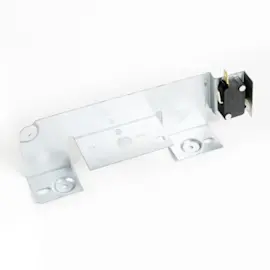
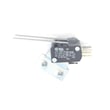
- Downdraft vent up/down switch S97011238 (won’t raise or lower)
Why it matters
Downdraft ventilation is as much a cabinetry and ducting project as it is an appliance purchase. Planning around the correct duct size, outlet location, and clearances helps avoid rework and surprise labor charges.
Last updated: February 2026