Owner’s manual
 Error Codes


How to raise a refrigerator off the floor?
To raise a Kenmore Elite refrigerator model 59677602800 off the floor, adjust the front leveling screws and (if equipped) the rear roller adjustment screws after removing the base grille. Raise each side evenly so the cabinet is stable and the doors close properly; then set the brake foot firmly on the floor.
Steps to raise the refrigerator safely
- Remove the base grille by grasping it firmly and pulling it toward you.
- Use a 3/8-inch hex driver to turn the roller adjustment screw on each side.
- Turn the adjustment screw to the right (clockwise) to raise that side.
- Adjust both sides the same amount to keep the cabinet level side-to-side.
- If your model has rear roller adjustment screws, adjust the rear as needed to tilt the refrigerator slightly back for better door closing.
- Turn the brake foot clockwise until it is firmly against the floor to prevent the refrigerator from rolling forward.
What to check after you raise it
A properly adjusted bottom-mount refrigerator should feel steady and close easily.
- The cabinet does not rock when you press on the corners.
- The doors close without needing to be pushed hard.
- The freezer drawer does not pull the refrigerator forward.
- The base grille fits back on without rubbing.
Quick direction guide
| Adjustment | What you do | Result |
|---|---|---|
| Raise one side | Turn roller adjustment screw right (clockwise) | Cabinet lifts |
| Lower one side | Turn roller adjustment screw left (counterclockwise) | Cabinet drops |
| Prevent rolling | Turn brake foot clockwise to the floor | Stabilizes unit |
Why it matters
Raising and leveling the refrigerator helps prevent door seal leaks, reduces vibration noise, and keeps the freezer drawer from shifting the cabinet forward over time. For the exact adjustment points and illustrations for model 59677602800, follow the 59677602800 owner's manual.
Last updated: January 2026
What year did the Kenmore Elite come out?
Kenmore Elite launched as a premium Kenmore line in the late 1990s (commonly cited as 1999). For your specific Kenmore Elite refrigerator model 59677602800, the most accurate way to determine its age is to decode the manufacturing date from the serial number using the 59677602800 owner's manual.
How to find the manufacture date for model 59677602800
We use the serial number because “Kenmore Elite” is a product line, not a single release year for every refrigerator.
- Look for the model and serial tag inside the fresh food compartment (often on a side wall or ceiling area).
- Check behind the crisper drawers or near the door hinge area if you do not see it at first.
- Write down the full serial number exactly as shown.
- Use the serial decoding guidance in the manual to identify the production date.
- If the tag is damaged, take a clear photo and compare each character carefully.
Quick timeline: line launch vs. your refrigerator’s build date
| What you are trying to learn | What it means | Best way to confirm |
|---|---|---|
| “When did Kenmore Elite come out?” | When the Elite line first appeared | Late 1990s (commonly 1999) |
| “How old is my 59677602800?” | When your specific unit was built | Serial number date code |
Why it matters
Knowing the build date helps us match the correct refrigerator parts, revisions, and troubleshooting steps for your Kenmore Elite bottom-mount refrigerator. It is also useful when diagnosing issues like cooling problems, ice maker failures, or water filter and dispenser concerns.
Last updated: January 2026
What is the average lifespan of a Kenmore Elite refrigerator?
A Kenmore Elite refrigerator like model 59677602800 typically lasts 10 to 15 years under normal household use. Regular care (cleaning, good door sealing, and stable temperatures) helps it reach the high end of that range and reduces costly sealed-system and cooling failures.
Typical lifespan and what affects it
Most refrigerators wear out from cooling-system strain, airflow problems, or door-seal leaks. These factors have the biggest impact:
- Condenser coil cleanliness (dust buildup raises compressor workload)
- Door gasket condition (warm air leaks cause longer run times and frost)
- Evaporator airflow (fan and vents must stay clear)
- Room temperature and ventilation around the cabinet
- Ice maker and water system upkeep (clogs and leaks create secondary issues)
Quick maintenance checklist (high impact)
Use these habits to extend the life of your Kenmore Elite 59677602800 bottom-mount refrigerator:
- Vacuum or brush the condenser area on a regular schedule
- Keep door gaskets clean and ensure doors close fully every time
- Avoid overpacking; keep air vents inside the refrigerator and freezer clear
- Set stable temps (about 37°F fresh food, 0°F freezer)
- Follow the cleaning and care steps in the 59677602800 owner's manual
Common “end-of-life” symptoms vs. fixable issues
Some symptoms point to a simple repair; others suggest major cooling-system trouble.
| Symptom | Often fixable? | Common next step |
|---|---|---|
| Warm refrigerator, freezer OK | Yes | Check evaporator fan, airflow, frost pattern |
| Frost buildup, doors hard to close | Yes | Inspect/replace door gasket, check defrost system |
| No ice or slow ice | Yes | Diagnose ice maker and water inlet valve |
| Both sections warm, loud clicking | Sometimes | Check start components; sealed system may be involved |
If you’re troubleshooting cooling airflow, the refrigerator evaporator motor W11024089 and refrigerator evaporator fan blade WP2169142 are common parts involved in temperature complaints.
Why it matters
Once a refrigerator reaches the 10 to 15 year range, small efficiency losses (dirty coils, weak gaskets, restricted airflow) can push the compressor and sealed system harder. Preventive maintenance helps avoid food spoilage, high energy use, and expensive repairs.
Last updated: January 2026
What are the common problems with Kenmore Elite refrigerators?
Common problems on a Kenmore Elite bottom-mount refrigerator like model 59677602800 include weak or no cooling, frost buildup, water leaks, ice maker or dispenser issues, and unusual noises. Our best starting point is the troubleshooting section in the 59677602800 owner's manual, then checking the most failure-prone airflow, defrost, and water-supply components.
Most common symptoms and what usually causes them
- Not cooling or warm temperatures: dirty condenser coil, failed evaporator fan motor, sealed-system issue
- Frost or ice buildup: defrost heater failure, door not sealing, blocked air vents
- Water puddles: clogged defrost drain, cracked drain pan, loose water line connection
- Ice maker not making ice: low water pressure, frozen fill tube, failed inlet valve or ice maker
- Buzzing, clicking, or rattling: condenser fan area debris, compressor start components, loose panels
Quick checks we recommend before replacing parts
- Confirm temperature settings and allow 24 hours after any adjustment.
- Clean the condenser area and make sure airflow around the cabinet is not blocked.
- Check door gaskets for gaps, tears, or areas not contacting the cabinet.
- Look for ice blocking vents or the evaporator cover (a sign of defrost trouble).
- If you have an ice maker, verify the shutoff arm or switch is in the ON position and the water supply valve is fully open.
Parts that commonly relate to these problems (examples for this model)
| Symptom | Common part to inspect | Example part for 59677602800 |
|---|---|---|
| Warm fridge/freezer | Evaporator fan motor | Refrigerator evaporator motor W11024089 |
| Frost buildup | Defrost heater | Refrigerator defrost heater WP67002493 |
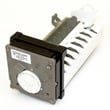
| No ice or slow ice | Ice maker assembly | Refrigerator ice maker D7824706Q |
| Water under fridge | Drain pan | Pan, drain 1 WP12579803 |
Why it matters
Cooling, defrosting, and water delivery work as a system. A simple airflow problem (like a failed evaporator fan motor) can look like a sealed-system failure, and a small door-seal gap can create heavy frost that blocks airflow and warms the fresh-food section.
Related DIY help
- Common refrigerator ice maker problems and solutions
- How to fix your evaporator cooling fan
- How to get rid of refrigerator puddles
Last updated: January 2026