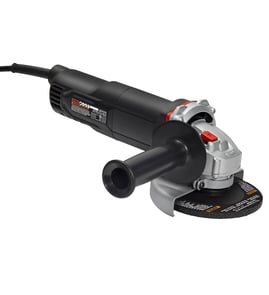

Who makes Craftsman grinders?
Craftsman grinders (including the Craftsman 90011651TY1 angle grinder) are sold under the Craftsman brand, which is owned by Stanley Black & Decker. The actual factory that built a specific grinder can vary by model and production run, so the most reliable identifier for parts is the exact model number.
Because Craftsman is a brand (not a single factory), the best way to match the right switch, cord, guard, or spindle parts is to use the model number and the tool’s type.
- Use the full model number: 90011651TY1
- Match the product type: angle grinder
- Compare electrical specs on the tool label (volts, amps, Hz)
- Confirm whether your grinder is corded or cordless
- Check for any suffixes or extra numbers on the rating plate
Look for the rating plate on the grinder housing or handle area and note these details before ordering:
| What to check | Why it matters |
|---|---|
| Model number (90011651TY1) | Ensures the correct parts list and diagrams |
| Voltage and amperage | Helps match switches, cords, and motor components |
| Arbor size and guard style | Helps match flanges, guards, and accessory fit |
| Cord condition and strain relief | Common wear items on corded grinders |
Angle grinder parts are highly model-specific. Even within Craftsman, small design changes can affect fitment for items like the brush caps, field/armature, gear case, or power cord. Using the exact model number prevents ordering the wrong replacement.
For help confirming you have the right model number format before searching, use how to find your appliance model number (and what it means for parts).
Last updated: February 2026
Are all angle grinder discs interchangeable?
No. Angle grinder discs are only interchangeable when they match your Craftsman 90011651TY1 grinder’s wheel diameter, arbor hole size, and maximum RPM rating; you also need the correct disc type for the job (cutoff, grinding, flap, wire) to avoid unsafe operation.
- Disc diameter: Use only the size your guard and tool are designed for (common sizes are 4-1/2 inch and 5 inch).
- Arbor hole size: The center hole must match the spindle (common sizes include 7/8 inch and 5/8 inch).
- Max RPM rating: The disc’s rated speed must be at least the grinder’s no-load RPM.
- Disc thickness and style: Cutoff wheels and grinding wheels mount differently and are used differently.
- Material rating: Use metal-rated discs for steel, masonry-rated discs for concrete/brick, etc.
| Check | What you’re looking for | Why it matters |
|---|---|---|
| Diameter | Same as the grinder’s rated wheel size | Prevents guard interference and overspeed risk |
| Arbor hole | Same as spindle/flange size | Prevents wobble, slippage, and poor clamping |
| RPM | Disc RPM rating ≥ grinder RPM | Reduces risk of disc failure |
| Disc type | Cutoff vs grinding vs flap vs wire | Ensures correct use and control |
- A 4-1/2 inch disc often fits many 4-1/2 inch grinders, but it still must match arbor size and RPM.
- A smaller disc can physically mount on some larger grinders, but it can be unsafe if the grinder’s RPM exceeds the disc rating.
- “Wood carving” or toothed blades marketed for grinders are high-risk; use only accessories specifically rated for grinder use and your material.
Disc mismatch is one of the fastest ways to get vibration, poor cuts, damaged flanges, or a disc that binds or breaks. Matching size, arbor, and RPM keeps your Craftsman 90011651TY1 running smoothly and helps protect the guard, spindle, and operator.
For basic electrical troubleshooting tools that help when a grinder won’t start (switch, cord, brushes, continuity checks), see how to use a multimeter to test electrical parts video.
Last updated: February 2026
Can I use a 7/8 arbor on a 5/8 grinder?
Yes, you can use a wheel with a 7/8-inch arbor hole on a 5/8-inch Craftsman 90011651TY1 angle grinder when you install the correct reducing bushing (adapter ring) and clamp hardware so the wheel centers tightly and runs true.
Most 5/8-inch arbor grinders are designed to accept 7/8-inch arbor accessories by using a bushing that reduces the wheel’s center hole down to the grinder’s arbor size.
- A reducing bushing sized 7/8-inch OD to 5/8-inch ID
- The correct flanges/washers (inner and outer) for the grinder
- The correct spindle nut (threaded clamp nut) for the grinder
- A wheel rated for the grinder’s RPM and intended use (grinding vs. cutting)
Use this checklist before mounting the wheel.
- The wheel’s max RPM rating meets or exceeds the grinder’s no-load RPM
- The bushing seats fully and the wheel sits flat against the flange
- The wheel does not wobble when hand-spun (with power unplugged)
- The guard fits and is positioned between you and the wheel
- The wheel type matches the job (cut-off wheel is not used for side grinding)
| Wheel arbor hole | Grinder arbor | What makes it work |
|---|---|---|
| 5/8-inch | 5/8-inch | No bushing needed |
| 7/8-inch | 5/8-inch | Reducing bushing (7/8 to 5/8) |
If the wheel is not centered by the correct bushing and clamped by the proper flanges, it can vibrate, wear unevenly, and bind during a cut. A tight, centered fit helps the Craftsman 90011651TY1 run smoother and reduces the chance of wheel damage.
For electrical checks if the grinder is acting up after a wheel change (no power, intermittent run), use our guide: how to use a multimeter to test electrical parts video.
Last updated: February 2026
How deep can a 230mm grinder cut?
A 230 mm (9-inch) angle grinder typically cuts to about 60 to 70 mm deep in a single pass; around 65 mm is a common real-world maximum, depending on wheel thickness, guard design, and how you hold the tool.
Even with the same 230 mm cutting disc, the usable depth varies based on setup and technique.
- Wheel type and thickness (cut-off wheel vs. diamond blade; thicker wheels reduce depth)
- Guard and flange design (some guards limit how far the wheel can reach)
- Material and approach angle (square cuts usually reach deeper than angled cuts)
- Wear on the disc (depth decreases as the disc diameter shrinks)
- Tool power and load (bogging down encourages shallow, safer passes)
| Disc diameter | Common name | Typical max cut depth |
|---|---|---|
| 115 mm | 4-1/2 inch | 25 to 35 mm |
| 125 mm | 5 inch | 30 to 40 mm |
| 180 mm | 7 inch | 45 to 55 mm |
| 230 mm | 9 inch | 60 to 70 mm |
If you need to cut thicker stock than the grinder can reach, we recommend safer, more controlled methods.
- Cut from both sides when possible (mark the line and flip the work)
- Make multiple shallow passes instead of forcing one deep pass
- Clamp the work securely so it cannot shift or pinch the wheel
- Let the wheel do the work; avoid twisting or side-loading a cut-off wheel
- Inspect the power cord and switch if the tool surges or cuts out mid-cut
Knowing the realistic cut depth helps you choose the right blade and plan the cut so you avoid binding, kickback, and overheated wheels, especially on heavy steel, masonry, or thick plate.
For electrical checks during troubleshooting (no power, intermittent running), use our guide: how to use a multimeter to test electrical parts video.
Last updated: February 2026
How many watts is a good angle grinder?
A “good” angle grinder wattage depends on the work and wheel size, not a single number. For a Craftsman angle grinder like model 90011651TY1, most homeowners do well with roughly 700 to 1,200 watts; heavy, frequent grinding is typically 1,500 to 2,500 watts.
- 500 to 900W: light, occasional cutting and cleanup
- 700 to 1,200W: regular DIY work (cutting metal, general grinding)
- 1,200 to 1,800W: tougher materials, longer sessions, less bogging
- 1,800 to 2,500W: heavy-duty, frequent use and faster material removal
- Wheel size matters: 4-1/2 inch grinders commonly fall in the lower to mid ranges; 7 to 9 inch grinders typically need higher wattage
- Material load: thick steel, masonry, and aggressive grinding push you higher
- Run time: longer continuous use benefits from more power and better cooling
- Control and comfort: higher wattage tools are often heavier and can be harder to manage one-handed
| Task | Typical wattage range | What you gain |
|---|---|---|
| Light rust removal, flap disc finishing | 500 to 900W | Better control, less fatigue |
| Cutting thicker steel (rebar, angle iron) | 900 to 1,500W | Less stalling under load |
| Aggressive grinding, frequent use | 1,500 to 2,500W | Faster removal, steadier speed |
Choosing enough wattage reduces stalling and overheating, which helps protect common wear items like the motor brushes, switch, and power cord.
If you are diagnosing a grinder that will not start or keeps cutting out, use how to use a multimeter to test electrical parts video.
Last updated: February 2026