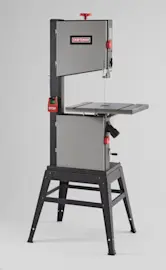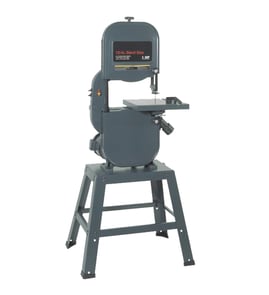


How do I know the size of my bandsaw blade?
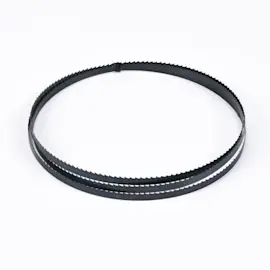
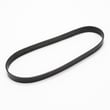
For your Craftsman 11324340 12-inch band saw, blade “size” means the blade length, width, and tooth pitch (TPI). The most reliable way is to measure the blade you have now, then match those measurements when you shop for a replacement.
What to measure (the 3 specs that matter)
- Length: the total loop length of the blade (end-to-end around the full band).
- Width: from the tooth tip to the back edge of the blade.
- TPI (teeth per inch): how many teeth fall in a 1-inch span.
How to measure blade length (simple and accurate)
- Unplug the band saw and open the wheel covers.
- Release blade tension and carefully remove the blade (wear gloves).
- Lay the blade flat on the floor.
- Mark a starting point (the weld is a good reference).
- Use a tape measure and “walk” the blade along it until the mark comes back around.
Quick alternative (when the blade is broken)
If the blade snapped, lay the pieces end-to-end and measure the total length; then subtract nothing and record the full combined length.
How to measure width and TPI
- Width: measure straight across from tooth tip to back edge.
- TPI: count teeth across exactly 1 inch; if it is between two counts, use the closest whole number.
| Spec | How to record it | Example format |
|---|---|---|
| Length | Total loop length | 93-1/2 in |
| Width | Tooth tip to back | 1/4 in |
| TPI | Teeth in 1 inch | 6 TPI |
Why it matters
Correct blade size keeps tracking stable, reduces vibration, and helps the Craftsman 11324340 cut straight. Matching width and TPI to your material also improves cut quality and motor load.
Helpful tip for buying the right blade
- Match length first (it must fit the wheels).
- Choose narrower blades for tighter curves.
- Choose lower TPI for thicker wood and faster cuts.
- Choose higher TPI for thinner stock and smoother cuts.
For more help identifying the exact model number on your saw before ordering, use how to find your appliance model number (and what it means for parts).
Last updated: February 2026
What is the 4 inch rule for bandsaw?
The 4-inch rule for a band saw means we keep our hands and fingers at least 4 inches away from the moving blade at all times. On a Craftsman 11324340 12-inch band saw, that usually means using a push stick, push block, or a jig whenever the cut would bring your hands close to the blade.
How to follow the 4-inch rule on a 12-inch band saw
- Set the blade guard and guide post as low as practical (close to the workpiece) to reduce exposed blade.
- Use a push stick or push block for narrow rips, small parts, and short offcuts.
- Use a miter gauge, sled, or simple jig for small or awkward shapes instead of freehanding.
- Keep your hands to the sides of the cut line, not in line with the blade.
- Plan the cut so your hands never “finish” within 4 inches of the blade; stop and reposition instead.
- Wait for the blade to stop fully before reaching near the blade area to clear scraps.
Quick guide: when you need a push tool or jig
| Cutting situation | Safer approach | Why it helps |
|---|---|---|
| Narrow stock (your hand would pass near the blade) | Push stick or push block | Maintains the 4-inch clearance |
| Small parts | Sled or clamp-on jig | Keeps fingers away and stabilizes the work |
| Curves/tight radii | Relief cuts plus steady feed | Reduces binding and sudden workpiece movement |
| Resawing tall boards | Fence plus featherboard (if available) | Improves control and reduces drift corrections |
Why it matters
Band saw blades can grab, twist, or pull a workpiece unexpectedly, especially with small stock, dull blades, or tight curves. The 4-inch rule builds in a safety buffer so a slip, kick, or sudden jump does not put fingers into the blade path.
Related DIY reading
For general DIY safety guidance that applies to power tools like band saws, use are diy appliance repairs safe.
Last updated: February 2026
What is the 3-tooth rule for bandsaw blades?
The 3-tooth rule means your Craftsman 11324340 12" band saw blade should have at least 3 teeth in the cut at all times (and ideally about 6 to 12). This prevents tooth stripping and gullet overload, improves tracking, and helps you get a cleaner cut with less vibration.
How to use the rule (pick the right TPI)
Match blade teeth-per-inch (TPI) to the material thickness so multiple teeth stay engaged.
- Thin stock needs higher TPI so you still have 3+ teeth in the cut
- Thick stock can use lower TPI for faster cutting and better chip clearance
- Softer materials generally tolerate a coarser blade than hard, dense materials
- If the saw chatters or grabs, move to a higher TPI or slow the feed rate
- If the blade burns or loads up with dust/chips, move to a lower TPI or increase dust collection
Quick TPI selection guide (rule-of-thumb)
Use this as a starting point, then fine-tune based on cut quality and feed pressure.
| Material thickness | Typical goal | Common TPI range |
|---|---|---|
| 1/8 in. to 1/4 in. | Keep teeth engaged in thin stock | 14 to 24 TPI |
| 1/4 in. to 3/4 in. | Balance speed and finish | 6 to 10 TPI |
| 3/4 in. to 3 in. | Clear chips in thicker cuts | 3 to 6 TPI |
Why it matters on a 12-inch band saw
On a 12-inch saw like the Craftsman 11324340, the motor and frame are sized for steady, controlled cutting. When too few teeth are engaged, each tooth takes a bigger bite; that increases vibration, can pull the workpiece, and shortens blade life.
If you are still getting rough cuts
These setup checks usually matter as much as TPI:
- Verify blade tension and tracking before cutting
- Set blade guides and thrust bearing close to the blade (without pinching)
- Use a slower, consistent feed rate (do not force the cut)
- Use the right blade width for the curve radius you are cutting
For more help finding the exact model number format and what it means when ordering blades or other items, use how to find your appliance model number (and what it means for parts).
Last updated: February 2026
What is the specs of the Craftsman 12 inch bandsaw 11324340?
For the Craftsman 12-inch band saw model 11324340, the most useful “specs” to confirm are the cutting capacity (throat depth and max cut height), table size and tilt range, and motor rating. This model is commonly described as a 12-inch vertical band saw with roughly a 12-inch throat and about a 6-inch max cutting height.
Key specs to look for
These are the specs most customers use to match blades, set up the saw, and plan cuts:
- Throat depth (capacity): typically about 12 in.
- Max cutting height: typically about 6 in.
- Table size: commonly listed around 23 in. x 27 in.
- Table tilt: typically 0° to 45°
- Motor: often listed around 1-1/8 HP (varies by configuration and labeling)
Quick spec summary table
| Spec | What it affects | Typical value for 11324340 |
|---|---|---|
| Throat depth | Max width you can cut from blade to frame | ~12 in. |
| Max cut height | Thickest stock you can cut upright | ~6 in. |
| Table tilt | Bevel and angle cuts | 0° to 45° |
| Table size | Work support and stability | ~23 in. x 27 in. |
| Motor rating | Cutting power under load | ~1-1/8 HP |
Why it matters
These specs determine whether your Craftsman 11324340 can handle the thickness and width of your workpiece, and they help you choose the right blade type (width, tooth count, and material) for clean, accurate cuts.
Tips for confirming the exact configuration
Because older Craftsman band saws can have variations by production run or prior owner modifications, we recommend verifying these items directly on your saw:
- Check the model tag to confirm 11324340 exactly
- Measure the table and confirm the tilt stop range
- Read the motor nameplate for HP, volts, and amps
- Inspect for add-ons like a rip fence, stand, or mobility wheels
For help identifying the correct model tag location and what the numbers mean, use how to find your appliance model number (and what it means for parts).
Last updated: February 2026