Owner’s manual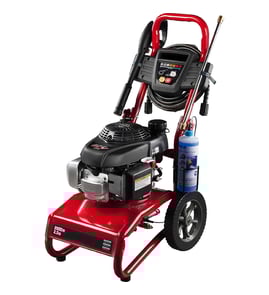


What PSI should my pressure washer be?
For a Craftsman pressure washer like model 580750700, the “right” PSI depends on what you’re cleaning; most homeowners get the best results in the 1,300 to 2,800 PSI range for cars, decks, fences, and general outdoor cleanup. Use the PSI guidance and operating limits in the 580750700 owner's manual to match pressure to the job.
Quick PSI guide by cleaning task
- 1,300 to 1,900 PSI: cars, patio furniture, grills, delicate painted surfaces
- 2,000 to 2,800 PSI: decks, fences, siding (use care), most home concrete
- 2,900+ PSI: heavy concrete and tough stains (higher risk of surface damage)
How to “set” PSI on a gas pressure washer
Most gas pressure washers do not have a simple PSI dial; pressure is mainly controlled by the spray tip/nozzle and how much water the pump is fed.
- Choose the correct spray tip for the surface (wider fan angle equals lower impact).
- Keep a steady water supply; low flow can cause surging and weak pressure.
- Start farther away (2 to 3 feet), then move closer until cleaning is effective.
- Avoid holding a tight stream in one spot; it can etch wood and concrete.
- If your spray pattern is uneven, check for a clogged or worn nozzle.
Nozzle selection and what it changes
| Nozzle choice | What you’ll notice | Best for |
|---|---|---|
| Wider fan spray | Lower cutting action, safer | Siding, vehicles, painted surfaces |
| Narrower fan spray | Higher cutting action | Decks, fences, concrete |
| Worn/clogged nozzle | Pulsing, poor pattern, weak cleaning | Replace/clean before troubleshooting the pump |
If you need replacement tips for consistent pressure and spray pattern, use the Craftsman pressure washer spray nozzle set 319856GS.
Why it matters
Using too much PSI can damage wood fibers, strip paint, and force water behind siding; using too little PSI wastes time and can make you overwork the pump and engine. Matching PSI to the task gives faster cleaning with fewer repairs.
Last updated: January 2026
How to tell if a pressure washer unloader valve is bad?
On the Craftsman pressure washer model 580750700, a bad unloader valve usually shows up as low or surging pressure, engine bogging or stalling when you squeeze the trigger, or pressure “hammering” and overheating when the valve sticks. Use the 580750700 owner's manual for your model’s operating checks and safety steps.
Common signs the unloader valve is failing
- Pressure is weak, drops off, or pulses while spraying
- Engine stalls, bogs down, or struggles when the trigger is pulled
- Loud cycling or “hammering” sound as pressure builds and releases
- Unit overheats, especially if you leave it running with the trigger released
- Spray pattern looks normal but cleaning power is inconsistent
- Pull-start feels unusually hard (pressure trapped in the pump)
Quick checks before blaming the unloader valve
Many “bad unloader” symptoms are caused by flow restrictions or air leaks. Check these first:
- Confirm full water supply and a non-kinked garden hose
- Inspect the high-pressure hose for internal collapse or leaks (a worn hose can mimic low pressure)
- Clean the spray tip and try a different tip from the Craftsman pressure washer spray nozzle set 319856GS
- Look for air leaks at hose connections and worn O-rings
- Verify the thermal relief is not dumping water constantly (a stuck valve can reduce pressure)
Symptom-to-likely-cause guide
| What you notice | More likely cause | Also check |
|---|---|---|
| Low pressure all the time | Unloader stuck open | Clogged nozzle, hose restriction |
| Engine stalls when trigger is pulled | Unloader stuck closed or misadjusted | Nozzle too small, pump issue |
| Pressure pulses or “hammering” | Unloader cycling | Air in water supply, clogged inlet screen |
| Overheats when idling | Unloader not bypassing correctly | Thermal relief valve |
Why it matters
The unloader valve controls how pump pressure is bypassed when you release the trigger. When it sticks or cycles, it can cause poor cleaning performance, hard starting, overheating, and premature pump wear.
For step-by-step replacement guidance, use how to replace a pressure washer unloader valve.
Last updated: January 2026
Can I use 87 gas in my pressure washer?
Yes. For the Craftsman pressure washer model 580750700, regular 87-octane (unleaded) gasoline is the correct everyday choice for most small gas engines; higher octane does not improve cleaning power and can add cost without benefit. For exact fuel guidance and storage steps, follow the 580750700 owner's manual.
What fuel to use (and what to avoid)
- Use fresh, clean unleaded 87 octane from a busy station.
- Avoid old gas (more than 30 days in the can) because it causes hard starting and surging.
- Avoid overfilling the tank; leave room for expansion.
- If your area sells E10 (up to 10% ethanol), it typically runs fine, but it is less storage-friendly.
- Do not mix oil into the gas unless your engine is specifically a 2-cycle design (most pressure washers are 4-cycle).
Ethanol vs non-ethanol: quick comparison
| Fuel type | Best for | Main downside | Our recommendation |
|---|---|---|---|
| 87 octane E10 | Normal weekly use | Absorbs moisture during storage | Use it, but stabilize for storage |
| 87 octane non-ethanol | Seasonal equipment | Can be harder to find, costs more | Great choice if available |
| Premium (91-93) | Not required | No performance gain in most small engines | Skip it unless manual requires it |
If you use E10, do these 5 things
- Add a fuel stabilizer any time the washer may sit more than 2 to 4 weeks.
- Store fuel in an approved, sealed container; keep it cool and out of sun.
- Run the engine a few minutes after adding stabilized fuel so treated fuel reaches the carburetor.
- Shut off the fuel valve (if equipped) and let the engine run until it stalls before storage.
- Winterize the pump and hoses so you do not trap water; see steps for winterizing and storing a pressure washer.
Why it matters
Using the right gasoline helps prevent carburetor varnish, hard starting, and power loss. Good fuel habits also protect the pump system by reducing long idle periods and inconsistent engine speed that can affect pressure output.
Last updated: January 2026
Is it worth repairing a pressure washer?
Yes, repairing a pressure washer is worth it when the problem is a low-cost wear item or a simple leak, and the machine is otherwise in good shape. For the Craftsman 580750700, repairs usually make sense when the total cost stays under about half the price of a comparable new gas pressure washer.
Quick way to decide
Use this checklist before you buy parts or schedule service:
- Repair it if the issue is a hose leak, clogged nozzle, worn O-ring, or a small fitting problem.
- Repair it if the engine starts and runs smoothly, and pressure loss is clearly tied to the spray tip, hose, or a valve.
- Replace it if the pump housing is cracked, the pump has severe internal wear, or the engine has low compression.
- Replace it if it has repeated breakdowns and you are chasing multiple symptoms (hard starting plus low pressure plus leaks).
- Repair it if you use it often and the frame, wheels, and handle are still solid.
Common “worth it” repairs on model 580750700
These are typical fixes that restore performance without major teardown:
- Replace a damaged high-pressure hose such as the pressure washer hose 84006753.
- Replace worn or mismatched spray tips using the Craftsman pressure washer spray nozzle set 319856GS.
- Address overheating and pressure spikes by replacing the pressure washer thermal release valve 318923GS.
Repair vs. replace cost guide
Use this as a practical rule of thumb for a gas pressure washer like the Craftsman 580750700.
| Situation | Typical outcome | Recommendation |
|---|---|---|
| Minor leak at hose or fitting | Quick restore of pressure and safety | Repair |
| Poor spray pattern, low cleaning power | Often a nozzle/tip issue | Repair |
| Pressure surges or overheats in bypass | Valve-related or pump wear | Repair first, then reassess |
| Major pump failure or major engine failure | High parts and labor cost | Replace |
Why it matters
A pressure washer that is losing pressure, surging, or leaking can waste water, reduce cleaning performance, and shorten pump life. Fixing small issues early often prevents bigger pump damage and keeps your PSI and GPM closer to normal.
Helpful references for troubleshooting
- Use the 580750700 owner's manual for operating limits, maintenance intervals, and safe setup.
- For deeper diagnosis, follow solving pressure washer problems to narrow down whether the issue is the pump, unloader, nozzle, or water supply.
Last updated: January 2026