Owner’s manual
 Error Codes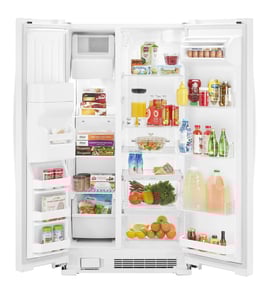

Are GE side-by-side refrigerators good?
Yes. GE side-by-side refrigerators like model GSS25TSRESS are a solid choice for everyday use because they typically deliver consistent cooling, easy food organization (shelves and door bins), and convenient ice and water dispensing. Normal operating sounds are also expected with modern high-efficiency designs; see the GSS25TSRESS owner's manual.
We judge side-by-side refrigerators on temperature stability, usable storage, and dispenser reliability. For the GE GSS25TSRESS, the manual highlights features and behaviors that align with a dependable day-to-day refrigerator.
- Steady cooling once temperatures are set (allow about 24 hours after adjustments)
- Built-in ice and water dispenser convenience
- Adjustable storage with shelves and bins for better organization
- Modern compressor operation that can sound different than older units
- Designed to run in a range of room temperatures (check the rating plate guidance in the manual)
Many owners like the layout and dispenser features, but side-by-sides can have a few predictable tradeoffs.
| Area | What’s good | What can be annoying |
|---|---|---|
| Storage | Easy access to both fresh and frozen foods | Narrower compartments than some French-door models |
| Dispenser | Quick access to water and ice | Ice can clump or jam in the chute if not used regularly |
| Noise | Efficient cooling and airflow | Hums, whooshes, clicks, and pops can be normal |
These steps help any GE side-by-side run better and reduce nuisance issues.
- Keep doors closed as much as possible; frequent openings can increase run time.
- After changing temperature settings, wait 24 hours before judging results.
- If ice jams in the chute, clear it with a wooden spoon (not metal tools).
- Replace the water filter on schedule to protect taste and water flow; use the refrigerator water filter MWFP.
- If the interior light is out, replace the bulb with the correct type such as appliance light bulb, 40-watt 40A15.
A “good” refrigerator is one that holds safe temperatures, fits your storage habits, and has serviceable parts when wear items (like filters and bulbs) need replacement. Keeping up with basic maintenance helps the GSS25TSRESS stay reliable longer.
Last updated: January 2026
What is the average lifespan of a GE refrigerator?
Most GE refrigerators last 12 to 16 years on average, and many run 10 to 20 years with normal use. For your GE GSS25TSRESS side-by-side, steady temperatures, clean airflow, and proper water system maintenance are the biggest factors that help it reach the high end of that range; see the GSS25TSRESS owner's manual for model-specific care and operating guidance.
- Condenser airflow and cleanliness: dust buildup makes the compressor run longer and hotter.
- Door seal condition: air leaks force longer run times and can cause temperature swings.
- Temperature settings and stability: frequent changes or warm room conditions increase workload.
- Ice maker and dispenser use: more moving parts and water components mean more wear.
- Water quality and filter changes: reduces restriction and helps protect the valve and filter head.
- Vacuum and brush the condenser area regularly (typical: every 6 to 12 months).
- Keep vents inside the refrigerator and freezer clear of food packages.
- Allow 24 hours after temperature adjustments for temperatures to stabilize (per the manual).
- Replace the water filter on schedule; a common option for this model is the GE refrigerator water filter MWFP.
- If the refrigerator will be unused, avoid leaving controls at 0 unless you intend to stop cooling (the manual notes 0 stops cooling but does not shut off electrical power).
| Refrigerator age | What’s typical | What we recommend |
|---|---|---|
| 0 to 5 years | Normal operation, minor issues | Keep coils clean, keep temps stable |
| 6 to 10 years | Wear items may show up | Watch door seals, fan noise, ice maker performance |
| 11 to 16 years | Average end-of-life window | Plan for repairs vs. replacement decisions |
| 17 to 20+ years | Above-average lifespan | Maintain aggressively; address cooling issues early |
A side-by-side like the GE GSS25TSRESS can run longer when it does not have to fight heat, dust, and air leaks. The manual also notes that ambient room temperature and door openings affect internal temperature, which directly impacts run time and long-term wear.
Last updated: January 2026
What is the most common problem with a GE refrigerator?
Cooling problems are the most common issue we see with GE refrigerators like model GSS25TSRESS. In many cases, the root cause is restricted airflow (dirty condenser coils, doors not sealing) or a defrost-related problem that lets frost build up and blocks cold air movement.
- Temperature controls accidentally set too warm or set to 0 (off)
- Doors left open or a package holding a door open
- Dirty condenser area causing long run times and weak cooling
- Frost buildup from a defrost system problem (heater, thermostat, sensor)
- Evaporator fan issues (poor airflow inside the freezer)
- “Showroom mode” enabled (unit looks on but does not cool)
- Confirm settings: Make sure the controls are set to a normal cooling setting (not 0/off). See the GSS25TSRESS owner's manual.
- Give it time after power-up: After plugging in, allow up to 24 hours for temperatures to stabilize.
- Check door sealing and loading: Verify nothing is preventing the doors from closing fully.
- Listen for normal operation: Clicking, gurgling, and fan “whir” sounds can be normal during cooling and defrost cycles.
- Inspect for frost blockage: Heavy frost on the freezer back wall often points to a defrost problem.
| Symptom | Common area | Example part for GSS25TSRESS |
|---|---|---|
| Warm refrigerator, freezer OK or inconsistent temps | Temperature sensing/control | GE profile refrigerator temperature sensor WR55X10025 |
| Frost buildup, weak airflow, warming temps | Defrost system | Refrigerator defrost heater WR51X10055 |
| No water/ice and sometimes warm temps from poor airflow management | Airflow and door use patterns | Check door closure and vents first |
Cooling issues can spoil food quickly and also force the compressor to run longer than normal. Catching simple causes early (settings, door closure, airflow) prevents unnecessary part replacement and helps the refrigerator maintain stable temperatures.
Last updated: January 2026