Owner’s manual
 Error Codes


What are the dimensions of the Samsung RF28JBEDBSR?
The Samsung RF28JBEDBSR refrigerator measures 35 3/4 in. wide and is about 70 in. tall with hinges and doors installed. Depth varies by configuration: 36 1/2 in. with hinges, handles, and doors; 34 in. with hinges and doors (no handle); and 29 3/8 in. without hinges and door.
Dimension breakdown (common install scenarios)
Use these measurements to confirm fit through doorways and to plan cabinet clearance. For the most accurate configuration notes, we recommend checking the RF28JBEDBSR owner's manual.
- With hinges, handles, and doors (WxHxD): 35 3/4" x 70" x 36 1/2"
- With hinges and doors, no handle (WxHxD): 35 3/4" x 70" x 34"
- Without hinges and door (WxHxD): 35 3/4" x 68 7/8" x 29 3/8"
- Listed weight: 390.2 lb
Quick comparison table
| Configuration | Width | Height | Depth |
|---|---|---|---|
| Hinges + handles + doors | 35 3/4" | 70" | 36 1/2" |
| Hinges + doors (no handle) | 35 3/4" | 70" | 34" |
| No hinges and door | 35 3/4" | 68 7/8" | 29 3/8" |
Why it matters
Getting the right depth measurement prevents common installation problems like doors not opening fully, drawers hitting an island, or the refrigerator sticking out farther than expected. Height differences (with or without hinges) also affect whether the unit clears overhead cabinets.
Last updated: February 2026
Why is my Samsung bottom ice maker not working?
If the bottom ice maker in your Samsung RF28JBEDBSR isn’t making ice, the most common causes are no water supply to the ice maker, a frozen fill tube or ice path, or a cooling/airflow problem in the freezer. We troubleshoot these in a quick, safe order using your owner's manual.
Quick checks (fastest fixes first)
- Confirm the ice maker is turned on (not in “off” mode).
- Make sure the freezer temperature is set cold enough (target is about 0°F).
- Verify the ice bin is seated correctly and not jammed with clumped ice.
- Dispense water at the door (if equipped); weak or no water points to a supply issue.
- Look for frost buildup around the ice maker area (can indicate a defrost or airflow issue).
Water supply problems to rule out
A bottom ice maker needs steady water pressure and an open water path.
- Check the household shutoff valve is fully open.
- Inspect the water line behind the refrigerator for kinks.
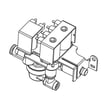
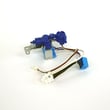
- If water flow is weak, a failing refrigerator water inlet valve DA62-04027A can prevent the ice maker from filling.
- If the ice maker fills slowly or makes hollow cubes, replace the refrigerator water filter haf-qin/exp.
Freezer airflow and temperature issues
If the freezer is cold but airflow is poor, ice production can stop.
- Listen for the evaporator fan running; if it’s noisy or not spinning, cooling air may not reach the ice maker.
- A failed sensor can misread temperature and disrupt ice cycles; this model uses sensors such as the refrigerator temperature sensor DA32-10104N.
Symptoms and likely causes
| Symptom | Most likely cause | What to check next |
|---|---|---|
| No ice at all | No water fill | Water filter, inlet valve, frozen fill tube |
| Small/hollow cubes | Restricted water flow | Water filter, supply valve, line kinks |
| Frost/ice buildup near ice maker | Air leak or airflow issue | Door seal, fan operation, frost pattern |
Why it matters
An ice maker that is starved for water or airflow often leads to clumping, jams, and repeated freeze-ups. Fixing the root cause protects the ice maker assembly and helps the freezer maintain stable temperatures.
For model-specific control settings and any reset steps, follow the procedures in the owner's manual. You can also use our troubleshooting guide: why your Samsung fridge stopped making ice and how to fix it.
Last updated: February 2026
How to defrost Samsung RF28JBEDBSR?
To defrost your Samsung RF28JBEDBSR, use the refrigerator’s built-in defrost/forced defrost procedure listed for your exact control panel, or do a manual defrost by unplugging and leaving the doors open. The correct button sequence varies by Samsung model and panel style.
Fastest option: use the model-specific forced defrost
Follow the steps in the RF28JBEDBSR owner's manual for the exact key presses and display prompts for your unit.
- Remove items that could be damaged by warming.
- Keep doors closed as much as possible during the cycle.
- Start the forced defrost procedure from the control panel (per the manual).
- Let the cycle complete; fans may stop and you may hear water dripping.
- Confirm your temperature settings after the refrigerator returns to cooling.
Manual defrost (works on any refrigerator)
Use this method if you cannot access the control-panel defrost procedure.
- Unplug the refrigerator.
- Open the fresh food and freezer doors.
- Place towels to catch water; empty the ice container if needed.
- Allow ice to melt naturally; do not use sharp tools to chip ice.
- Dry the compartment, then restore power and allow temperatures to stabilize.
| Defrost method | Typical time | Best for |
|---|---|---|
| Control-panel forced defrost | 20 to 60 minutes | Moderate frost affecting airflow or ice making |
| Unplug and doors open | 4 to 24 hours | Heavy ice buildup or no access to forced defrost |
Why it matters
Frost on the evaporator blocks airflow, which causes warm refrigerator temperatures, weak ice production, and noisy fan operation. Defrosting restores airflow so the evaporator fan and temperature sensors can regulate cooling correctly.
If frost comes back quickly
Repeated icing usually points to a defrost-system or airflow issue. Common checks include:
- Door not sealing or vents blocked by food packages
- Drain area icing up (often leads to refreezing)
- Defrost control components not operating consistently
Last updated: February 2026