Installation guide
 Owner’s manual
 Error Codes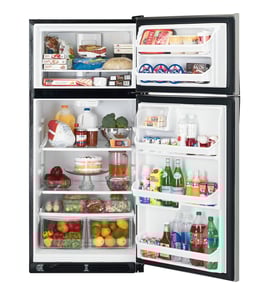


What is the upper part of a fridge called?
On the Kenmore 25367882504 top-mount refrigerator, the upper section is the freezer compartment. It’s the coldest area of the appliance, designed to keep foods frozen and, on some versions, support an automatic ice maker and its temperature controls (see the 25367882504 owner's manual).
The freezer is built to maintain below-freezing temperatures so food stays safe and keeps quality longer.
- Freezes and stores foods long-term
- Circulates cold air to help stabilize temperatures
- Often includes door shelves and interior shelves/bins
- May include an ice maker (if your model is equipped)
- Works with the defrost system to prevent heavy frost buildup
| Compartment | Typical use | Typical temperature setting |
|---|---|---|
| Freezer (upper) | Frozen foods, ice | Around 0°F |
| Fresh food (lower) | Refrigerated foods | Around 37°F to 40°F |
These habits help the freezer in a top-mount refrigerator like the Kenmore 25367882504 cool evenly and avoid freezer burn.
- Leave space between packages so cold air can circulate
- Avoid overloading the freezer with warm food at one time
- Keep hard-to-freeze items (like ice cream) toward the interior, not the door
- Keep the refrigerator level so doors close tightly
- Do not block the toe grille; airflow is essential for proper operation
Knowing the “upper part” is the freezer helps when you’re adjusting temperature controls, diagnosing cooling issues, or following storage guidance. It also helps you use the right section for foods that must stay frozen versus refrigerated.
Last updated: January 2026
How to tell cubic feet of Kenmore refrigerator by model number?
For Kenmore model 25367882504, the most reliable way to get the refrigerator’s cubic feet is to look up the capacity in the specifications section of the 25367882504 owner's manual. If you need a quick estimate, you can calculate interior volume by measuring the usable inside space and converting cubic inches to cubic feet.
Use the full model number exactly as shown on the serial plate inside the fresh food compartment.
- Locate the model/serial label inside the refrigerator compartment (commonly on a side wall or near the crisper area).
- Match the model number character-for-character: 25367882504.
- Check the manual’s specs section for “capacity” or “cubic feet.”
- If you are comparing similar Kenmore 253-prefix units, use the manual for the final answer because cabinet size and insulation vary.
Measure the usable interior space (not the outside cabinet).
- Empty the section you are measuring (refrigerator or freezer).
- Measure width, depth, and height in inches.
- Multiply:
W × D × H = cubic inches. - Divide by 1728 to convert to cubic feet.
- Repeat for freezer and fresh food sections, then add them.
| What you have | What to do | Result |
|---|---|---|
| Interior inches (W × D × H) | Multiply to get cubic inches | Total cubic inches |
| Cubic inches | Divide by 1728 | Cubic feet (approx.) |
Knowing cubic feet helps us match the right shelves, bins, and storage parts, and it also helps when comparing energy use and fit in your kitchen opening.
Last updated: January 2026
What water filter fits my Kenmore fridge?
For Kenmore refrigerator model 25367882504, the correct water filter depends on whether your unit is equipped with a filtration system in the water line (often tied to an optional ice maker hookup). We match the right filter by confirming your exact model and the filter location shown in the 25367882504 owner's manual.
Use these quick checks before ordering:
- Look inside the fresh food compartment for a filter housing (usually upper right, upper left, or base grille area).
- Check the back of the refrigerator for a water supply connection (common when an ice maker is installed).
- If you have an inline filter in the water line, identify the filter body label and fittings.
- Confirm your water pressure is in the typical operating range (many ice maker systems use 30 to 100 psi).
- Avoid 1/4-inch plastic supply tubing; copper or braided line is the safer standard for leak prevention.
If you do not see a filter housing inside the refrigerator, many top-mount models use no internal cartridge and instead use an inline water filter only when connected to a water supply.
| What you see on the refrigerator | What it usually means | What to do next |
|---|---|---|
| No filter housing inside | No internal filter cartridge | Use the manual to confirm; consider an inline filter if plumbed for ice/water |
| Filter housing inside | Uses a cartridge-style filter | Match the cartridge by the manual’s filter section and the filter label |
| Inline filter on the back or under sink | Uses an external inline filter | Match by the inline filter’s printed model/size and fitting type |
Using the wrong filter can restrict water flow to the ice maker, cause slow fill issues, or create leaks at the fittings. Matching by model 25367882504 and the exact filter style keeps water flow and filtration performance where it should be.
- Use How to replace the water filter in a Kenmore refrigerator to understand the common Kenmore filter styles and replacement steps.
Last updated: January 2026
Why is my Kenmore Elite refrigerator not cooling enough?
On the Kenmore 25367882504 top-mount refrigerator, weak cooling is usually caused by incorrect temperature control settings (including being set to “0”), poor airflow from dirty condenser coils or blocked vents, or a fan problem that stops cold air from circulating. Use the 25367882504 owner's manual to confirm control settings and airflow clearances.
- Make sure the temperature control is not set to “0” (that turns off the compressor and stops cooling).
- Wait 20 minutes and recheck if the unit just stopped; it may be in a normal defrost cycle.
- Confirm the refrigerator is plugged directly into a properly grounded 3-prong outlet (no extension cord or adapter).
- Verify the toe grille is not blocked and the unit has airflow clearance (sides/top and back).
- Clean the condenser area; periodic cleaning helps the refrigerator run efficiently.
- Check for overpacking or blocked air vents; crowded shelves reduce cold-air circulation.
| What you notice | Most common cause | What to do next |
|---|---|---|
| Refrigerator section warm, freezer also warmer than normal | Airflow or sealed-system issue | Clean condenser, check fans, then evaluate compressor/start components |
| Freezer cold but refrigerator warm | Airflow blockage or damper/vent issue | Clear vents, avoid overpacking, confirm doors close tightly |
| Unit runs but temps never recover | Dirty condenser, weak fan, or low voltage | Clean coils, listen for fan operation, confirm stable power |
| Unit not running at all | Control set to “0”, breaker/fuse, defrost cycle | Adjust control, reset breaker, wait 20 minutes |
If you hear unusual fan noise, have weak airflow, or see frost patterns that point to a defrost issue, these model-matched parts are common suspects:
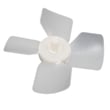
- Refrigerator evaporator fan blade 5308000010 (moves cold air through the freezer and into the fresh-food section)
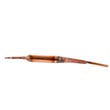
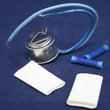
- Refrigerator defrost bi-metal thermostat 5303918202 (helps control defrost heating to prevent heavy frost buildup)
- Chest freezer run capacitor 297286803 (supports compressor starting and running on some designs)
Low cooling is often an airflow problem first; fixing airflow (clean condenser, clear vents, proper clearances, tight door seal) prevents long run times, food spoilage, and compressor strain.
Last updated: January 2026